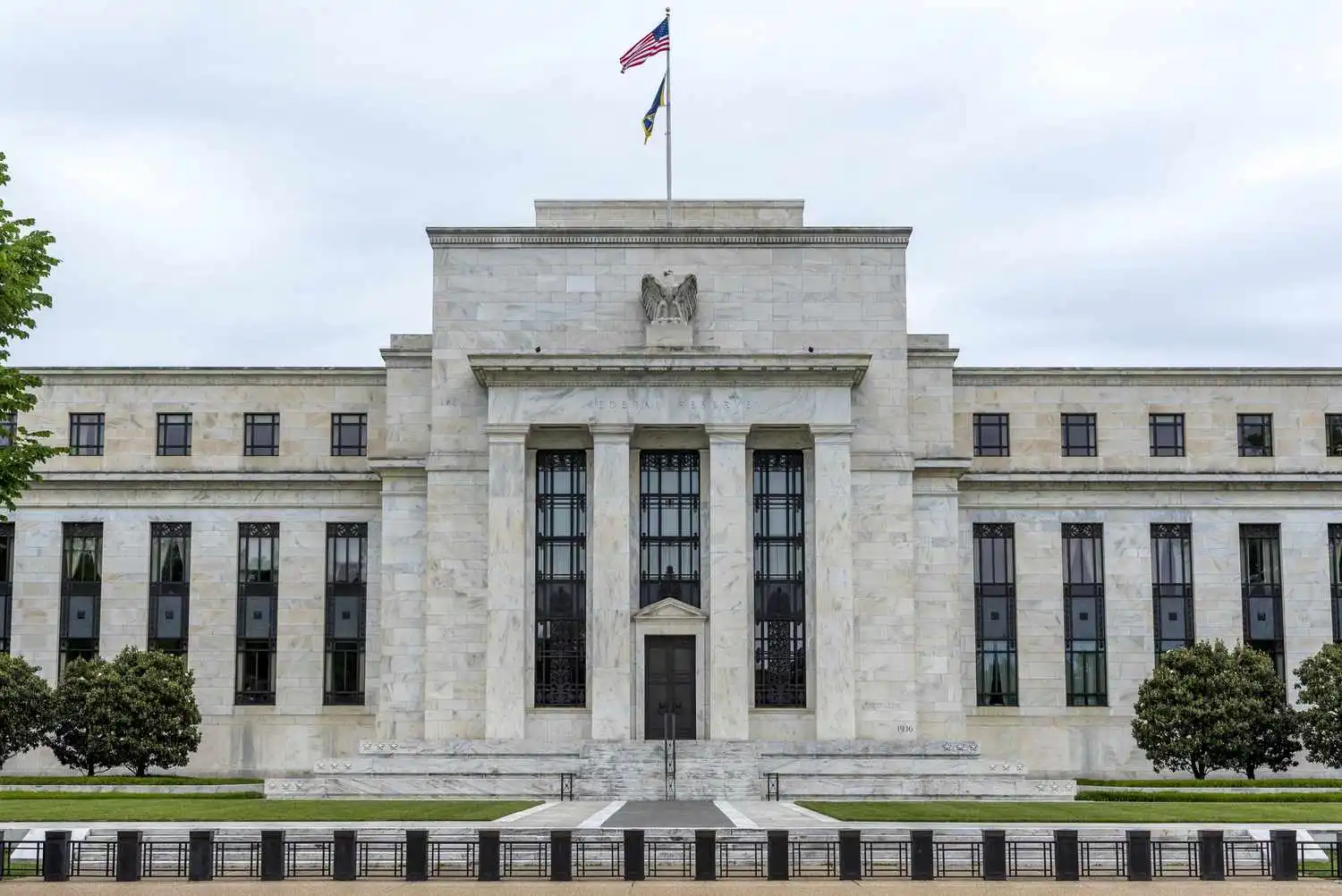
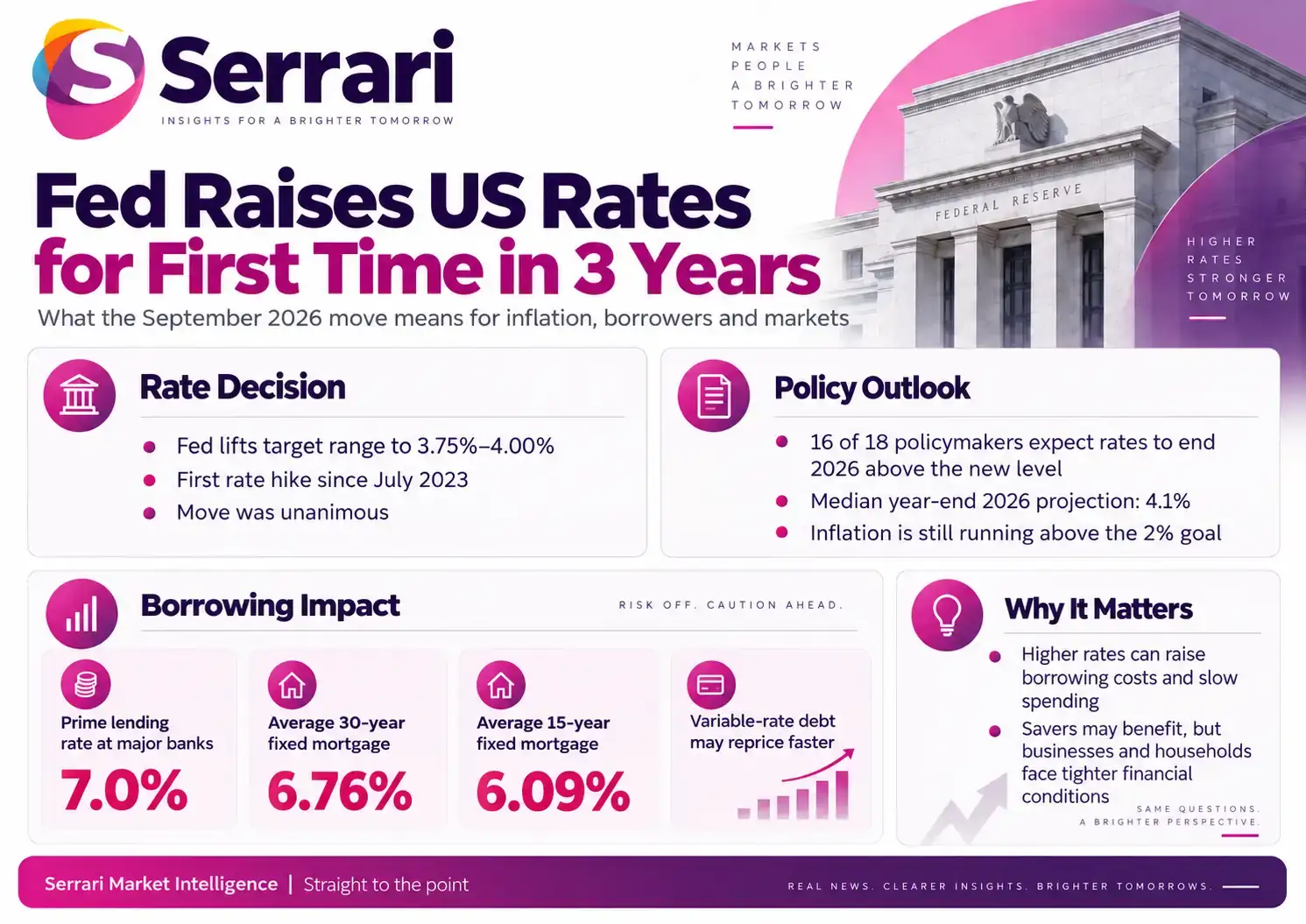
The US Federal Reserve has raised interest rates for the first time in more than three years, increasing its benchmark target range by 25 basis points from 3.50%-3.75% to 3.75%-4.00%.
The unanimous September 16 decision marks the Fed’s first increase since July 2023 and reverses the direction of monetary policy as officials respond to inflation that remains above their 2% objective.
Higher policy rates can raise borrowing costs for households and businesses while potentially improving returns available on some savings products. The effects are already beginning to filter into US bank lending rates.
Key Overview
Fed officials are signalling that the September increase may not be the final move of 2026. Updated interest-rate projections from policymakers show 16 of 18 participants expect rates to end the year above the level established after the September decision.
The median projection for the federal funds rate is 4.1% at the end of 2026, consistent with a 4.00%-4.25% target range. The median remains at 4.1% for 2027 before declining to 3.9% in 2028 and 3.6% in 2029.
Why the Fed Raised Interest Rates
The Fed said US economic activity continues to expand at a solid pace, with resilient domestic spending, strong productivity growth and robust capital investment.
Inflation, however, remains the central concern. The committee said its latest policy action is intended to support a faster return toward the central bank’s 2% inflation objective.
September’s economic projections show headline PCE inflation at 3.7% in 2026, up slightly from the 3.6% median forecast made in June. Core PCE inflation, which excludes food and energy, is projected at 3.4%.
At the same time, policymakers expect real US GDP to grow 2.3% in 2026, while unemployment is projected at 4.1%. That combination of persistent inflation and relatively resilient economic activity gives policymakers more room to tighten monetary conditions without responding to a major deterioration in the labour market.
Another Rate Increase Could Follow
The Fed’s so-called dot plot points clearly toward additional tightening.
Of the 18 policymakers submitting projections, 12 see the appropriate federal funds rate at 4.125% by year-end, while four project 4.375%. Only two see rates remaining around 3.875%, the midpoint of the new target range.
The distribution of officials’ projections therefore indicates that an additional quarter-point increase has broad support among policymakers, although the projections are not binding commitments.
Future decisions will depend on inflation, employment, spending and other economic data available at upcoming meetings.
Context is everything. Stay ahead of shifting trends with today’s market updates, and uncover emerging opportunities using the Serrari Group Market Index and Marketplace. Then, take control of your own financial future by exploring our Money & Life Reset Transformation Blueprint ™ to build stronger habits, create better systems, and design a path toward lasting wealth.
What Higher Rates Mean for American Borrowers
The effect of the Fed’s decision can already be seen in commercial bank lending.
Major US banks including JPMorgan, Bank of America, Citigroup and Wells Fargo raised their prime lending rates to 7.00% from 6.75%, effective September 17.
The prime rate is commonly used as a benchmark for products such as credit cards, personal loans and some business borrowing. Consumers with variable-rate debt could therefore see borrowing costs increase relatively quickly.
Mortgage rates operate differently because they are heavily influenced by longer-term Treasury yields and broader market expectations rather than moving automatically with the federal funds rate.
Even before the latest Fed decision, the average 30-year fixed mortgage rate stood at 6.76% as of September 10, while the average 15-year fixed rate was 6.09%.
Existing homeowners with fixed-rate mortgages generally will not see their current monthly interest rate change because of the Fed decision. New buyers and homeowners seeking to refinance may face different borrowing costs depending on subsequent movements in the mortgage market.
Fed Decision Comes Amid Political Pressure
The rate increase came despite President Donald Trump’s public calls for substantially lower interest rates.
After the decision, Trump continued to argue that US rates should be lower while saying he retained confidence in Fed Chair Kevin Warsh. He also criticised the broader Fed board following the decision, while Warsh maintained that the central bank’s focus was on restoring price stability.
The September vote itself was 12-0, meaning Warsh joined every other voting member in supporting the quarter-point increase.
Central-bank independence remains important to the policy framework because Congress has given the Federal Reserve responsibility for pursuing maximum employment and stable prices rather than setting rates according to the preferences of elected officials.
Inflation Path Will Determine What Happens Next
The September projections suggest policymakers expect inflation to ease gradually rather than immediately.
Headline PCE inflation is projected to fall from 3.7% in 2026 to 2.3% in 2027, then to 2.1% in 2028 before reaching the 2% objective in 2029.
That trajectory means the Fed faces a balancing act. Keeping rates high for longer could restrain credit demand, household spending and business investment, while easing policy too quickly could allow inflation pressures to persist.
For borrowers, investors and businesses, attention will now turn to upcoming inflation and employment data and the Fed’s remaining meetings of 2026. With most policymakers currently projecting another increase, the September hike may represent the beginning of a renewed tightening phase rather than a one-off adjustment.
Sources
Federal Reserve / Freddie Mac / Reuters
Your financial future isn’t something you wait for—it’s something you build.
The real question is: when do you begin?
Move beyond simply staying informed.
Navigate the markets with clarity—track trends through the Serrari Group Market Index, uncover opportunities in the Serrari Marketplace, and build practical knowledge with our Curated Wealth Builder Platform.
Stay connected to what truly matters.
Get daily insights on macro trends and financial movements across Kenya, Africa, and global markets—delivered through the Serrari Newsletter.
Growth opens doors.
Advance your career through professional programs including ACCA, HESI A2, ATI TEAS 7 , HESI EXIT , NCLEX – RN and NCLEX – PN, Financial Literacy!🌟—designed to move you forward with confidence.
See where money is flowing—clearly and in real time.
Track Money Market Funds, Treasury Bills, Treasury Bonds, Green Bonds, and Fixed Deposits, alongside global and African indexes, key economic indicators, and the evolving Crypto and stablecoin landscape—all within Serrari’s Market Index.