
South Africa crypto regulations are set to tighten oversight of cross-border cryptocurrency transfers through new draft guidelines issued by the South African Reserve Bank (SARB). The framework requires offshore crypto transfers to pass through authorized providers, strengthens reporting and anti-money laundering (AML) controls, and marks another step toward integrating digital assets into the country’s financial regulatory system.
Key Overview
South Africa has released draft regulations governing cross-border cryptocurrency transactions, introducing reporting obligations for offshore crypto transfers and clarifying how individuals can legally move digital assets abroad. While crypto will not become legal tender under the proposal, the framework strengthens regulatory oversight and aligns the country with evolving global crypto regulation standards.
South Africa Unveils Draft Crypto Regulations
South Africa has taken another significant step toward regulating the cryptocurrency industry by publishing draft guidelines that establish how cross-border cryptocurrency transfers will be supervised.
The draft framework, released by the South African Reserve Bank (SARB), provides the first detailed guidance on when moving crypto assets across national borders becomes a regulated and reportable financial transaction.
Rather than recognizing cryptocurrencies as legal tender, the proposed regulations focus on improving oversight, transparency, and compliance within the country’s growing digital assets ecosystem.
Interested stakeholders have until September 30 to submit comments before the framework is finalized.
Cross-Border Crypto Transfers Face New Reporting Rules
One of the most significant changes introduced under the draft regulations concerns offshore cryptocurrency transfers.
Once implemented, individuals wishing to transfer crypto assets outside South Africa will be required to conduct those transactions through an authorized provider. The transactions will also be reported to the Reserve Bank’s Financial Surveillance Department (FinSurv), strengthening oversight of cross-border capital flows.
The proposed reporting requirements aim to improve regulatory visibility while supporting broader anti-money laundering (AML) and financial surveillance objectives.
Context is everything. Stay ahead of shifting trends with today’s market updates, and uncover emerging opportunities using the Serrari Group Market Index and Marketplace. Then, take control of your own financial future by exploring our Money & Life Reset Transformation Blueprint ™ to build stronger habits, create better systems, and design a path toward lasting wealth.
Individual Allowances Still Apply
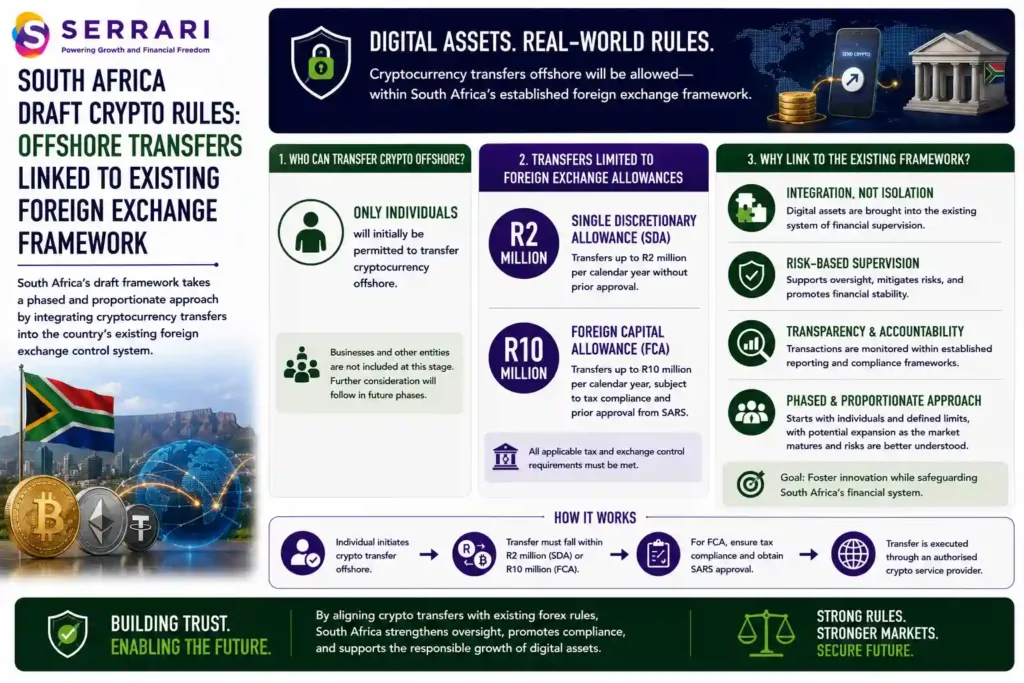
Under the draft framework, only individuals will initially be permitted to transfer cryptocurrency offshore.
These transfers must fall within South Africa’s existing foreign exchange allowances:
- The R2 million Single Discretionary Allowance, or
- The R10 million Foreign Capital Allowance, which requires tax compliance and prior approval from the South African Revenue Service (SARS).
By linking cryptocurrency transfers to the country’s established foreign exchange control framework, regulators intend to integrate digital assets into existing financial supervision rather than creating an entirely separate regime.
Crypto Remains Outside Legal Tender Status
Despite introducing new reporting requirements, the SARB emphasized that the framework does not grant cryptocurrency legal tender status.
The central bank also noted that the current draft does not distinguish between different categories of crypto assets, indicating that additional research remains underway before more detailed classifications are introduced.
This cautious approach reflects the Reserve Bank’s objective of balancing financial innovation with regulatory safeguards as the digital asset market continues to evolve.
Industry Responds to the Draft Rules
The proposed regulations have received cautious support from parts of the cryptocurrency industry.
Farzam Ehsani, Chief Executive Officer of cryptocurrency exchange VALR, welcomed the decision to treat the withdrawal of crypto assets from a Crypto Asset Service Provider (CASP), rather than the initial purchase of digital assets, as the reportable event.
However, Ehsani argued that South Africa would benefit more from eliminating exchange controls altogether while maintaining appropriate reporting, transparency, and regulatory oversight.
According to him, adapting decades-old exchange control regulations to modern blockchain technology presents ongoing challenges for policymakers.
Strengthening Crypto Compliance
The draft framework represents another important milestone in South Africa’s evolving crypto regulation landscape.
Over recent years, the country has progressively expanded oversight of cryptocurrency businesses through the Financial Sector Conduct Authority (FSCA), which licenses and supervises Crypto Asset Service Providers (CASPs).
The latest proposals complement these existing supervisory measures by introducing greater oversight of international cryptocurrency transfers while reinforcing broader crypto compliance obligations.
Together, these initiatives aim to create a more transparent and regulated digital asset ecosystem.
Regional Momentum for Digital Asset Regulation
South Africa’s latest proposals come as several African countries continue strengthening regulation of virtual asset service providers (VASPs).
Kenya recently began implementing its Virtual Asset Service Providers (VASP) Act, 2025, establishing the country’s first legal framework governing cryptocurrency businesses. The legislation designates the Central Bank of Kenya (CBK) and the Capital Markets Authority (CMA) as the principal regulators responsible for licensing and supervising virtual asset service providers.
The parallel regulatory developments across Africa reflect growing recognition of cryptocurrencies as an increasingly important component of regional financial markets.
Outlook
The proposed South Africa crypto regulations mark another significant step toward integrating cryptocurrency within the country’s broader financial regulatory framework.
By introducing reporting requirements for cross-border transactions while maintaining foreign exchange controls, the draft rules seek to improve transparency, strengthen anti-money laundering (AML) compliance, and provide greater regulatory certainty for market participants.
As consultations continue ahead of the September deadline, the final framework could become an important reference point for cryptocurrency regulation across the African continent.
FAQs
What do South Africa’s draft crypto regulations cover?
The draft South Africa crypto regulations establish reporting requirements for cross-border cryptocurrency transfers and require offshore crypto transactions to be processed through authorized providers.
Will cryptocurrency become legal tender in South Africa?
No. The South African Reserve Bank (SARB) has confirmed that the proposed framework does not grant legal tender status to cryptocurrencies.
Who can transfer crypto assets offshore?
Under the draft rules, only individuals will initially be permitted to transfer cryptocurrency abroad using the existing foreign exchange allowances, subject to applicable conditions.
Why are the new regulations being introduced?
The draft regulations aim to improve crypto compliance, strengthen anti-money laundering (AML) oversight, increase transparency in cross-border digital assets transactions, and integrate cryptocurrency into South Africa’s existing financial regulatory framework.
Sources: Reuters, Kenyan Wallstreet, Moneyweb
Your financial future isn’t something you wait for—it’s something you build.
The real question is: when do you begin?
Move beyond simply staying informed.
Navigate the markets with clarity—track trends through the Serrari Group Market Index, uncover opportunities in the Serrari Marketplace, and build practical knowledge with our Curated Wealth Builder Platform.
Stay connected to what truly matters.
Get daily insights on macro trends and financial movements across Kenya, Africa, and global markets—delivered through the Serrari Newsletter.
Growth opens doors.
Advance your career through professional programs including ACCA, HESI A2, ATI TEAS 7 , HESI EXIT , NCLEX – RN and NCLEX – PN, Financial Literacy!🌟—designed to move you forward with confidence.
See where money is flowing—clearly and in real time.
Track Money Market Funds, Treasury Bills, Treasury Bonds, Green Bonds, and Fixed Deposits, alongside global and African indexes, key economic indicators, and the evolving Crypto and stablecoin landscape—all within Serrari’s Market Index.