Bitcoin payments Kenya are entering a new phase as local fintech company Tando enables users to send and receive Bitcoin through Kenya’s existing M-Pesa ecosystem. By connecting Bitcoin’s Lightning Network with phone-number-based Lightning addresses, the platform allows compatible Bitcoin wallets to transact using Kenyan mobile numbers. The innovation aims to simplify crypto payments Kenya, making digital assets more practical for everyday transactions while supporting wider cryptocurrency adoption across the country.
Key Overview
- Tando enables Bitcoin transfers using Kenya’s M-Pesa infrastructure.
- The platform was launched in 2024 by Jason and Sabina Waithira Gitau.
- Users can send Bitcoin directly to Kenyan phone numbers through Lightning addresses.
- The service uses Bitcoin’s Lightning Network to enable near-instant transactions.
- Recipients can create non-custodial Bitcoin wallets after claiming their Lightning addresses.
- The solution aims to make Bitcoin spending as simple as using Kenyan shillings.
- Kenya has approximately 40 million M-Pesa users who could potentially access the service.
- The innovation supports broader cryptocurrency adoption across Kenya’s digital payments ecosystem.
Bitcoin Payments Kenya Gain Momentum Through M-Pesa Integration
Kenya has long been recognised as one of Africa’s most innovative digital payments markets, largely due to the widespread success of M-Pesa. Now, Bitcoin payments Kenya is taking another step forward after local fintech company Tando introduced a solution that allows users to send and receive Bitcoin using the country’s existing mobile money infrastructure.
Rather than replacing M-Pesa, the platform builds on its popularity by connecting Bitcoin’s Lightning Network with Kenya’s mobile payment ecosystem. This approach could significantly lower barriers for individuals interested in using Bitcoin for everyday transactions without requiring entirely new payment systems.
Tando’s Vision for Everyday Bitcoin Payment
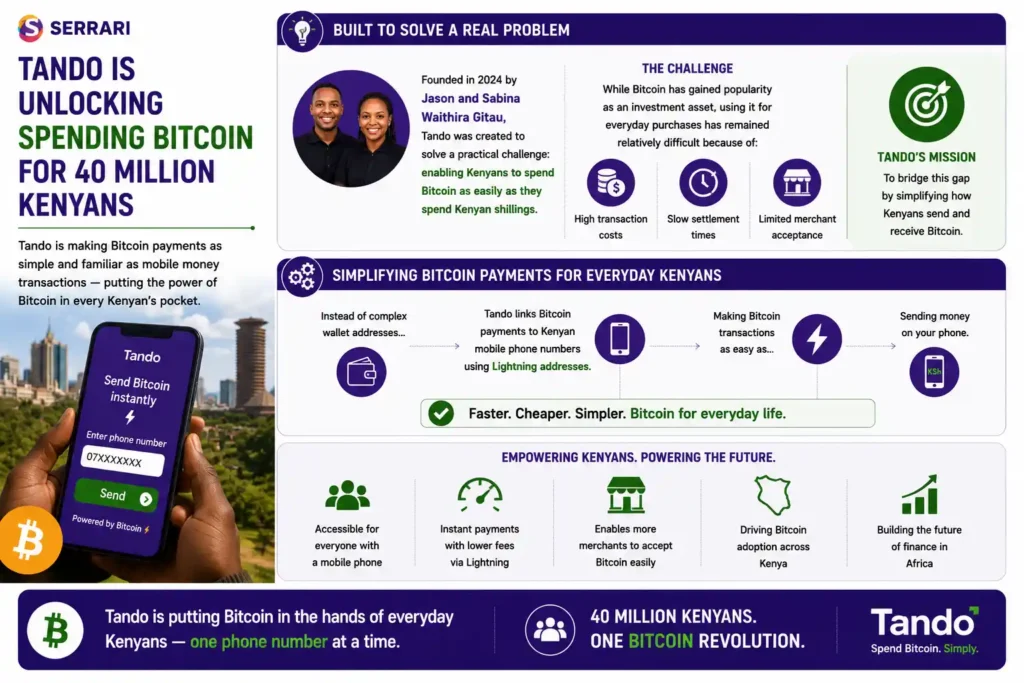
Founded in 2024 by Jason and Sabina Waithira Gitau, Tando was created to solve a practical challenge: enabling Kenyans to spend Bitcoin as easily as they spend Kenyan shillings.
While Bitcoin has gained popularity as an investment asset, using it for everyday purchases has remained relatively difficult because of transaction costs, settlement times and limited merchant acceptance. Tando seeks to bridge this gap by simplifying how users send and receive Bitcoin.
Instead of relying on complex wallet addresses, the company links Bitcoin payments to Kenyan mobile phone numbers using Lightning addresses, making transactions significantly easier for everyday users.
How the Technology Works
The platform relies on Bitcoin’s Lightning Network, a second-layer protocol designed to make Bitcoin transactions faster and less expensive than traditional on-chain transfers.
Users with Bitcoin wallets that support Lightning addresses can send Bitcoin directly to a Kenyan phone number. Once recipients claim their phone-number-linked Lightning address, they can receive Bitcoin almost instantly.
Recipients also have the option of creating a non-custodial Bitcoin wallet Kenya users control themselves. This means individuals maintain ownership of their private keys instead of relying on a third-party custodian, an important feature for users seeking greater control over their digital assets.
The Lightning Network effectively acts as the transaction layer while M-Pesa remains the familiar payment interface for Kenyan users.
Building on Kenya’s Digital Payments Leadership
Kenya is widely regarded as one of Africa’s leading digital payments markets.
For years, M-Pesa has transformed how millions of people send money, pay bills, receive salaries and conduct business. The platform has become deeply integrated into everyday economic activity across urban and rural communities.
By integrating Bitcoin into infrastructure that people already use daily, Tando reduces one of the biggest barriers to cryptocurrency adoption: user familiarity.
Rather than asking consumers to abandon existing payment habits, the platform extends those habits into digital assets using technology that operates largely behind the scenes.
Context is everything. Stay ahead of shifting trends with today’s market updates, and uncover emerging opportunities using the Serrari Group Market Index and Marketplace. Then, take control of your own financial future by exploring our Money & Life Reset Transformation Blueprint ™ to build stronger habits, create better systems, and design a path toward lasting wealth.
Expanding Cryptocurrency Adoption
The introduction of simpler crypto payments Kenya could contribute to broader cryptocurrency adoption across the country.
Kenya already ranks among Africa’s more active cryptocurrency markets, with growing interest in Bitcoin for investment, cross-border transfers and financial inclusion.
Making Bitcoin easier to spend may encourage greater practical use beyond speculative investing.
Small businesses, freelancers and individuals receiving international payments could particularly benefit from lower-cost, faster Bitcoin transactions enabled through the Lightning Network.
As digital assets become more integrated into existing payment systems, cryptocurrency may increasingly function as both an investment and a payment method.
Similar Innovations Across Africa
Tando’s approach shares similarities with other African Bitcoin payment innovations.
One notable example is South Africa’s Machankura, which enables users to send and receive Bitcoin over the Lightning Network using USSD technology without requiring internet access.
Both platforms focus on adapting Bitcoin technology to African payment behaviours rather than expecting users to adopt entirely new financial systems.
These innovations demonstrate how local fintech companies are developing practical solutions tailored to regional infrastructure and consumer needs.
Potential Benefits for Consumers
The integration of Bitcoin with existing payment infrastructure offers several potential advantages.
Lightning Network transactions generally settle much faster than traditional Bitcoin transfers while charging significantly lower transaction fees.
Users also gain greater flexibility when moving value between Bitcoin and Kenya’s mobile money ecosystem.
For people receiving international payments, Bitcoin transfers may offer an alternative to conventional remittance channels that often involve higher fees and longer settlement periods.
By simplifying user experience through phone-number-based payments, Tando may also reduce technical barriers that have traditionally discouraged first-time cryptocurrency users.
Challenges That Remain
Despite the innovation, wider adoption will still depend on several factors.
Consumer education remains essential, particularly regarding wallet security, private key management and responsible cryptocurrency use.
Regulatory developments will also influence the pace of adoption as governments across Africa continue developing frameworks for digital assets and virtual asset service providers.
In addition, merchant acceptance will play a significant role. While peer-to-peer transfers are important, broader commercial adoption will determine whether Bitcoin becomes a practical payment option for everyday purchases.
Outlook for Bitcoin Payments in Kenya
Tando’s integration highlights how Bitcoin technology continues evolving beyond investment use cases into practical financial infrastructure.
Instead of competing directly with mobile money, the platform complements Kenya’s existing payments ecosystem by using familiar tools to introduce new digital payment capabilities.
As the Lightning Network continues to mature and more wallets support phone-number-based Lightning addresses, similar solutions could emerge across other African markets where mobile money already dominates daily transactions.
Conclusion
The launch of Tando’s service represents an important milestone for Bitcoin payments Kenya. By combining Bitcoin’s Lightning Network with the country’s well-established M-Pesa infrastructure, the company has created a simpler way for millions of Kenyans to send and receive Bitcoin. While challenges around regulation, education and merchant acceptance remain, the innovation demonstrates how cryptocurrency can integrate with existing financial systems rather than replacing them. If adoption continues to grow, Kenya could further strengthen its position as one of Africa’s leading markets for digital payments and blockchain innovation.
FAQs
1. How does Tando enable Bitcoin payments through M-Pesa?
Tando connects Bitcoin’s Lightning Network with Kenyan mobile phone numbers by assigning users Lightning addresses linked to their phone numbers. Anyone using a compatible Bitcoin wallet can send Bitcoin directly to that number, making transfers much simpler than using traditional wallet addresses. While the Lightning Network processes the Bitcoin transaction, the service integrates with the familiar M-Pesa ecosystem, helping users access Bitcoin payments without learning an entirely new financial system.
2. What is the Lightning Network and why is it important?
The Lightning Network is a second-layer payment protocol built on top of the Bitcoin blockchain. It allows transactions to be processed almost instantly while significantly reducing transaction fees compared to regular on-chain Bitcoin transfers. This makes Bitcoin far more practical for everyday purchases and small-value payments, addressing two of the biggest limitations that have historically prevented Bitcoin from being widely used as a payment method.
3. What are the benefits of using Bitcoin payments in Kenya?
Bitcoin payments can provide faster cross-border transfers, lower transaction costs for international payments, and greater financial flexibility for users who already hold digital assets. Services like Tando also simplify the payment experience by linking Bitcoin transactions to mobile phone numbers rather than lengthy wallet addresses. This familiar approach may encourage more people to explore cryptocurrency while continuing to use Kenya’s trusted mobile money infrastructure.
4. Will Bitcoin replace M-Pesa in Kenya?
At present, Bitcoin is unlikely to replace M-Pesa. Instead, solutions like Tando are designed to complement the existing mobile money ecosystem by adding another payment option. M-Pesa remains deeply integrated into Kenya’s economy and serves millions of users daily. Bitcoin payments may become valuable for specific use cases such as international transfers, digital commerce and crypto transactions, while M-Pesa continues to dominate everyday domestic payments.
Sources: Crypto News, Forbes, Pluang, Binance Square, HTX
Your financial future isn’t something you wait for—it’s something you build.
The real question is: when do you begin?
Move beyond simply staying informed.
Navigate the markets with clarity—track trends through the Serrari Group Market Index, uncover opportunities in the Serrari Marketplace, and build practical knowledge with our Curated Wealth Builder Platform.
Stay connected to what truly matters.
Get daily insights on macro trends and financial movements across Kenya, Africa, and global markets—delivered through the Serrari Newsletter.
Growth opens doors.
Advance your career through professional programs including ACCA, HESI A2, ATI TEAS 7 , HESI EXIT , NCLEX – RN and NCLEX – PN, Financial Literacy!🌟—designed to move you forward with confidence.
See where money is flowing—clearly and in real time.
Track Money Market Funds, Treasury Bills, Treasury Bonds, Green Bonds, and Fixed Deposits, alongside global and African indexes, key economic indicators, and the evolving Crypto and stablecoin landscape—all within Serrari’s Market Index.