AI insurance coverage is evolving as BOXX Insurance introduces affirmative protection for deepfake protection and AI-related social engineering attacks within its commercial cyber insurance offering. The move reflects growing concern over artificial intelligence risks, rising AI fraud, and the need for stronger business cyber protection as cyber threats become increasingly sophisticated.
Key Overview
- BOXX expands AI insurance coverage.
- Deepfake-related fraud now included in coverage.
- AI-powered cyber threats continue rising.
- Businesses face growing social engineering risks.
- The cyber insurance market adapts to AI.
- Fraud losses reach record levels.
- Insurers refine AI-related policy wording.
- Cyber risk management becomes increasingly important.
AI Insurance Coverage Expands as BOXX Adds Deepfake Protection
AI insurance coverage is entering a new phase as BOXX Insurance, a global cyber insurtech and part of the Zurich Insurance Group, expands its commercial cyber insurance offering to include affirmative protection against AI-generated deepfake attacks and other artificial intelligence-related social engineering incidents.
The enhancement to BOXX’s Cyberboxx Business policy comes as insurers worldwide reassess how artificial intelligence risks should be addressed within commercial insurance products. While some insurers have narrowed protection for AI-generated fraud, BOXX has taken the opposite approach by explicitly covering eligible losses arising from AI-enabled impersonation and security failures.
BOXX Introduces AI and Deepfake Protection
The updated policy provides affirmative coverage for incidents involving AI-generated content linked to social engineering attacks and security failures.
Rather than relying on broad policy interpretation, BOXX has specifically included protection for losses involving technologies such as voice cloning and video deepfakes where coverage conditions are met.
The announcement positions the insurer among a growing group of providers adapting their business insurance products to reflect the changing cyber threat landscape.
As AI tools become more sophisticated, businesses increasingly require insurance policies that explicitly recognise emerging digital risks rather than relying solely on traditional cyber coverage.
Context is everything. Stay ahead of shifting trends with today’s market updates and uncover emerging opportunities using the Serrari Group Market Index and Marketplace. Then, take control of your own financial future by exploring our Money & Life Reset Transformation Blueprint ™ to build stronger habits, create better systems, and design a path toward lasting wealth.
Cyber Insurance Market Takes Different Approaches
The introduction of expanded AI insurance coverage reflects a broader divide within the cyber insurance industry.
Beginning in January 2026, several insurers introduced policy changes that explicitly excluded AI-generated deepfake fraud from standard social engineering coverage, reducing protection for businesses renewing their policies.
Other insurers chose the opposite strategy by revising policy wording to affirmatively include losses resulting from AI-powered impersonation attacks.
BOXX has aligned itself with this second group by expanding protection rather than limiting it, highlighting the industry’s evolving response to rapidly changing cyber threats.
The differing approaches emphasise the growing importance for businesses to carefully review cyber insurance policies to understand exactly which AI-related risks are covered.
AI-Driven Cyber Threats Continue Rising
The insurer cited research indicating that AI-enabled cyber incidents have rapidly become a mainstream business concern.
According to Cisco’s 2025 Cybersecurity Readiness Index, approximately 86% of U.S. business leaders responsible for cybersecurity reported experiencing at least one AI-related security incident during the previous twelve months.
The findings suggest that threats involving artificial intelligence have evolved beyond theoretical concerns into practical operational risks affecting organisations across multiple industries.
Increasingly sophisticated AI technologies allow cybercriminals to create highly convincing fraudulent communications capable of bypassing traditional verification methods.
Deepfake Fraud Increases Business Risk
One of the fastest-growing threats involves deepfake protection against AI-generated impersonation.
Modern AI systems can accurately replicate voices, generate realistic videos and produce convincing written communications that closely resemble legitimate individuals.
Cybercriminals increasingly use these capabilities to conduct sophisticated social engineering attacks targeting employees responsible for financial transactions, confidential information and corporate systems.
Unlike traditional phishing campaigns, AI-generated attacks can appear highly authentic, making them considerably more difficult for employees to identify.
As a result, businesses are placing greater emphasis on both employee awareness and comprehensive cyber risk management strategies.
Fraud Losses Reach Record Levels
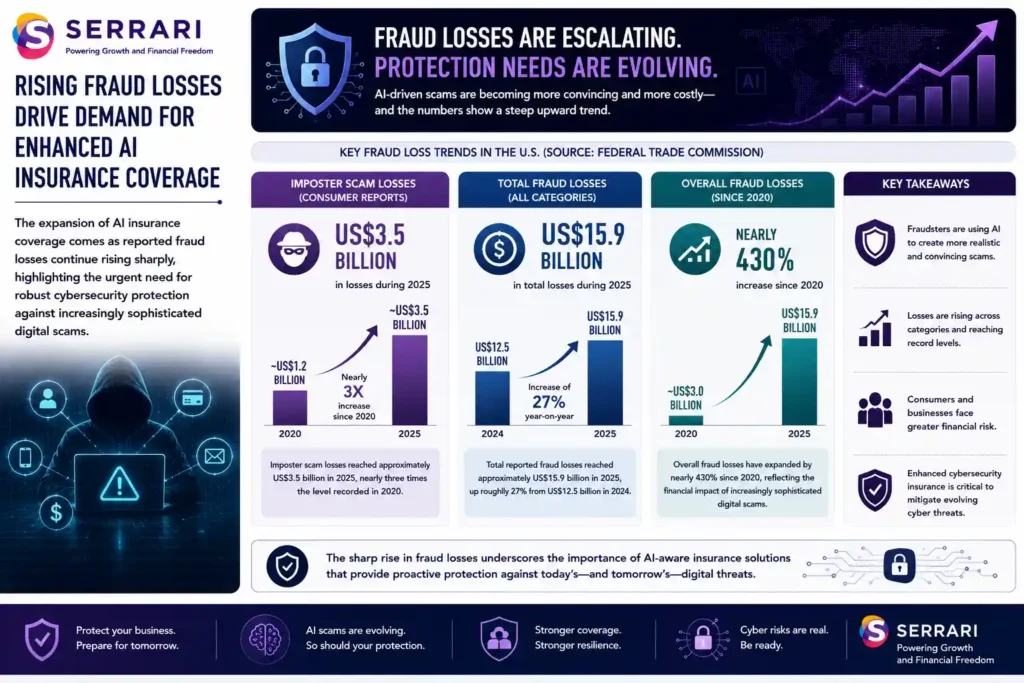
The expansion of AI insurance coverage comes as reported fraud losses continue rising sharply.
According to the U.S. Federal Trade Commission, consumers reported approximately US$3.5 billion in losses from imposter scams during 2025, representing nearly three times the level recorded in 2020.
Across all fraud categories, total reported losses reached approximately US$15.9 billion, increasing by roughly 27% from US$12.5 billion in 2024.
Overall fraud losses have expanded by nearly 430% since 2020, illustrating the growing financial impact of increasingly sophisticated digital scams.
These trends continue driving demand for enhanced cybersecurity insurance capable of addressing evolving cyber risks.
Canada Faces Similar AI Fraud Challenges
The trends observed in the United States are also evident in Canada.
According to BOXX, approximately 81% of Canadian businesses experiencing fraud during the past year also encountered AI-enabled attacks.
Meanwhile, the Canadian Anti-Fraud Centre reported that Canadians lost approximately C$643 million to fraud during 2024, representing an increase of nearly 300% since 2020.
Authorities also caution that actual losses are likely significantly higher because many fraud incidents are never formally reported.
These developments reinforce growing demand for stronger business cyber protection across both public and private sectors.
Regulation Continues to Evolve
Governments and industry bodies are simultaneously updating regulatory frameworks to address emerging AI risks.
The Insurance Services Office (ISO) introduced new general liability exclusions addressing AI-related exposures that became effective in January 2026, reflecting efforts to clarify which AI losses fall within traditional insurance policies.
In Canada, proposed Bill C-8 would establish mandatory cybersecurity standards and incident reporting requirements for operators of critical infrastructure.
Such regulatory developments may increasingly influence how insurers evaluate AI-related cyber exposures, governance practices and organisational cybersecurity controls when underwriting commercial policies.
Outlook for AI Insurance Coverage
The expansion of AI insurance coverage demonstrates how rapidly the insurance industry is adapting to the emergence of AI-driven cyber threats. By adding affirmative deepfake protection within its commercial cyber insurance offering, BOXX has responded to growing business demand for protection against increasingly sophisticated AI fraud and social engineering attacks.
As artificial intelligence risks continue evolving, insurers, regulators and businesses are expected to place even greater emphasis on comprehensive cyber risk management, clearer policy wording and stronger cybersecurity frameworks. The continued rise of AI-enabled fraud is likely to accelerate innovation across the business insurance sector as providers develop products tailored to emerging digital risks.
FAQs
What is AI insurance coverage?
AI insurance coverage refers to insurance protection designed to address losses arising from artificial intelligence-related risks, including AI-powered social engineering attacks, deepfake fraud and other cyber incidents involving advanced digital technologies.
What is deepfake protection?
Deepfake protection provides coverage against fraud involving AI-generated voice, video or image impersonation. These attacks are increasingly used by cybercriminals to deceive employees into transferring funds or revealing confidential business information.
Why are insurers changing cyber insurance policies?
As AI-powered cyber threats become more sophisticated, insurers are updating policy wording to clarify whether losses involving artificial intelligence are covered. Some insurers have introduced exclusions, while others, including BOXX, have expanded coverage to include eligible AI-related incidents.
Why is AI fraud becoming a growing concern?
Artificial intelligence enables cybercriminals to create highly convincing fake communications, voices and videos that are more difficult to detect than traditional phishing attacks. The rapid increase in reported fraud losses has encouraged businesses to strengthen cybersecurity measures and seek more comprehensive cyber insurance protection.
Sources: Yahoo Finance, Beinsure, PR Newswire, Insurance Business
Your financial future isn’t something you wait for—it’s something you build.
The real question is: when do you begin?
Move beyond simply staying informed.
Navigate the markets with clarity—track trends through the Serrari Group Market Index, uncover opportunities in the Serrari Marketplace, and build practical knowledge with our Curated Wealth Builder Platform.
Stay connected to what truly matters.
Get daily insights on macro trends and financial movements across Kenya, Africa, and global markets—delivered through the Serrari Newsletter.
Growth opens doors.
Advance your career through professional programs including ACCA, HESI A2, ATI TEAS 7 , HESI EXIT , NCLEX – RN and NCLEX – PN, Financial Literacy!🌟—designed to move you forward with confidence.
See where money is flowing—clearly and in real time.
Track Money Market Funds, Treasury Bills, Treasury Bonds, Green Bonds, and Fixed Deposits, alongside global and African indexes, key economic indicators, and the evolving Crypto and stablecoin landscape—all within Serrari’s Market Index.