Kenya has begun shaping a long-term national strategy intended to guide its development after Vision 2030 and potentially move the country towards developed-economy status between 2030 and 2060.
President William Ruto received a proposal titled Developing a New Vision for Kenya: Towards a First World Nation on July 21, 2026. The report was prepared by independent scholars led by Kisumu Governor Anyang’ Nyong’o and Japanese economist Hiroyuki Hino.
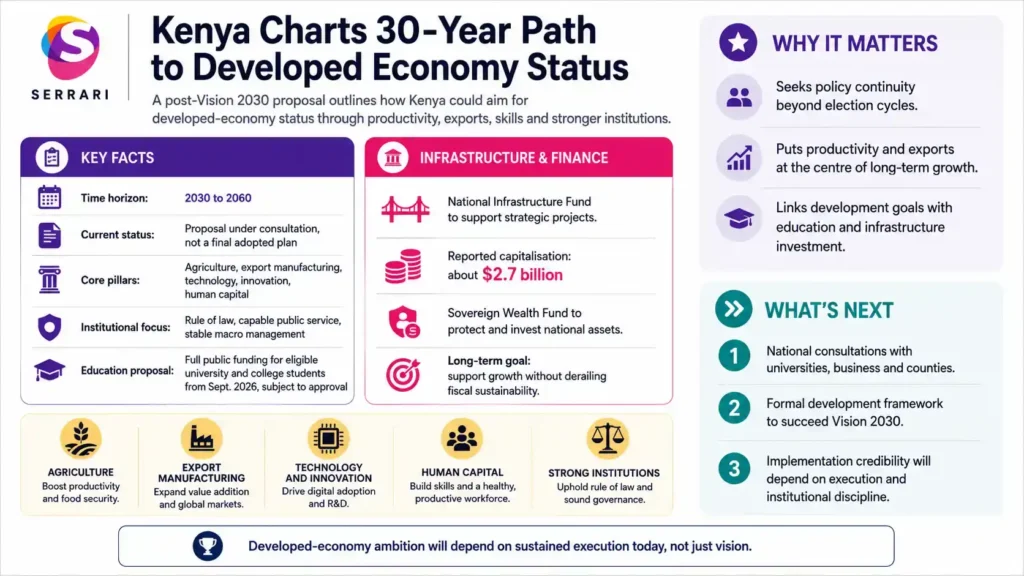
The document is not yet Kenya’s final 30-year plan. It begins a consultation process expected to involve universities, businesses, counties and communities before a formal successor to Vision 2030 is adopted.
Key Overview
- Kenya is considering a national development framework covering 2030 to 2060.
- The strategy prioritises productive agriculture, export-oriented manufacturing, technology, innovation and human-capital development.
- Its institutional foundations include political stability, the rule of law, a capable public service and sustainable public finances.
- The proposal calls for legislation and an independent implementation structure to protect long-term policies from electoral disruption.
- Infrastructure financing will increasingly involve the National Infrastructure Fund and Sovereign Wealth Fund.
- Full public funding for university and college students from September 2026 remains subject to parliamentary approval.
Kenya Opens Debate on Its Post-2030 Future
The proposed strategy would succeed Kenya Vision 2030, the national blueprint launched in 2008 to build a newly industrialising, middle-income economy with a high quality of life.
During the presentation at State House, Ruto argued that national transformation should not restart after every election. He called for a development agenda capable of surviving political transitions and maintaining investment priorities across successive administrations.
According to reporting on the submitted proposal, the scholars believe Kenya could reach developed status within 30 to 40 years if it sustains policy consistency, strong institutions and investment in productive sectors.
Nyong’o described the document as the first step towards a 2030–2060 plan rather than a completed blueprint. Its targets, financing requirements and implementation timelines still require public debate and formal approval.
Productivity and Exports Anchor the Economic Strategy
The roadmap emphasises higher agricultural productivity, export-oriented manufacturing and deeper investment in technology and innovation. These priorities reflect the need to move Kenya from consumption-led growth towards an economy that produces more tradable goods and higher-value services.
Agricultural reforms would need to improve yields, irrigation, storage, processing and market access, strengthening food security while supplying manufacturers and export markets.
Manufacturing expansion would target industries capable of competing regionally and internationally, supported by reliable energy, efficient transport, affordable finance, technical skills and predictable regulation.
Technology and innovation are expected to support productivity across farming, manufacturing, financial services, healthcare and public administration. The proposal also identifies universities and research institutions as important centres for generating evidence, testing policy and developing commercially useful knowledge.
Ruto asked universities to lead the national discussion, arguing that Kenya’s future strategy should be shaped by research and long-term analysis rather than short political calculations.
Context is everything. Stay ahead of shifting trends with today’s market updates, and uncover emerging opportunities using the Serrari Group Market Index and Marketplace. Then, take control of your own financial future by exploring our Money & Life Reset Transformation Blueprint ™ to build stronger habits, create better systems, and design a path toward lasting wealth.
Institutions Will Determine Whether the Plan Survives
The proposed vision links economic progress to political stability, professional public administration, the rule of law and sound macroeconomic management.
Its authors reportedly favour national development legislation and an independent implementation secretariat. These mechanisms would help maintain continuity, publish progress measures and prevent major projects from being abandoned simply because a new administration takes office.
Legislation alone cannot guarantee continuity. Kenya would also need realistic targets, transparent procurement, credible cost estimates, regular reporting and independent evaluation.
Fiscal sustainability will be especially important. A developed-economy strategy requires major investment, but excessive borrowing could increase debt-service costs and reduce funding available for education, healthcare and productive infrastructure.
New Funds Could Reshape Infrastructure Financing
Kenya has established a National Infrastructure Fund to mobilise capital for commercially viable roads, railways, airports, seaports, energy systems and other strategic projects.
The fund is expected to draw money from privatisation proceeds, institutional investors, sovereign partners, climate-finance institutions and returns from its own investments. Parliament retains oversight through approval of the fund’s investment policy.
The National Treasury said the partial sale of the government’s Safaricom stake was expected to generate approximately KSh244.5 billion for the infrastructure and sovereign funds.
Subsequent reporting placed the National Infrastructure Fund’s capital at about KSh347 billion, or $2.7 billion, after including proceeds associated with Safaricom and Kenya Pipeline Company. The figure should be treated as reported capitalisation rather than the fund’s final investment capacity.
Kenya’s Sovereign Wealth Fund, signed into law in July 2026, includes stabilisation, strategic infrastructure and future-generations components. Its purpose is to preserve national wealth, attract investment and protect part of the country’s resources for future citizens.
These funds could reduce dependence on conventional public borrowing, but only if investments are professionally selected, commercially viable and protected from political interference.
Education Reform Would Build the Required Workforce
Kenya also plans to introduce full government funding for qualified students placed in universities, colleges and the Kenya Medical Training College from September 2026.
The proposed higher-education funding model would replace the current needs-based arrangement and make family contributions optional. Implementation still depends on Parliament approving amendments to the Higher Education Loans Board law.
Universal funding could expand access, but its value will depend on teaching quality, labour-market relevance and financial sustainability. Higher enrolment without stronger institutions could leave graduates underprepared for the industries the strategy seeks to build.
Kenya’s ambition is therefore credible only as a sustained national project. The proposal provides a direction, but developed-economy status will depend on consistent execution, stronger institutions, competitive production and measurable improvements in citizens’ living standards.
Sources
Kenya Vision 2030 / The Star / Kenya Broadcasting Corporation / Education News / Parliament of Kenya / National Treasury / The Kenya Times / Citizen Digital
Your financial future isn’t something you wait for—it’s something you build.
The real question is: when do you begin?
Move beyond simply staying informed.
Navigate the markets with clarity—track trends through the Serrari Group Market Index, uncover opportunities in the Serrari Marketplace, and build practical knowledge with our Curated Wealth Builder Platform.
Stay connected to what truly matters.
Get daily insights on macro trends and financial movements across Kenya, Africa, and global markets—delivered through the Serrari Newsletter.
Growth opens doors.
Advance your career through professional programs including ACCA, HESI A2, ATI TEAS 7 , HESI EXIT , NCLEX – RN and NCLEX – PN, Financial Literacy!🌟—designed to move you forward with confidence.
See where money is flowing—clearly and in real time.
Track Money Market Funds, Treasury Bills, Treasury Bonds, Green Bonds, and Fixed Deposits, alongside global and African indexes, key economic indicators, and the evolving Crypto and stablecoin landscape—all within Serrari’s Market Index.