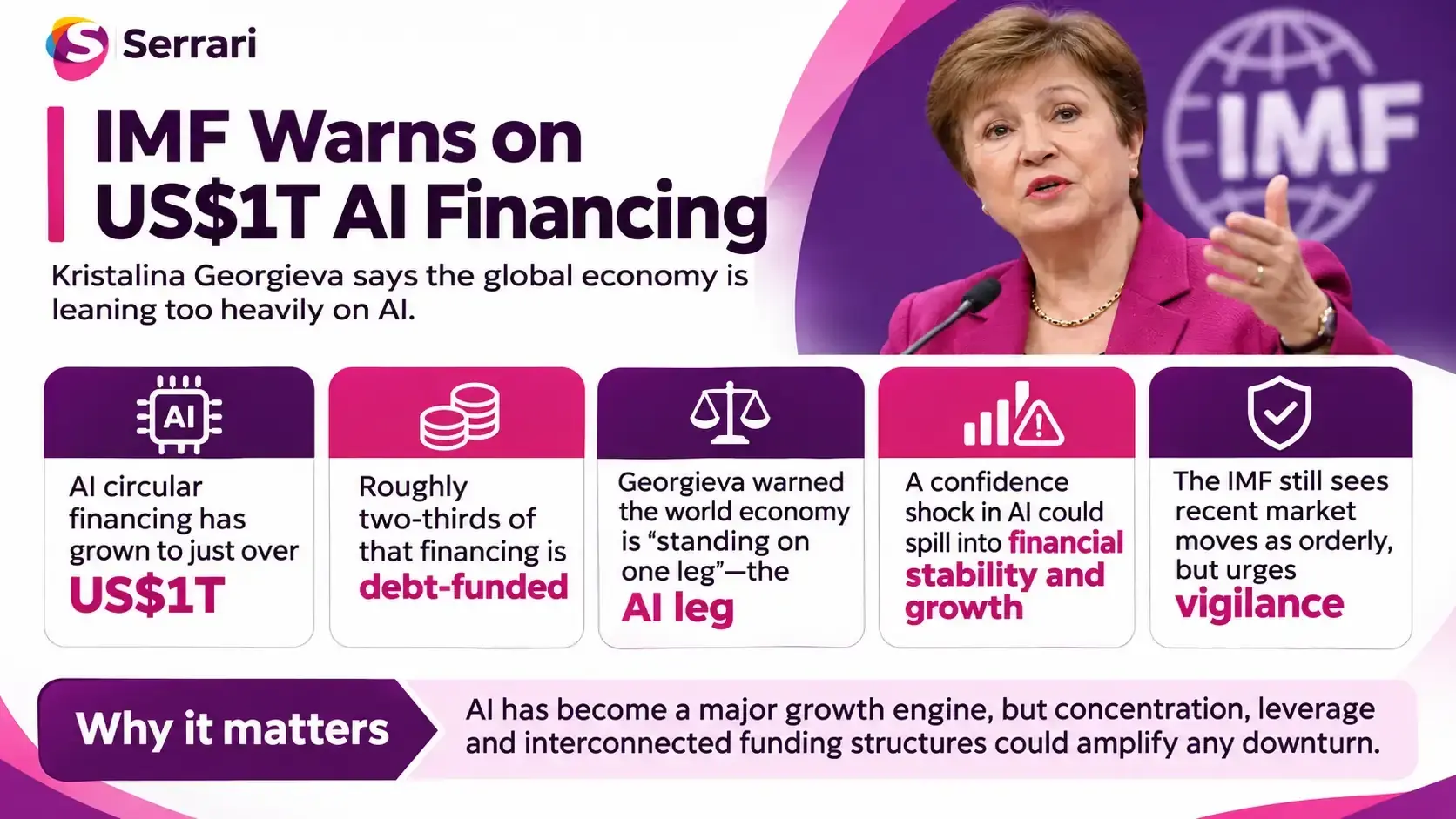
The global economy has become dangerously reliant on artificial intelligence investment, International Monetary Fund Managing Director Kristalina Georgieva warned on November 16, 2026, as interconnected financing arrangements linked to the sector exceeded $1 trillion. Roughly two-thirds of that financing involves debt, raising the risk that weaker demand, falling valuations or a pullback by major technology companies could travel rapidly through lenders and capital markets. Her warning follows a sharp reassessment of AI stocks and the departure of Nvidia’s long-serving chief executive Jensen Huang. Yet the IMF is not predicting an inevitable collapse: it says recent market turbulence remains orderly. The concern is that AI has become an unusually important source of growth at a time when higher energy costs, borrowing expenses and public debt leave the world economy less able to absorb another shock.
Key Overview
- IMF warning: Georgieva said the global economy was effectively “standing on one leg”—AI investment—and that instability in the sector could create financial-stability problems.
- Financing exposure: Circular AI financing has exceeded $1 trillion, with approximately two-thirds debt-funded, according to figures cited by the IMF chief.
- Underlying evidence: An IMF review of 14 transactions since 2023 identified about $300 billion in equity, $650 billion in debt and $1.4 trillion in future revenue commitments; these are different measures and should not be added together as losses.
- Growth dependence: The IMF projects 3.1% global economic growth in 2026, with AI-related investment supporting activity despite other economic pressures.
- Market catalyst: Nvidia confirmed Jensen Huang’s resignation on November 12 and appointed Chief Financial Officer Colette Kress as interim chief executive.
- Policy concern: A reversal in AI spending could affect technology earnings, corporate borrowing, equity valuations and investment in infrastructure well beyond Silicon Valley.
Why the IMF Says the Global Economy Is Too Dependent on AI
Speaking on November 16 on the sidelines of an ASEAN summit in the Philippines, Georgieva warned that the world economy was “standing on one leg”, with AI now doing an outsized share of the work supporting investment and market confidence. The metaphor describes concentration rather than the failure of the technology itself: growth becomes more fragile when a small group of companies and projects supplies a disproportionate share of optimism, capital spending and anticipated earnings.
The mechanism starts with the AI infrastructure boom. Companies are spending heavily on advanced chips, data centres, electricity connections, networking equipment and computing services. Those outlays create orders for semiconductor makers, construction contractors and utilities, while rising expectations for future AI productivity support the valuations of technology companies. The spending is real, but the long-term returns depend on customers ultimately paying enough for AI services to cover the enormous cost of delivering them.
The IMF’s October World Economic Outlook projected global growth of 3.1% in 2026 and 3.4% in 2027. It identified investment in AI as an important positive force offsetting pressure from high energy prices and geopolitical uncertainty. That makes the industry economically significant even for countries that are not producing the leading AI models. If spending slows, the first effect may appear in chip orders, but the consequences could extend to trade, industrial investment and hiring.
This is why the warning comes now. AI investment has expanded rapidly while financing structures have become more complicated, and investors are beginning to question how much of today’s spending will translate into lasting profits. A slowdown would matter more when other growth engines are already under strain.
How $1 Trillion in Circular Financing Creates Interconnected Risk
Circular financing occurs when money invested or lent within the AI ecosystem eventually returns to its financiers as revenue. For example, a chip supplier might invest in a model developer that uses the financing to purchase computing infrastructure built with the supplier’s products. A cloud provider might commit capital to a customer that then buys cloud capacity from that same provider. Such relationships can help finance expensive infrastructure, but they can also make revenue, funding and valuations depend on one another.
In its October financial-stability analysis, the IMF examined 14 transactions announced since 2023, identifying approximately $300 billion in equity investments and $650 billion of debt associated with $1.4 trillion in future revenue commitments. Georgieva subsequently described circular financing as a little over $1 trillion, around two-thirds debt-funded. These figures concern related but distinct concepts: financing commitments, borrowings and expected future business are not equivalent to cash already spent or money already lost.
The risk is a feedback loop. If an AI developer cannot secure enough paying customers, its valuation may weaken. Investors could then reduce new funding, limiting its ability to buy chips or computing services. Lower orders would pressure its suppliers’ expected revenues, potentially undermining the value of their investments in the same developer. Lenders could respond by charging more or restricting credit, amplifying the initial slowdown.
Debt intensifies the problem because interest and repayment obligations do not disappear when optimistic revenue forecasts are revised. The IMF is not saying that every circular arrangement is improper, or that all the debt will default. It is warning that overlapping exposures make it harder to judge how independently healthy the businesses actually are, especially when several parties depend on the same projected expansion.
Context is everything. Stay ahead of shifting trends with today’s market updates, and uncover emerging opportunities using the Serrari Group Market Index and Marketplace. Then, take control of your own financial future by exploring our Money & Life Reset Transformation Blueprint ™ to build stronger habits, create better systems, and design a path toward lasting wealth.
Why Nvidia’s Leadership Crisis Matters Beyond One Stock
Nvidia has become central to the AI investment chain because its processors and supporting technology underpin large portions of the industry’s computing expansion. Its relationships with customers, investors and infrastructure developers therefore influence expectations across the sector. A loss of confidence in Nvidia can affect companies whose business plans assume continuing demand for its chips and associated infrastructure.
The company confirmed on November 12 that Jensen Huang had resigned as chief executive and board member. It named Colette Kress interim CEO and Harvey C. Jones board chair. Separate reporting linked the departure to allegations concerning personal relationships and potential security concerns, but those allegations should not be treated as proven findings of espionage or corporate misconduct.
The leadership upheaval adds governance and execution uncertainty to a sector already exposed to concentrated valuations. Nvidia’s next earnings disclosure, management guidance and ability to maintain customer commitments will be more informative about the industry’s economic health than speculation alone. The company said it expected its leadership team to continue executing its roadmap, but investors will still assess whether the transition affects customer relationships or financing confidence.
The broader lesson is that when a small number of companies anchor a major global investment theme, an unexpected corporate event can have consequences out of proportion to the company’s immediate operating changes. Share-price volatility can also influence capital raising and investor risk appetite across firms that have no direct involvement in the event.
Could an AI Correction Spread to Banks and the Real Economy?
The IMF’s Global Financial Stability Report highlights the danger of an AI-related asset-price correction interacting with leverage, higher sovereign bond yields and vulnerabilities in nonbank finance. A falling technology share price alone is not necessarily a financial crisis. The risk becomes larger when price declines trigger collateral demands, asset sales, credit tightening or funding shortfalls for borrowers.
Private credit funds, banks and other lenders can have direct or indirect exposure to data-centre projects and technology borrowers. If expected cash flows fall short, some borrowers could find refinancing more expensive. Investors holding concentrated technology positions might sell other assets to meet liquidity needs. Rising government-bond yields could compound the problem by lifting discount rates, lowering the value assigned to future earnings and increasing debt-servicing costs.
The IMF also warned that banks holding 22% of global banking assets would fall below regulatory capital thresholds in its adverse stress scenario, up from 18% in a comparable earlier assessment. That is a systemwide stress-test result, not an estimate of banks that will fail because of AI. It illustrates why shocks can become more dangerous when they meet existing financial weaknesses.
Outside finance, the impact could appear through delayed construction projects, lower technology-sector hiring and weaker demand for power equipment and industrial components. Exporters serving AI supply chains may be particularly exposed. Consumers could be affected indirectly if falling investment reduces economic growth or retirement portfolios suffer losses in heavily weighted technology stocks.
The Bigger Picture: Real AI Potential, but Uneven Financial Returns
There is a critical distinction between AI’s technological potential and the profitability of every investment made in its name. AI may ultimately improve productivity, scientific research and business operations. But even transformative technologies have historically attracted projects that were built too early, financed too aggressively or priced on unrealistic assumptions.
Georgieva did not describe the November market swings as a financial emergency. She characterized them as orderly and urged continued vigilance. That qualification matters: a correction can remove excessive valuations without destroying the underlying technology, and some financial retrenchment may prevent even larger losses later.
For investors, the central questions concern revenues rather than announcements: how much AI capacity is being used, whether customers are paying sustainable prices, how much funding is borrowed, and whether promised future purchases depend on money supplied by the sellers themselves. For policymakers and regulators, the priorities are understanding concentrated exposures, monitoring leverage and ensuring financial institutions can withstand shocks without abruptly withdrawing credit from the wider economy.
The IMF’s warning is therefore not simply that AI stocks might fall. It is that AI-related financing has become intertwined with an already vulnerable global economy. The decisive test over the coming quarters will be whether actual productivity and cash generation can catch up with the enormous investment commitments. If they do, today’s infrastructure boom could underpin long-term growth. If they do not, the reversal could extend well beyond the companies that initially financed it.
Sources: International Monetary Fund / CNBC / NVIDIA / Reuters / Associated Press / Philippine News Agency
Your financial future isn’t something you wait for—it’s something you build.
The real question is: when do you begin?
Move beyond simply staying informed.
Navigate the markets with clarity—track trends through the Serrari Group Market Index, uncover opportunities in the Serrari Marketplace, and build practical knowledge with our Curated Wealth Builder Platform.
Stay connected to what truly matters.
Get daily insights on macro trends and financial movements across Kenya, Africa, and global markets—delivered through the Serrari Newsletter.
Growth opens doors.
Advance your career through professional programs including ACCA, HESI A2, ATI TEAS 7 , HESI EXIT , NCLEX – RN and NCLEX – PN, Financial Literacy!🌟—designed to move you forward with confidence.
See where money is flowing—clearly and in real time.
Track Money Market Funds, Treasury Bills, Treasury Bonds, Green Bonds, and Fixed Deposits, alongside global and African indexes, key economic indicators, and the evolving Crypto and stablecoin landscape—all within Serrari’s Market Index.