Lagos State is positioning the 2027 Intra-African Trade Fair (IATF) as a major opportunity to attract buyers, financiers and investment into African businesses, with organisers targeting more than $50 billion in trade and investment deals across the event. State Commissioner for Commerce, Cooperatives, Trade and Investment Folashade Bada Ambrose-Medebem outlined the ambition at the close of the Lagos International Trade Fair on November 15, 2026. The continental event, scheduled for November 5–11, 2027, comes as Lagos seeks to expand manufacturing, exports and employment under the African Continental Free Trade Area (AfCFTA). Yet the headline amount is a target for deals facilitated by the fair—not money already invested in Lagos—and the state’s longer-term gains will depend on whether business commitments translate into factories, reliable supply chains and sustained sales.
Key Overview
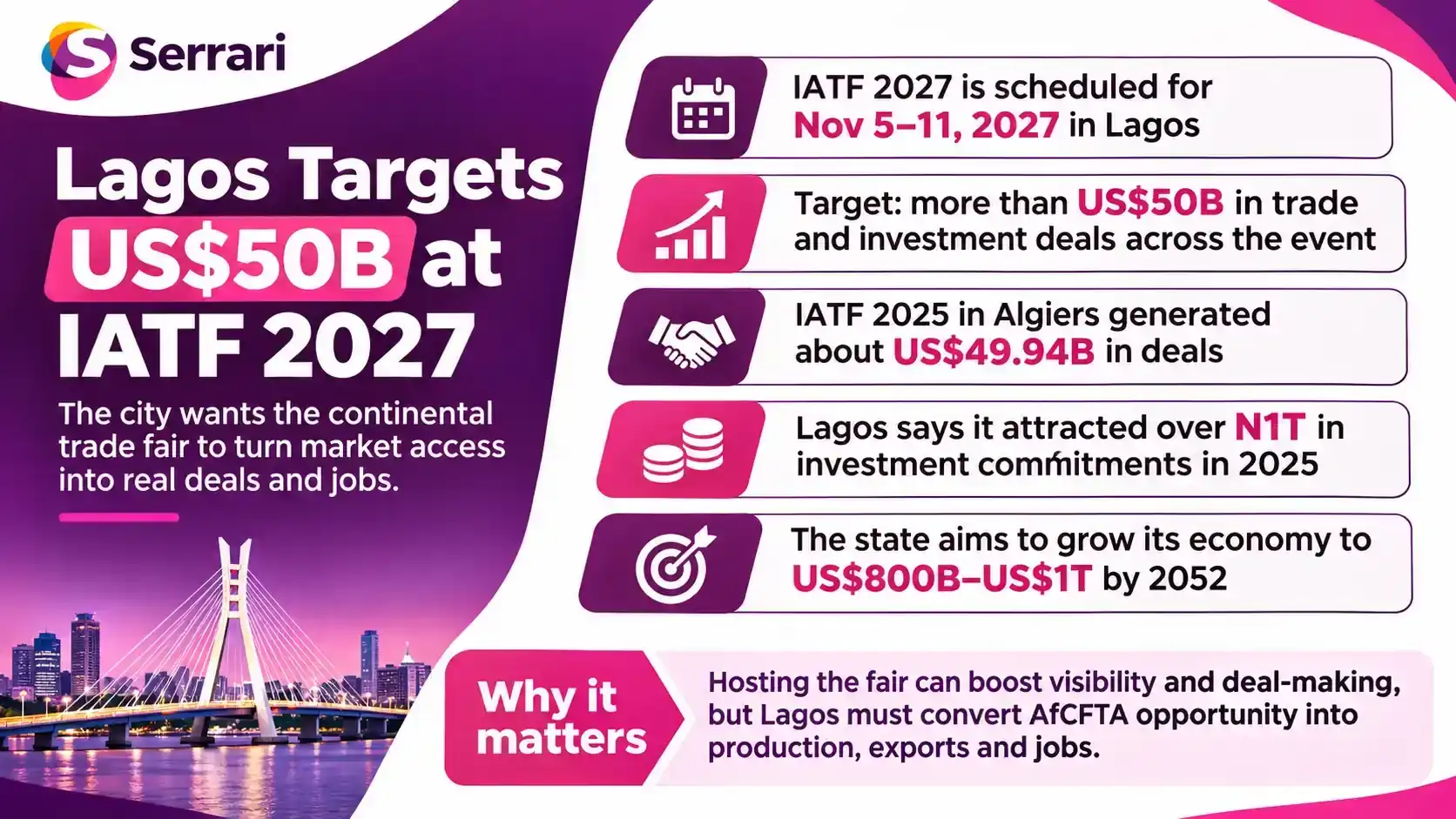
- $50 billion ambition: Organisers aim for more than $50 billion in trade and investment deals at IATF 2027; this is a continent-wide event target, not guaranteed investment for Lagos alone.
- Confirmed dates: Lagos hosts the fifth edition of IATF from November 5 to 11, 2027.
- Scale: Organisers have targeted more than 100,000 visitors, 2,500 exhibitors and participation from over 100 countries.
- Previous benchmark: The 2025 event in Algiers was reported to have generated approximately $49.94 billion in trade and investment deals.
- Investment claims: Lagos officials have reported investment activity exceeding ₦1 trillion, including commitments in technology, healthcare, logistics and ports; announcement values should not be confused with capital already deployed.
- Long-term objective: Lagos has set out an ambition to build an 1 trillion economy by 2052, requiring sustained productivity and export growth.
Why Lagos Is Pursuing a $50 Billion Trade Fair Opportunity
Lagos wants the 2027 Intra-African Trade Fair to do more than generate a week of exhibitions and publicity. At the closing ceremony of the 2026 Lagos International Trade Fair, Commissioner Folashade Bada Ambrose-Medebem framed the forthcoming event as a way to connect local businesses with investors, buyers and export partners across the continent. The timing reflects a policy challenge: Nigeria’s largest commercial hub needs to convert its extensive trading activity into productive investment and durable employment.
The $50 billion figure is substantial, but its meaning is frequently misunderstood. It is the target for trade and investment deals facilitated by the entire continental fair, including transactions involving businesses and governments beyond the host city. It is not an allocation from the government, an announced inflow into Lagos State or a forecast that $50 billion will be deposited into Nigerian bank accounts. Deals announced at trade fairs can include commercial agreements, memoranda of understanding, project proposals and financing commitments, with different levels of certainty.
The March 2026 host-country agreement confirmed that Nigeria would host the fifth edition in Lagos from November 5 to 11, 2027. Organisers set a target exceeding $50 billion, alongside more than 100,000 visitors and 2,500 exhibitors. For Lagos, hosting creates direct commercial opportunities in accommodation, transport, event services and professional support. The more important prize, however, would be long-lasting supply contracts and investment projects that continue after delegates leave.
Why the Previous Fair Sets a High Benchmark
The 2027 ambition is grounded in the reported performance of the previous event. Organisers said the fourth edition, held in Algiers in 2025, generated approximately $49.94 billion in trade and investment deals. That provides an explanation for setting the next target just above $50 billion rather than choosing the amount arbitrarily.
Yet this benchmark needs careful interpretation. The value of announced deals measures the scale of commercial interest and potential transactions generated through the fair; it does not prove that all purchases, construction projects or loan disbursements have been completed. An exporter signing a supply agreement may still need certification, financing, production capacity and delivery arrangements. An infrastructure investor may require permits and commercially viable terms before committing cash.
For policymakers, a more meaningful assessment would follow transactions after the event. How many agreements become paid orders? How many factories expand output? How many small businesses become regular exporters? And how many local jobs and tax revenues follow? The answer to those questions will distinguish an economically successful trade fair from one remembered mainly for its announced headline totals.
Context is everything. Stay ahead of shifting trends with today’s market updates, and uncover emerging opportunities using the Serrari Group Market Index and Marketplace. Then, take control of your own financial future by exploring our Money & Life Reset Transformation Blueprint ™ to build stronger habits, create better systems, and design a path toward lasting wealth.
The AfCFTA Opportunity Comes With Production Barriers
The African Continental Free Trade Area is central to the Lagos government’s pitch because it offers a framework for lowering trade barriers and expanding commerce among participating African countries. Businesses that once concentrated on Nigerian customers may be able to explore demand across West, East, Central, North and Southern Africa. But a continental market does not automatically turn an uncompetitive product into a viable export.
Ambrose-Medebem stressed the need for quality, appropriate certification, reliable supply, competitive prices and an understanding of export procedures. That warning identifies the real constraint facing many smaller manufacturers: a buyer may express interest at a trade fair, but suppliers must deliver the required quantity and specifications consistently. Border delays, transport costs, fragmented standards and currency settlement can then determine whether the order is profitable.
The wider scale of the opportunity is evident in African trade research, which estimated intra-African trade at $220.3 billion in 2024, up 12.4% from the preceding year. The figure is evidence of an existing regional market, not a projection of what the Lagos event itself will achieve. Trade-fair matchmaking can help companies enter that market, but the operating economics must work once the introductions are made.
For a Nigerian food processor, that might mean passing product-safety checks and securing refrigerated transport. For a clothing manufacturer, it could require stable fabric supplies and reliable delivery windows. For a technology company, the barriers may relate more to payments, regulatory compliance and after-sales support. The common lesson is that export readiness begins well before the exhibition floor opens.
Lagos Says Investment Momentum Is Building, but Delivery Matters
Lagos officials have pointed to investment activity exceeding ₦1 trillion as evidence that the state can attract capital. In an earlier government investment briefing, the commissioner reported more than ₦1 trillion attracted over the preceding year, including deals across digital services, healthcare, logistics and port operations. The November 2026 remarks also cited more than ₦1 trillion in 2025 investment activity and an improvement over 2024.
These announcements demonstrate the government’s investment-promotion ambition, but the reporting periods and measurement methodology are not sufficiently detailed to establish that they represent separate, additive investment totals. Nor should reported commitments be treated as fully completed projects. The distinction matters because investments can be announced well before construction, equipment purchases, hiring or production begin.
The commissioner’s emphasis on productive capacity, skills and local supply chains reflects that concern. Investment that builds a factory and sources inputs locally may have a larger economic effect than a transaction that simply changes ownership of an existing asset. Equally, a port or logistics investment may create value beyond its direct jobs if it reduces delivery times and costs for thousands of exporters.
What the 2052 Economic Ambition Requires
Lagos has articulated a goal of expanding its economy to between $800 billion and $1 trillion by 2052. According to the state’s reported long-term ambitions, reaching that scale would depend on stronger manufacturing, value addition and international exports. The target is an aspiration rather than an independently established growth forecast, and its interpretation will depend on how the economy is measured and what exchange-rate assumptions are applied.
Trade fairs can help by introducing capital providers and buyers to commercially viable projects. But the scale of the ambition requires repeated improvements in electricity reliability, transport capacity, workforce skills, industrial land access and business regulation. Without those foundations, businesses may secure expressions of interest yet struggle to manufacture at the price and quality their new customers demand.
The Lagos State Pavilion illustrates a smaller, practical intervention: giving agribusinesses, fashion enterprises, manufacturers and creative businesses visibility they may struggle to purchase individually. The real return on that public effort will be measurable in contracts fulfilled and companies graduating from occasional exhibitions to regular regional exports.
What Businesses and Investors Should Watch Before 2027
For companies considering IATF participation, preparation should begin with verified production capacity, product documentation, pricing in relevant currencies and a realistic plan for delivery across borders. The fair’s official event programme includes business matchmaking and investment-focused activity, but meetings will be valuable only where exporters can present commercially credible offers.
Investors should examine whether opportunities have clear project sponsors, necessary approvals, viable cash flows and a realistic implementation timetable. Governments and event organisers should publish follow-up measures that distinguish preliminary expressions of interest from executed contracts, financed projects and completed investments. This would make it easier to evaluate the event’s success without treating every announcement as realised economic output.
The bigger picture is Africa’s effort to turn a fragmented collection of national markets into a more connected production and trading system. Lagos has the commercial scale and transport links to benefit from that process, but it also faces intense competition from other African manufacturing and logistics hubs. Hosting IATF 2027 offers international visibility and access to business networks; retaining the resulting economic value will depend on what local companies can actually supply.
The $50 billion target matters now because the next year is a window for preparation, not because the money has already been secured. If Lagos can convert introductions into financed investment, fulfilled export orders and skilled employment, the fair could contribute to the state’s long-term transformation. If most commitments remain on paper, the headline total will say much less about the real economy than the number of functioning businesses left behind.
Sources: Nigerian Tribune / Intra-African Trade Fair / Nigerian Investment Promotion Commission / Lagos State Government / African Export-Import Bank / Vanguard
Your financial future isn’t something you wait for—it’s something you build.
The real question is: when do you begin?
Move beyond simply staying informed.
Navigate the markets with clarity—track trends through the Serrari Group Market Index, uncover opportunities in the Serrari Marketplace, and build practical knowledge with our Curated Wealth Builder Platform.
Stay connected to what truly matters.
Get daily insights on macro trends and financial movements across Kenya, Africa, and global markets—delivered through the Serrari Newsletter.
Growth opens doors.
Advance your career through professional programs including ACCA, HESI A2, ATI TEAS 7 , HESI EXIT , NCLEX – RN and NCLEX – PN, Financial Literacy!🌟—designed to move you forward with confidence.
See where money is flowing—clearly and in real time.
Track Money Market Funds, Treasury Bills, Treasury Bonds, Green Bonds, and Fixed Deposits, alongside global and African indexes, key economic indicators, and the evolving Crypto and stablecoin landscape—all within Serrari’s Market Index.