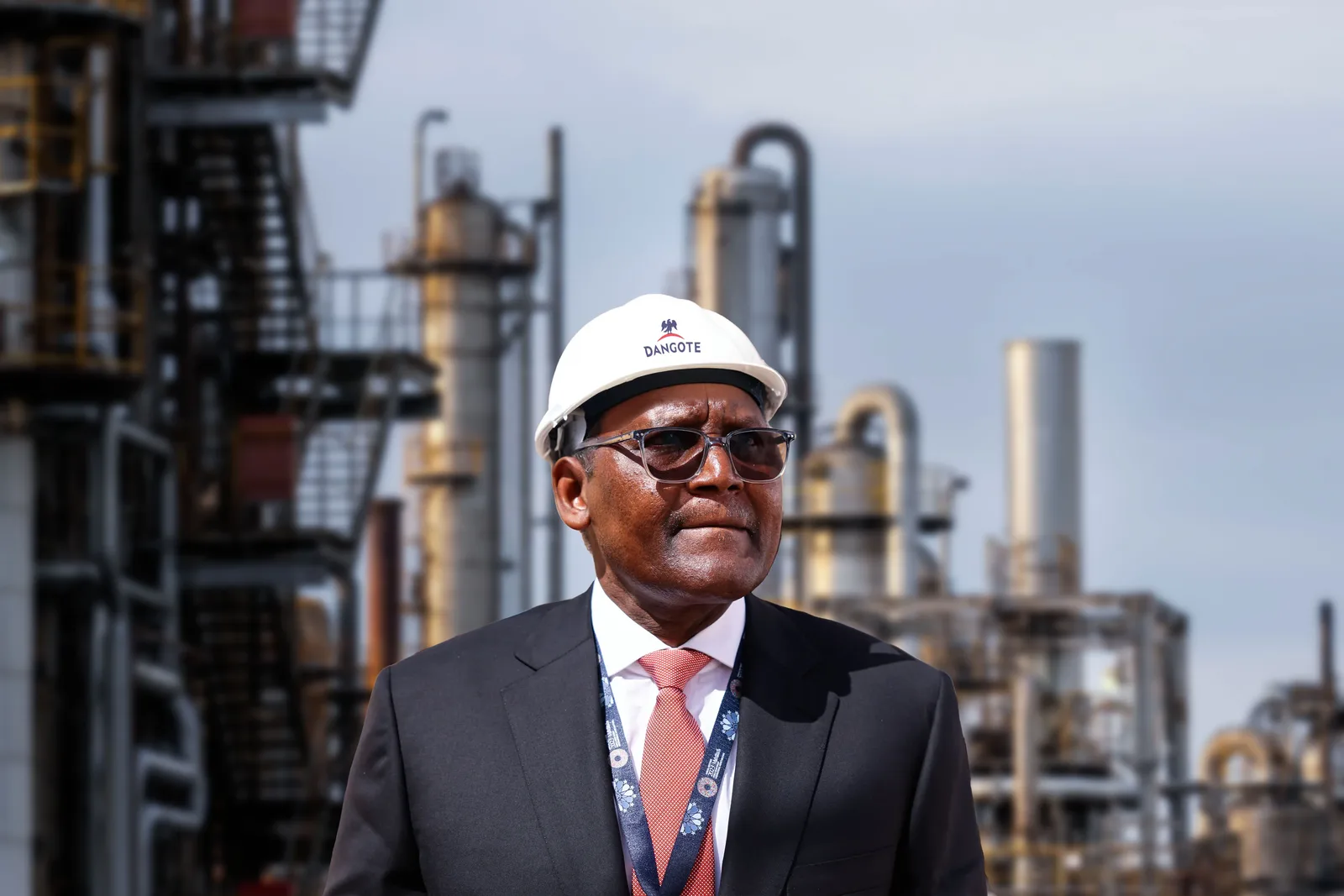
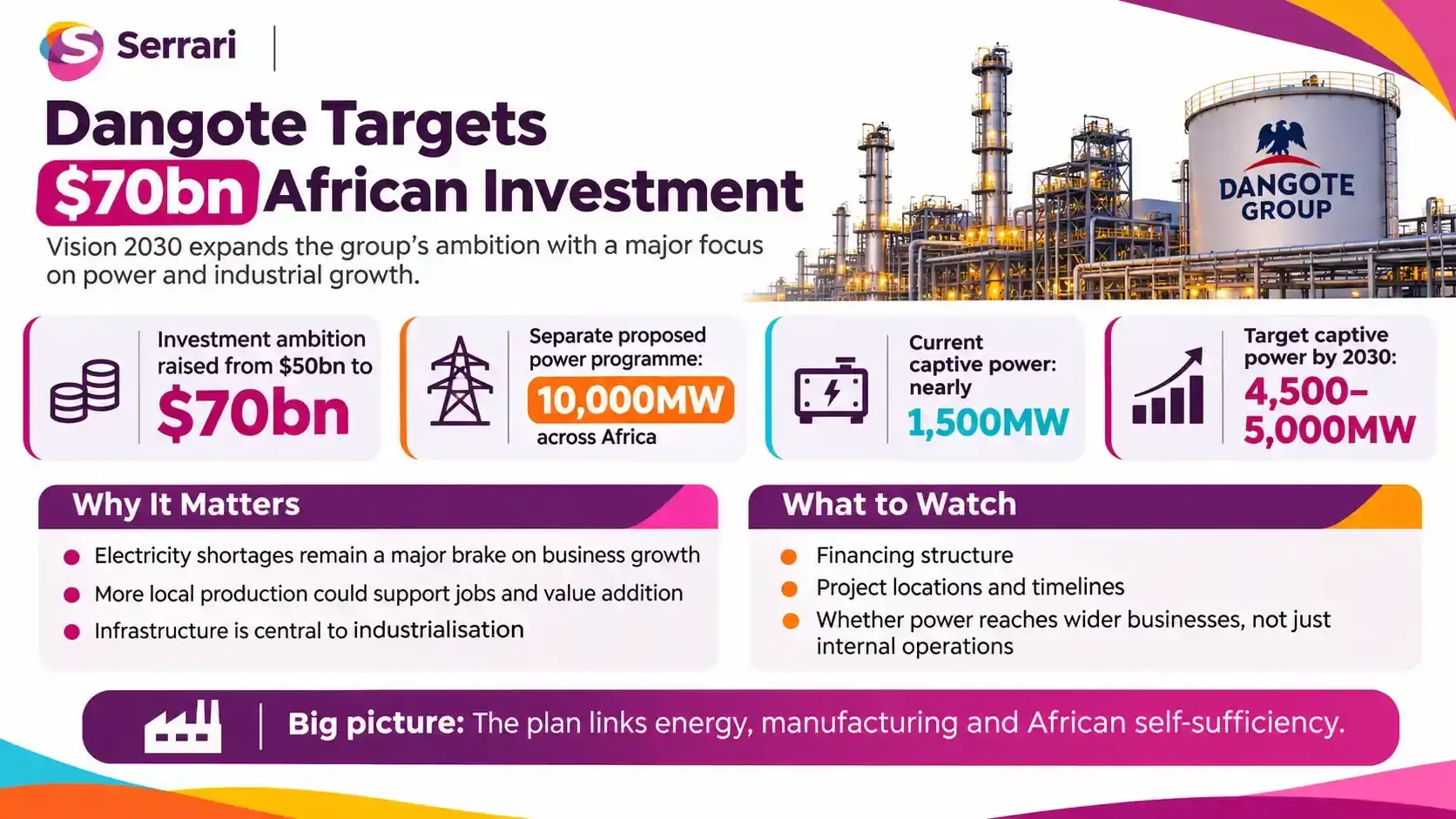
Dangote Industries has raised its Africa-wide investment ambition from $50 billion to approximately $70 billion under Vision 2030, with Aliko Dangote proposing a separate 10,000-megawatt power programme to support industrialisation. The announcement matters less as a single headline spending figure than as a response to two interconnected obstacles: unreliable electricity and Africa’s limited ability to process its own resources competitively. The group also intends to increase electricity generation for its own factories from nearly 1,500MW to between 4,500MW and 5,000MW. Both the broader power initiative and the investment target are ambitions rather than fully financed or completed projects, leaving execution, affordability and distribution as the decisive tests.
Key Overview
- Larger ambition: The Vision 2030 investment programme has been lifted from $50 billion to approximately $70 billion, a 40% increase over the earlier target.
- Continental electricity: Dangote is considering a separate 10,000MW power programme across Africa, potentially including Nigeria; its financing and locations remain unspecified.
- Factory power: The group says its captive generation is nearly 1,500MW and could reach 4,500–5,000MW by 2030.
- SME challenge: Unreliable grid power and costly generators weaken the competitiveness of smaller companies and limit job creation.
- Industrial strategy: Agriculture, minerals, energy infrastructure and local processing form part of a broader effort to retain more value within African economies.
- Execution risk: Capital requirements, dependable policy, electricity transmission and affordable tariffs will determine whether proposed capacity translates into meaningful economic benefits.
Why Dangote Is Expanding the Investment Plan Now
Aliko Dangote’s revised investment announcement comes amid a renewed push to build production capacity within Africa rather than depend on imported finished goods. Speaking to creative-industry representatives from Northern Nigeria, the industrialist argued that businesses cannot expand sustainably where electricity is unreliable and government policy is unpredictable. His point was not simply that factories need more capital. They need an operating environment in which that capital can earn a return.
The $70 billion figure is a target for the group’s investment programme under Vision 2030, not evidence of $70 billion in newly secured financing. It represents a $20 billion increase over the previously stated $50 billion ambition. Reports also indicate that Dangote had discussed a $60 billion target earlier in November, showing how quickly the proposed scope has expanded. The latest figure should therefore be interpreted as an evolving investment agenda, not a final project-by-project budget.
The logic behind the expansion is commercial as well as developmental. A company investing in cement, fertiliser, petroleum products or mineral processing depends on reliable power, transport and local supply chains. Without those systems, higher production capacity can become stranded or expensive to operate. Investing in supporting infrastructure can protect the economics of Dangote’s factories while potentially creating business opportunities for other producers.
Why Electricity Is at the Centre of Vision 2030
The announcement contains two different power targets that should not be combined. Dangote says the conglomerate already generates nearly 1,500MW for its own facilities and wants to increase this captive power capacity to between 4,500MW and 5,000MW by the end of Vision 2030. Separately, it is considering a 10,000MW African generation programme, potentially including Nigeria. Neither target means that equivalent electricity is already flowing to households or external businesses.
Captive generation gives major industrial groups a measure of control over operations that would otherwise be exposed to blackouts, fuel shortages and grid instability. It can reduce unplanned shutdowns, protect equipment and make delivery schedules more predictable. But it also illustrates an unequal playing field: large corporations can finance private plants, whereas smaller manufacturers and traders often cannot.
This constraint is material, not theoretical. A World Bank assessment of Nigeria’s business environment describes unreliable electricity as a leading private-sector obstacle, estimating that around 86% of businesses own or share a generator. It also cites substantial economic losses associated with unreliable supply. When firms divert revenue to diesel, petrol, repairs and backup equipment, they have less cash for workers, inventory and expansion.
A larger African power programme could help address that problem, but only if projects supply usable electricity at affordable prices. Generation capacity alone does not guarantee economic impact. Transmission lines, distribution networks, payment collection, regulation and customer demand must work together. A 10,000MW announcement with no defined locations or delivery timetable should therefore be judged by the power ultimately delivered, not by nameplate capacity alone.
What the Plan Could Mean for Small Businesses and Jobs
Dangote has specifically linked electricity supply to the survival of small and medium-sized enterprises. That matters because the jobs generated by a new industrial complex are only one part of its economic effect. Contractors, transport firms, food suppliers, retailers and maintenance businesses can benefit when a larger manufacturer operates consistently and buys locally.
Reliable electricity can also create opportunities for businesses not directly connected to Dangote. Cold storage operators can reduce spoilage, workshops can run machinery more predictably, and agricultural processors can operate beyond daylight hours without depending entirely on generators. These gains could improve output and lower the cost of goods, provided electricity prices remain competitive.
The wider electricity deficit remains enormous. A 2025 energy-access financing report estimated that roughly 600 million Africans lacked access to electricity and identified capital availability as a major barrier to expanding connections. This gap shows why a private-sector intervention could be consequential, but also why no single conglomerate can solve the continent’s power shortage on its own.
The distribution of benefits will matter as much as the aggregate investment. Projects serving only industrial enclaves may improve manufacturing output without substantially expanding access for households or smaller businesses. To produce wider gains, power programmes need transparent arrangements governing grid connections, pricing and the customers eligible to buy electricity.
Context is everything. Stay ahead of shifting trends with today’s market updates, and uncover emerging opportunities using the Serrari Group Market Index and Marketplace. Then, take control of your own financial future by exploring our Money & Life Reset Transformation Blueprint ™ to build stronger habits, create better systems, and design a path toward lasting wealth.
Why Local Processing Matters More Than Exporting Raw Materials
The strategy also reflects Dangote’s long-standing argument that African economies capture too little value when they export raw commodities and import the finished products made from them. Agriculture and solid minerals, particularly in Northern Nigeria, were among the sectors he highlighted as candidates for greater investment.
The economic reasoning is straightforward. Processing agricultural produce or minerals locally creates demand for technicians, logistics operators, packaging suppliers and professional services. It can keep more stages of production and more associated income within the country. However, processing is not automatically profitable: it requires competitive energy, dependable transport, skilled workers and access to buyers.
This connection between energy and manufacturing is also highlighted in an analysis of African value chains, which identifies limited energy supply as a constraint on industrial development and on efforts to capture more value from natural resources. Dangote’s proposed approach effectively treats electricity and industrial processing as complementary investments rather than unrelated projects.
Ports and distribution infrastructure form another part of that equation. A factory able to produce at scale still needs affordable ways to move goods into regional markets. In early November, Dangote launched a fuel-storage and pipeline project in Namibia, illustrating a broader interest in the logistics required to connect African production with customers across borders. The project is an example of the strategy’s geographic reach, not proof that all of Vision 2030 has been funded.
The Financing and Policy Questions Behind $70 Billion
The most significant unanswered question is how the enlarged programme will be financed and phased. Major power plants, ports and processing facilities require long-term capital, while construction delays can raise costs before revenues begin. The group has not published a complete financing structure or a country-by-country construction timetable for its proposed 10,000MW intervention.
Investment viability will also depend on regulatory consistency. Developers need confidence that permits, tariffs, fuel supply arrangements and contractual obligations will remain workable over many years. Sudden policy changes can undermine projects even after factories are built, especially where revenues are earned in local currencies but equipment or financing costs are denominated in dollars.
There is also an important distinction between public benefits and private incentives. Dangote may pursue projects that complement its industrial operations and make commercial sense for the group. Governments, meanwhile, must consider whether those projects support competition, fair access and affordable services for a wider range of users. The two objectives can overlap, but they are not always identical.
What Will Determine Whether Vision 2030 Succeeds
The near-term indicators are more concrete than the headline investment figure: announced project sites, financing commitments, permitting milestones, equipment procurement, construction progress and completed electricity connections. Investors and policymakers should also track whether captive generation actually reaches the 4,500–5,000MW range and whether the separate African programme develops bankable projects.
For Nigerian households and small businesses, the relevant outcome is not how large a corporate investment announcement becomes. It is whether reliable electricity and locally made goods become more accessible and affordable. For African industry, the larger question is whether new infrastructure can support firms beyond the Dangote group, encouraging additional private investment rather than reinforcing dependence on a few large operators.
The $70 billion ambition is therefore a statement about the constraints holding back African industrialisation. Dangote is betting that solving power and logistics bottlenecks can unlock production that conventional investment alone cannot deliver. If the projects reach financial close, are completed and serve competitive markets, Vision 2030 could have effects well beyond one company. Until then, its economic significance lies in the scale of the problem it seeks to address—and in the measurable commitments still required to turn ambition into output.
Sources: APA News / BusinessDay / World Bank / International Energy Agency / Reuters / Billionaires Africa
Your financial future isn’t something you wait for—it’s something you build.
The real question is: when do you begin?
Move beyond simply staying informed.
Navigate the markets with clarity—track trends through the Serrari Group Market Index, uncover opportunities in the Serrari Marketplace, and build practical knowledge with our Curated Wealth Builder Platform.
Stay connected to what truly matters.
Get daily insights on macro trends and financial movements across Kenya, Africa, and global markets—delivered through the Serrari Newsletter.
Growth opens doors.
Advance your career through professional programs including ACCA, HESI A2, ATI TEAS 7 , HESI EXIT , NCLEX – RN and NCLEX – PN, Financial Literacy!🌟—designed to move you forward with confidence.
See where money is flowing—clearly and in real time.
Track Money Market Funds, Treasury Bills, Treasury Bonds, Green Bonds, and Fixed Deposits, alongside global and African indexes, key economic indicators, and the evolving Crypto and stablecoin landscape—all within Serrari’s Market Index.