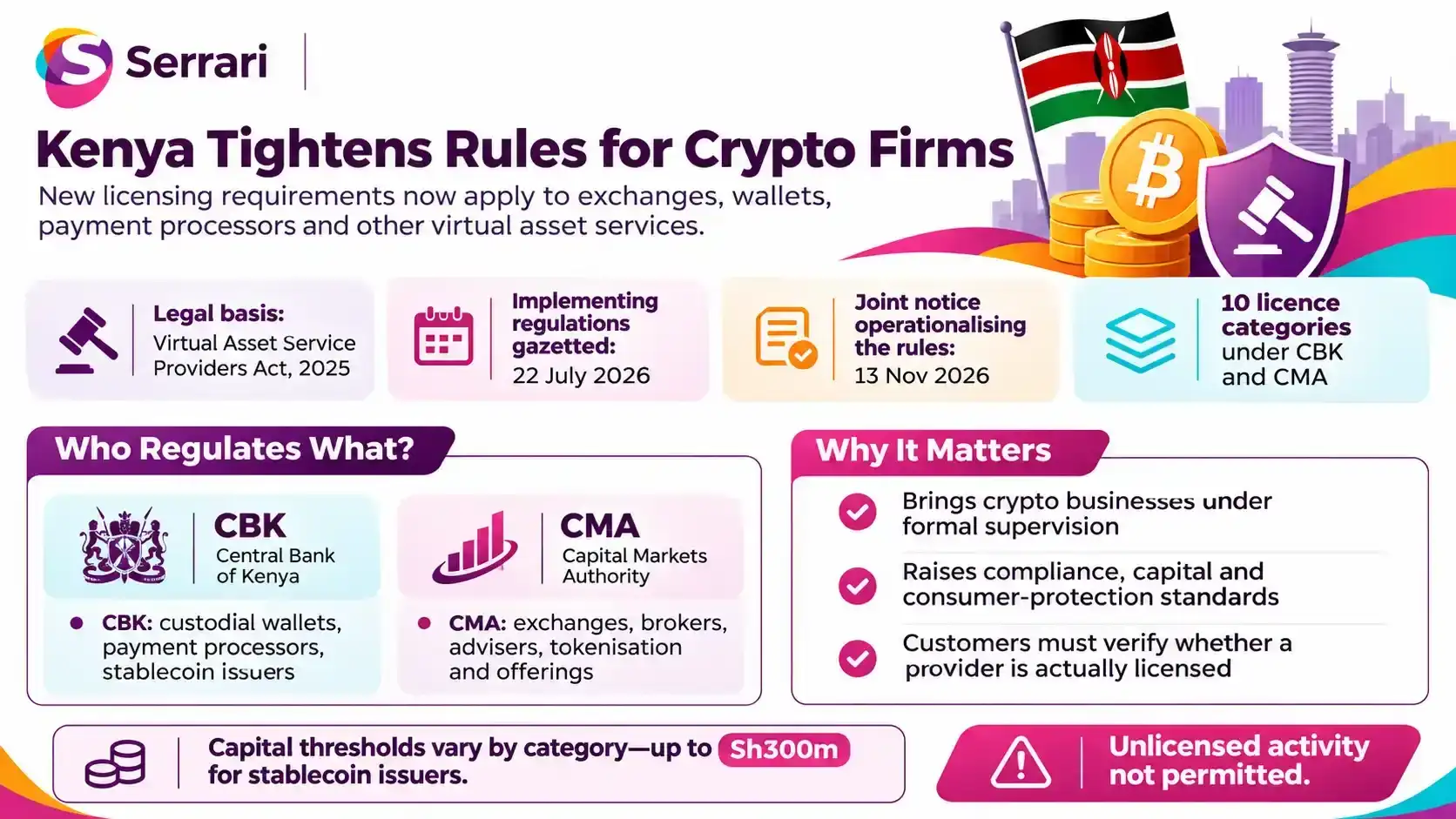
Kenya has moved from establishing a legal basis for cryptocurrency oversight to requiring virtual asset businesses to seek regulatory licences. In a joint public notice dated November 13, 2026, the Central Bank of Kenya (CBK) and Capital Markets Authority (CMA) confirmed that regulations gazetted on July 22 now operationalise the Virtual Asset Service Providers Act, 2025. Exchanges, custodial wallet providers, payment processors, stablecoin issuers and investment intermediaries must identify their supervising authority and apply under the relevant category. The shift is intended to reduce the risks of fraud, weak custody, money laundering and opaque dealings while giving legitimate digital-asset businesses a clearer legal framework. But capital thresholds, compliance costs and enforcement capacity will determine whether the rules create a safer market without shutting smaller innovators out.
Key Overview
- Official notice: CBK and CMA issued their joint notice on November 13, 2026; the implementing regulations had been gazetted on July 22, 2026.
- Two regulators: CBK oversees custodial wallets, virtual asset payment processing and stablecoin issuance, while CMA supervises exchanges, brokers, investment services and token offerings.
- Ten licence categories: Applicants are regulated according to the activity offered, and businesses combining services may require more than one authorisation.
- Capital thresholds: Minimum paid-up capital ranges from none for virtual asset investment advisers to Sh300 million for stablecoin issuers, with additional liquidity requirements.
- Customer safeguards: The rules address asset custody, disclosures, cybersecurity, complaints, market abuse and anti-money-laundering controls.
- Investor caution: Applying for a licence is not the same as receiving one, and regulatory oversight cannot eliminate losses from volatile digital assets.
Why Kenya Is Moving From Crypto Warnings to Formal Licensing
Kenya’s latest move is not a sudden ban or a declaration that cryptocurrency is risk-free. It is the implementation stage of legislation enacted in 2025. The joint regulatory notice confirms that the Virtual Asset Service Providers Act was gazetted on October 21, 2025 and commenced on November 4 that year. The National Treasury subsequently issued Legal Notice No. 134 on July 22, 2026, providing the detailed operating rules. The November announcement directs existing and prospective service providers to seek licensing from the responsible regulator.
The timing matters because Kenya has long had individuals and businesses trading digital assets without a comprehensive sector-specific licensing system. Where activity crosses traditional financial boundaries, customers can struggle to determine which authority is responsible when a platform freezes withdrawals, loses assets or markets misleading returns. A formal licensing framework places accountability on identifiable service providers rather than relying only on warnings after losses occur.
The final regulations also respond to operational risks: companies holding customer assets need secure systems, clear records, capable management and procedures for dealing with cyber incidents. The wider policy aim is to make legitimate innovation possible within enforceable rules, rather than leaving the sector in regulatory uncertainty.
Which Crypto Businesses Fall Under CBK and CMA?
The new framework divides supervision by service, not by whether a company calls itself a blockchain startup or a cryptocurrency exchange. CBK handles custodial wallet services, virtual asset payment processors and stablecoin issuance. These activities can resemble payment infrastructure because they involve holding value, enabling transfers or issuing instruments intended to maintain a stable value against conventional money.
CMA supervises virtual asset exchanges, brokers, investment advisers, managers, initial coin offering services, tokenisation providers and token issuance platforms. These functions are closer to capital-market intermediation, where fair dealing, investment risks and market conduct are central. The regulatory service classifications define the application process and associated obligations.
This distinction has practical implications for firms offering several products. An exchange that also holds customer tokens or operates a payment product cannot assume one business label covers every activity. It must examine the legal scope of each service and the licensing requirements that attach to it. The regulators say detailed checklists are available and that approved licensees will be published in public registers. Until an operator is verified on an official register, a claim that it has applied for approval should not be presented as proof of authorisation.
The regime targets businesses providing covered services to others. It should not be interpreted as a requirement that every Kenyan who buys Bitcoin for personal investment obtain a virtual asset service provider licence.
Context is everything. Stay ahead of shifting trends with today’s market updates, and uncover emerging opportunities using the Serrari Group Market Index and Marketplace. Then, take control of your own financial future by exploring our Money & Life Reset Transformation Blueprint ™ to build stronger habits, create better systems, and design a path toward lasting wealth.
Why Capital Requirements Could Reshape the Industry
The most immediate business consequence is the cost of becoming compliant. Under the regulations’ Fifth Schedule, a virtual asset exchange must maintain Sh100 million in minimum paid-up capital, a custodial wallet provider Sh150 million, and a payment processor Sh10 million. Brokers face a Sh10 million threshold, while virtual asset managers require Sh20 million. A stablecoin issuer faces the highest listed minimum at Sh300 million. Virtual asset investment advisers have no prescribed minimum paid-up capital under that schedule, although other licensing obligations still apply.
These are not simply application charges. Paid-up capital is an enduring financial buffer intended to help businesses absorb losses and support their operations. Separate liquid-capital rules also apply. In some categories, liquidity requirements are calculated partly by reference to liabilities, so compliance can become more demanding as a firm’s risk exposure increases.
The framework can therefore change the structure of Kenya’s crypto market. Larger, well-financed operators may find it easier to meet the thresholds and invest in audits, security and governance. Smaller startups could seek new equity, narrow their services, partner with licensed firms or leave activities that are too expensive to operate. That may improve resilience but could also increase concentration and reduce competition if entry costs become prohibitive.
For the authorities, the challenge is balancing sufficient financial safeguards with room for new businesses. Capital alone cannot prevent fraud or bad management; effective supervision must establish whether a firm actually follows the rules.
What the Rules Mean for Customer Funds and Crypto Investors
The consumer-protection case extends beyond the number of licences issued. The regulations address safekeeping of customer assets, recordkeeping, cybersecurity, disclosure of risks and fees, complaint handling and market manipulation. They also impose controls relevant to knowing customers and detecting illicit financial activity. A regulated custodian must have governance and operational arrangements suited to the risks of holding assets on behalf of users.
For someone transferring money into a digital wallet or trading through an exchange, these safeguards can improve transparency about who is responsible for the service and how complaints are handled. They can also create more defined expectations around custody and customer information. But the distinction between regulated provider and safe investment remains essential. A licensed platform does not guarantee that Bitcoin, another token or a stablecoin will hold its value, nor does licensing automatically protect customers from every technological failure.
The practical first step is checking the identity of the legal entity behind a platform and confirming its status against the lists the regulators promise to publish. Users should also examine withdrawal terms, fees, risk disclosures and whether the entity named in an advertisement is the one actually holding their assets. A well-known international brand is not, by itself, evidence that its particular Kenyan service is authorised.
Why Stablecoins and Tokenisation Are Especially Important
The framework is broader than speculative cryptocurrency trading. Stablecoins are designed to track reference assets such as national currencies and could eventually support payment or settlement services. Their appeal depends heavily on whether issuers hold appropriate reserves and honour redemption requests. The regulations address reserve assets, custody, disclosure and redemption, reflecting the risk that a supposedly stable instrument can lose its peg when confidence collapses.
Tokenisation presents a different opportunity and challenge. Digital representations of real-world assets can, in principle, make ownership interests easier to divide, transfer or administer. However, a token cannot automatically cure defects in the underlying legal ownership, asset valuation or investor rights. Rules governing offerings, white papers and platforms matter because buyers must understand exactly what they own and what claims they can enforce.
For Kenya’s financial sector, clearer rules may encourage carefully structured experiments in payments and capital raising. The impact will depend on whether regulated products solve real problems more efficiently than existing systems, not merely on the adoption of blockchain terminology.
What Happens Next for Companies and Regulators?
The November notice is a call for applications, not an announcement that every existing operator has already been licensed. The Act’s transitional arrangements and applicable deadlines require careful legal assessment by firms that operated before the framework took effect. Providers should not assume that historic activity or a pending application amounts to permanent permission to continue without meeting applicable requirements.
The next meaningful milestones will be published licence approvals, supervisory guidance, enforcement against unauthorised activity and the practical handling of complaints or failures. The number of applications alone will say little about whether the regime works. More useful measures include how quickly applications are assessed, whether users can identify licensed companies, and whether firms consistently safeguard client assets.
The larger story is Kenya’s attempt to move digital assets from a regulatory grey area into a supervised financial-services market. That could strengthen consumer confidence and provide more predictable conditions for investment, but it also introduces costs that will test smaller businesses. The success of the new rules will be judged not by the existence of licences, but by whether they reduce harm while allowing genuinely useful services to grow.
Sources: Central Bank of Kenya / Capital Markets Authority / Kenya Law / Kenyans.co.ke / People Daily
Your financial future isn’t something you wait for—it’s something you build.
The real question is: when do you begin?
Move beyond simply staying informed.
Navigate the markets with clarity—track trends through the Serrari Group Market Index, uncover opportunities in the Serrari Marketplace, and build practical knowledge with our Curated Wealth Builder Platform.
Stay connected to what truly matters.
Get daily insights on macro trends and financial movements across Kenya, Africa, and global markets—delivered through the Serrari Newsletter.
Growth opens doors.
Advance your career through professional programs including ACCA, HESI A2, ATI TEAS 7 , HESI EXIT , NCLEX – RN and NCLEX – PN, Financial Literacy!🌟—designed to move you forward with confidence.
See where money is flowing—clearly and in real time.
Track Money Market Funds, Treasury Bills, Treasury Bonds, Green Bonds, and Fixed Deposits, alongside global and African indexes, key economic indicators, and the evolving Crypto and stablecoin landscape—all within Serrari’s Market Index.