
Nigerian companies with overseas operations face closer scrutiny under the Nigeria Tax Act 2025, which took effect on January 1, 2026, and treats profits of Nigerian companies as arising in Nigeria regardless of where they are earned or received. The legislation also targets profits retained in controlled foreign companies and low-taxed overseas subsidiaries, seeking to reduce opportunities for shifting earnings outside Nigeria’s tax base. The implications are substantial for multinational groups, investment holding companies and exporters, but the rules do not mean every foreign profit is taxed twice or that every company faces the same minimum rate. Foreign-tax credits, treaty protections, company size and the detailed implementation rules will determine actual liabilities.
Key Overview
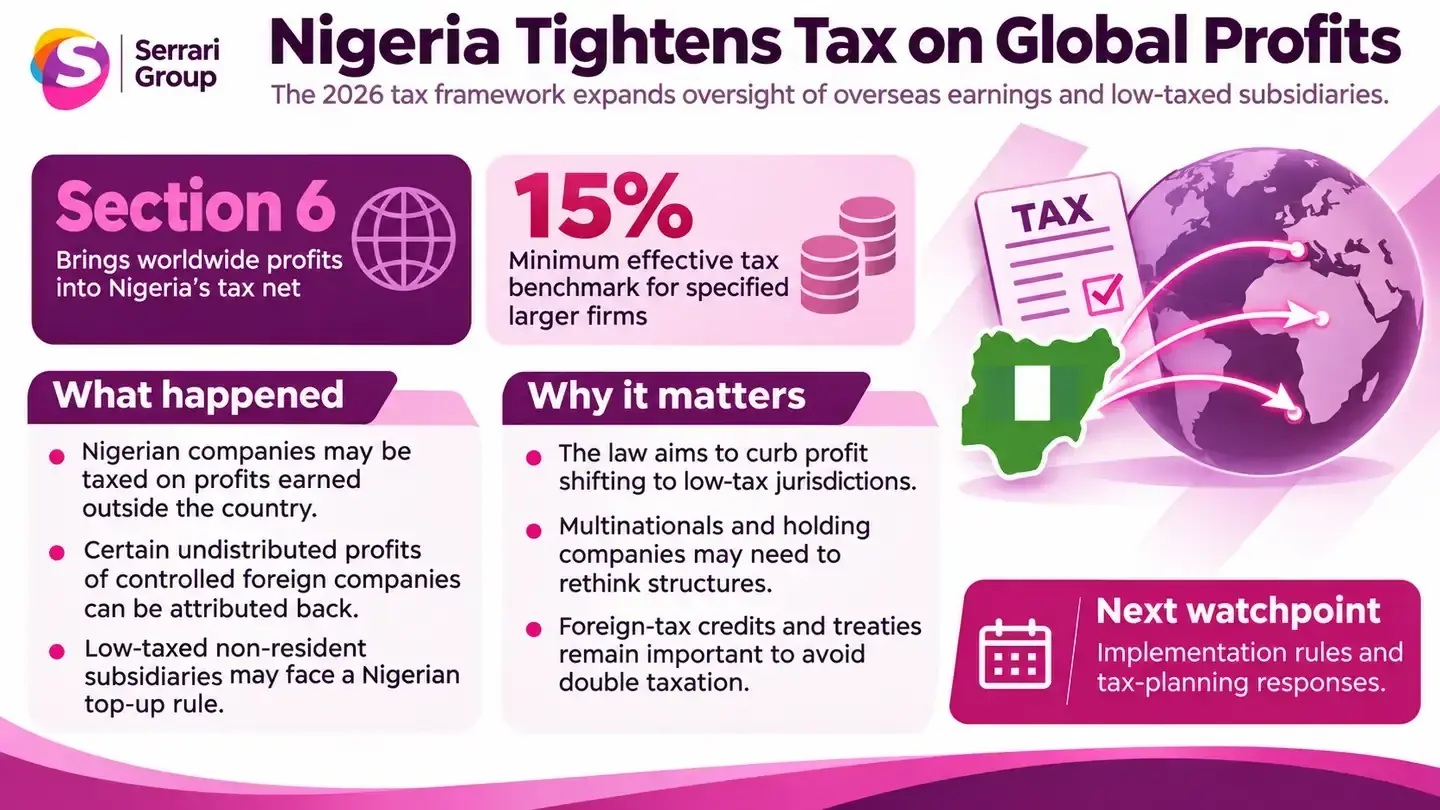
- Worldwide profits: Section 6(1) brings profits of Nigerian companies within Nigeria’s tax framework even when earned or retained abroad.
- Undistributed earnings: Section 6(2) can treat certain distributable profits of a controlled foreign company as if distributed to its Nigerian parent.
- Minimum effective taxation: Section 6(3) establishes a potential top-up where relevant overseas group entities pay below the prescribed minimum rate.
- 15% benchmark: Section 57 sets a minimum effective tax rate for specified multinational group entities and other companies meeting a ₦20 billion turnover threshold.
- Double-tax relief: The Act permits qualifying credits for foreign income taxes, subject to statutory limits and applicable treaties.
- Commercial impact: Cross-border groups may need to reassess ownership structures, profit retention, reporting and cash available to settle Nigerian tax obligations.
Why Nigeria Is Taxing Profits Earned Beyond Its Borders
The central rule is straightforward. Under Section 6 of the Nigeria Tax Act, the profits of a Nigerian company are treated as accruing in Nigeria wherever they arise, whether or not the money has been transferred into the country. A business cannot therefore assume that leaving earnings in a foreign account removes them from its Nigerian income-tax exposure.
The provision forms part of an overhaul that consolidated multiple tax laws into a common framework. It reinforces the distinction between where revenue is generated and the tax status of the company earning it. A Nigerian company may sell goods abroad, hold foreign investments or provide services to international customers, yet still have to consider those profits in its Nigerian tax computation.
That is not the same as saying every foreign-incorporated subsidiary automatically owes Nigerian corporate tax on its entire income. A subsidiary is a separate legal entity, and special rules govern whether and how its earnings are attributed to a Nigerian parent. Equally, being a company incorporated outside Nigeria does not necessarily settle its residence or taxable-presence position; management and control, domestic definitions and the relevant facts may matter.
The policy rationale is to protect the domestic tax base as Nigerian businesses become more internationally active. Without safeguards, a group could have incentives to accumulate profits in a low-tax jurisdiction rather than distribute them to its Nigerian parent. The new framework seeks to make the commercial location of investments less useful as a means of escaping tax, although ordinary overseas expansion is not itself unlawful or evidence of avoidance.
Why Profits Kept in Foreign Subsidiaries Now Matter
Section 6(2) addresses a specific form of deferral. Where a foreign company controlled by a Nigerian company does not distribute profits, the portion attributable to the Nigerian company that could have been distributed without harming the foreign company’s business may be treated as distributed for Nigerian tax purposes.
This matters because an overseas subsidiary may make a profit without sending the cash home. Historically, groups could potentially delay certain parent-level tax consequences by keeping earnings inside foreign subsidiaries. The controlled-foreign-company provision is designed to reduce that advantage where accumulated profits are available for distribution.
But the statutory limitation is significant: it concerns profits that could have been distributed without detriment to the foreign company’s business. Funding needed for legitimate working capital, loan commitments or expansion may raise difficult questions about what was genuinely available. The Act also directs the tax authority to provide detailed implementation rules for subsections 6(2) and 6(3), making administrative guidance important to consistent application.
Consider a Nigerian parent owning a profitable foreign operating company. If that company retains earnings to finance inventory and essential investment, those commercial needs are relevant to the statutory test. If it simply accumulates readily distributable profits offshore, the parent may face greater Nigerian tax exposure even without receiving a dividend. The example illustrates the distinction; it is not a determination of liability for any particular business.
How the 15% Minimum and Top-Up Rules Work
The minimum-tax provisions in Sections 56 and 57 add a second safeguard. Section 56 establishes a 0% company income-tax rate for qualifying small companies and 30% for other companies. Separately, Section 57 sets a 15% minimum effective rate for companies within its scope, including constituent entities of multinational enterprise groups and other companies with aggregate turnover of at least ₦20 billion.
An effective tax rate is not necessarily the same as the headline tax rate. It compares covered tax with a defined measure of profit, taking account of the legislation’s particular calculation rules. A company could therefore have a statutory 30% rate while its effective rate differs because of reliefs or other adjustments.
Section 6(3) looks outward: where a non-resident subsidiary or relevant multinational group member pays income tax below the prescribed minimum effective rate, the Nigerian parent may be required to pay a top-up. The broad principle is to reduce the benefit of placing group income in jurisdictions with very low taxation.
For illustration only, if a qualifying overseas profit base of ₦1 billion were subject to an effective 5% tax rate and a 15% minimum applied on the same recognised base, the difference would be ₦100 million. Actual calculations may be more complicated because statutory definitions, covered taxes, adjustments and implementation guidance matter. The illustration should not be treated as a universal formula for all Nigerian companies or subsidiaries.
The 2025 reform analysis describes these provisions as broadly consistent with the international push against low-taxed multinational profits. However, Nigeria’s domestic design should not be casually equated with full implementation of every OECD Pillar Two rule. What matters for businesses is the actual Nigerian legislation and the administrative directions governing its application.
Context is everything. Stay ahead of shifting trends with today’s market updates, and uncover emerging opportunities using the Serrari Group Market Index and Marketplace. Then, take control of your own financial future by exploring our Money & Life Reset Transformation Blueprint ™ to build stronger habits, create better systems, and design a path toward lasting wealth.
Does Worldwide Taxation Mean Paying Tax Twice?
Not necessarily. The Act contains provisions expressly intended to mitigate double taxation. Under Section 120’s foreign-tax-credit rules, tax paid abroad on income also taxable in Nigeria may be credited against Nigerian tax. The allowable credit is generally limited to the lower of the foreign tax paid and the Nigerian tax attributable to that income.
For example, if a qualifying foreign profit generated a Nigerian tax liability of ₦30 million and ₦20 million of eligible foreign tax had already been paid, the credit could reduce the Nigerian amount to ₦10 million. If the foreign tax was ₦40 million, the credit would ordinarily not exceed the ₦30 million Nigerian liability attributable to that income. These are simplified illustrations: eligibility, documentation and the character of the income must be checked.
The legislation also addresses double-taxation agreements, which can affect how taxing rights and credits operate between treaty partners. As a result, companies need jurisdiction-by-jurisdiction analysis rather than assuming either complete exemption or unavoidable double taxation.
Foreign tax credits are particularly important for legitimate international businesses. Without effective relief, the combined tax burden on overseas activity could discourage expansion and weaken competitiveness. With appropriately administered credits, Nigeria can assert taxation over resident companies while reducing the risk that the same profit is charged twice without relief.
What Changes for Investors and Nigerian Businesses?
The immediate consequence is a greater premium on tax planning, accounting records and transparency. A group with subsidiaries in several countries may need to document which entities it controls, where profits arise, how much foreign tax was paid and whether retained earnings were genuinely needed for operations. Audited financial statements and consistent intra-group records become more important when tax authorities assess effective rates and undistributed profits.
There may also be a cash-flow problem. A parent company could face a tax charge linked to profits that have not been physically transferred from its subsidiary. It would then need available cash or lawful distributions to fund the obligation. This can affect dividend policies, treasury management, borrowing and decisions about where subsidiaries reinvest their earnings.
For foreign investors, the rules are another reason to examine how a Nigerian holding company compares with alternative structures. Tax is only one consideration; regulatory access, operational substance, funding needs and treaty eligibility also matter. The reforms do not establish that Nigeria is categorically an unattractive headquarters location, but they make tax treatment a more explicit part of international expansion decisions.
Smaller domestic firms should also avoid reading the 15% headline as a flat levy on every Nigerian company. The Act distinguishes qualifying small companies from larger businesses, while the minimum effective-rate provision has specified scope conditions. The appropriate result depends on the company’s status, activities and applicable rules.
The Bigger Picture: Revenue Protection Versus Competitiveness
Nigeria’s reforms reflect a broader tension facing governments: they want multinational firms to invest abroad and compete internationally, yet they also want to prevent profits from being parked in places that provide little economic substance or taxation. Controlled-foreign-company measures and minimum effective-tax rules attempt to reconcile those objectives.
The difficult part is implementation. Businesses need predictable guidance, timely decisions and reliable mechanisms for claiming tax credits. Otherwise, uncertainty may create compliance costs and discourage investment even when the underlying intention is legitimate. Overly aggressive assessments could tie up capital in disputes; weak enforcement could leave the anti-avoidance framework ineffective.
This is why the law matters now. With the new regime in force from January 2026, overseas earnings and group structures have become current reporting and planning questions rather than distant policy proposals. The decisive test will not be how broadly the worldwide-income principle is stated, but whether Nigeria can apply it fairly, reduce artificial profit shifting and protect genuine cross-border trade without creating avoidable double taxation.
Sources: Nigerian Investment Promotion Commission / Federal Republic of Nigeria Official Gazette / EY / PwC / Nigerian Tribune
Your financial future isn’t something you wait for—it’s something you build.
The real question is: when do you begin?
Move beyond simply staying informed.
Navigate the markets with clarity—track trends through the Serrari Group Market Index, uncover opportunities in the Serrari Marketplace, and build practical knowledge with our Curated Wealth Builder Platform.
Stay connected to what truly matters.
Get daily insights on macro trends and financial movements across Kenya, Africa, and global markets—delivered through the Serrari Newsletter.
Growth opens doors.
Advance your career through professional programs including ACCA, HESI A2, ATI TEAS 7 , HESI EXIT , NCLEX – RN and NCLEX – PN, Financial Literacy!🌟—designed to move you forward with confidence.
See where money is flowing—clearly and in real time.
Track Money Market Funds, Treasury Bills, Treasury Bonds, Green Bonds, and Fixed Deposits, alongside global and African indexes, key economic indicators, and the evolving Crypto and stablecoin landscape—all within Serrari’s Market Index.