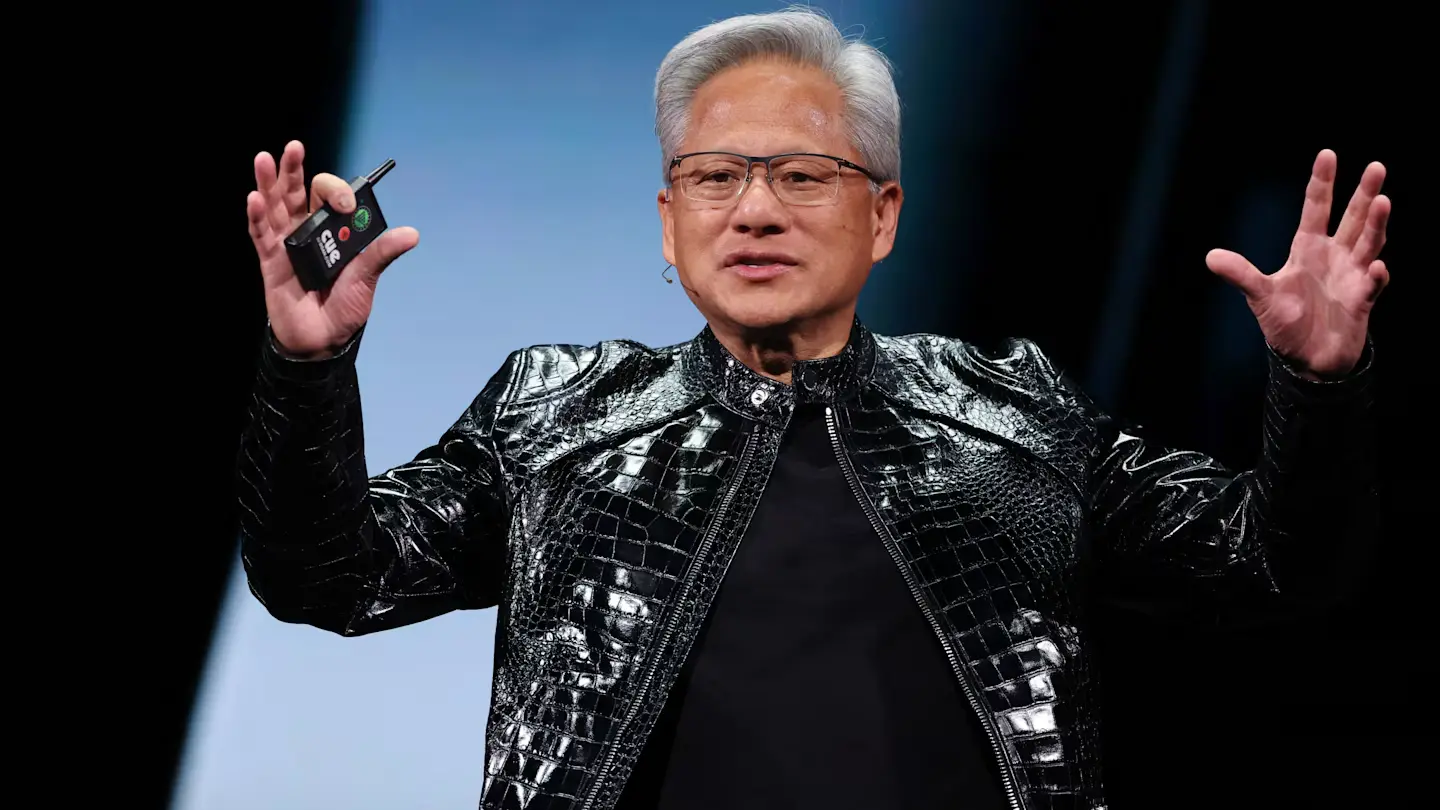
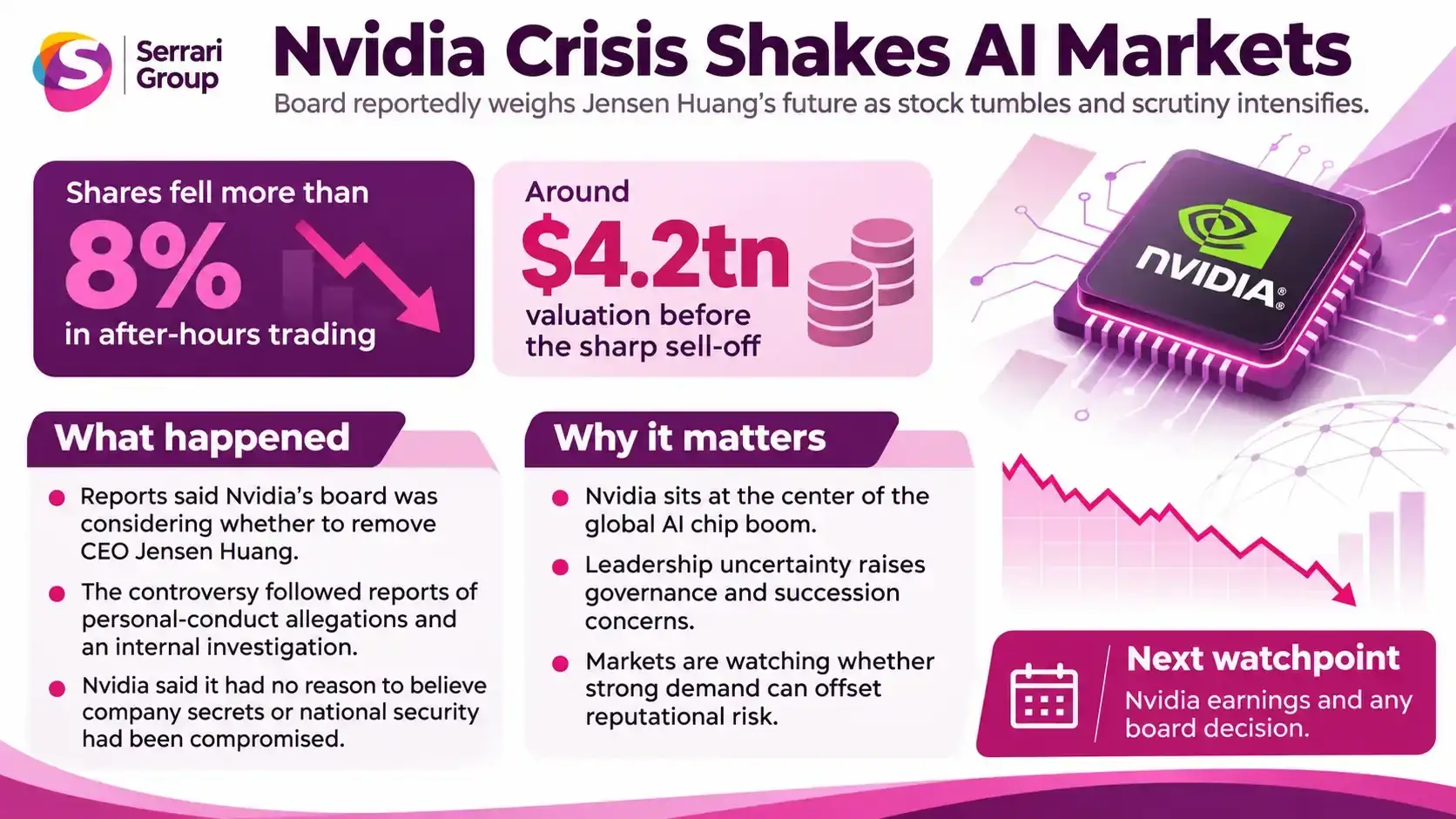
Nvidia faces an extraordinary leadership test after reports that its board is considering removing co-founder and chief executive Jensen Huang following allegations of two extramarital relationships, one involving a businesswoman suspected by US intelligence officials of ties to Chinese espionage. The company has confirmed an independent investigation but has not announced Huang’s removal. Shares fell more than 8% in Wednesday’s after-hours trading, turning a personal controversy into a question about corporate oversight, national security and the resilience of the global artificial intelligence industry.
Key Overview
- Nvidia shares dropped more than 8% in extended trading on November 11 as reports emerged that directors were weighing Huang’s future.
- Huang acknowledged being unfaithful to his wife; a separately reported relationship with a Nvidia executive remains an allegation.
- Nvidia opened an independent investigation into reports that Huang had been targeted by a foreign intelligence effort, while saying it had no reason to believe company secrets were compromised.
- The crisis exposes the governance and succession risks of a company closely identified with its co-founder.
- Nvidia’s November 17 earnings announcement will test whether strong AI demand can offset investor concerns about leadership.
Why Nvidia’s Board Is Facing Pressure to Act
Nvidia’s crisis escalated on November 11 after reports of a second relationship involving an executive who reported to Huang. Separate reporting citing people familiar with the discussions said directors were preparing to consider his removal. Neither a board vote nor a dismissal had been publicly confirmed at the time of writing.
The allegations arrived only days after Nvidia disclosed a formal inquiry into reports that its chief executive had been the target of a foreign intelligence effort. In its November 8 board statement, the company said independent directors, assisted by outside counsel, would examine the available information. It also expressed confidence in Huang and said it had no reason to believe Nvidia secrets or US national security had been compromised.
That distinction matters. The company has acknowledged an investigation, not a finding of espionage or wrongdoing. Huang has admitted marital infidelity and apologised to his family, but public reporting about a second relationship and any intelligence connection must not be confused with proven criminal conduct. China has rejected the spying allegations, adding another contested dimension to an already politically sensitive case.
The board’s problem is therefore broader than the private conduct of its chief executive. Directors must determine whether any relationship created conflicts of interest, exposed confidential information, undermined company policies or compromised their confidence in his judgment. They must also consider whether keeping him in place, placing him on leave or appointing another leader best protects shareholders while facts are established.
For a board that publicly backed Huang on November 8, even contemplating a change days later would be a significant reversal. Yet the latest allegations may have changed directors’ assessment of the risks. Their obligation is to evaluate the evidence independently rather than treat the founder’s achievements as a substitute for oversight.
Why the Stock Market Reaction Has Been So Severe
The sell-off reflects uncertainty about who will run one of the world’s most influential technology companies, rather than a sudden collapse in demand for Nvidia chips. Shares fell more than 8% after the close on November 11, with some reporting placing the extended-hours price near $159.51. That decline followed losses earlier in the week as investors reassessed the risks surrounding Huang.
At a valuation of roughly $4.2 trillion before the sharpest after-hours move, small percentage changes represent enormous sums. An 8% decline against a $4.2 trillion valuation would imply approximately $336 billion of market value at risk, although actual changes depend on the starting price, share count and trading period. The broader reported erosion of hundreds of billions over several sessions should not be confused with the loss from a single after-hours trade.
Why would investors attach such a premium to one executive? Huang co-founded Nvidia in 1993 and has helped transform it from a graphics-chip specialist into the dominant supplier of computing infrastructure for advanced AI. He is closely involved in the company’s technology roadmap, customer relationships, partnerships and public strategy. Markets may therefore discount the shares if an abrupt departure threatens decision-making continuity, even while the underlying products remain in demand.
The reaction also reflects the premium already embedded in Nvidia’s valuation. When investors expect years of exceptional growth, uncertainty about governance or execution can prompt a disproportionately large repricing. The immediate issue is not whether AI data centres will stop buying accelerators overnight. It is whether an unpredictable leadership transition could undermine the confidence supporting Nvidia’s high market value.
An Intelligence Allegation Adds a National Security Dimension
One reported relationship involved Alice Huang, a business executive associated with Singapore-based Megaspeed who, according to accounts of the US investigation, was suspected by American intelligence officials of links to China’s security apparatus. Those suspicions are allegations; the public material does not establish that Jensen Huang knowingly shared classified information or Nvidia intellectual property.
The distinction between an intelligence concern and a proven breach is essential because Nvidia’s chips sit at the centre of US restrictions on the transfer of advanced computing technology to China. Investigators have also reportedly examined possible export-control violations involving Megaspeed. That investigation does not, by itself, prove that Huang participated in or knew of unlawful shipments.
This is what makes the controversy unusual. In many companies, an executive’s private relationship might chiefly raise workplace ethics or reputational concerns. At Nvidia, reported connections to a suspected intelligence operation raise questions about access, security protocols and the handling of sensitive commercial information in a strategic industry.
The incident could also intensify scrutiny from Washington. Policymakers are already concerned about whether advanced AI chips can reach restricted end-users through intermediaries. Even without evidence that Nvidia secrets were compromised, an investigation involving its chief executive could fuel demands for stronger safeguards and more detailed disclosures.
Context is everything. Stay ahead of shifting trends with today’s market updates, and uncover emerging opportunities using the Serrari Group Market Index and Marketplace. Then, take control of your own financial future by exploring our Money & Life Reset Transformation Blueprint ™ to build stronger habits, create better systems, and design a path toward lasting wealth.
Could Nvidia Replace the Leader Behind Its AI Expansion?
Huang is difficult to replace because his role combines technical authority, commercial credibility and founder status. But difficult does not mean legally impossible. Unlike some founder-led technology groups with special voting structures, Nvidia has a single class of common stock, and Huang does not possess an automatic veto over a board decision to change the chief executive.
The more important question is succession readiness. Nvidia has experienced senior executives, including finance chief Colette Kress, while senior engineering and computing leaders help oversee core products. Their experience offers potential continuity, but no publicly confirmed successor has been named. It would be speculative to declare any individual the chosen replacement.
A temporary appointment might reassure investors that operational responsibilities remain covered while directors finish their review. A poorly managed transition, by contrast, could deepen concerns among customers and partners planning expensive, multi-year infrastructure investments.
There is also a governance test for Nvidia’s directors. The board must demonstrate that it can investigate its most powerful executive without prejudging the outcome, protect due process and communicate decisions credibly. Removing a founder without a convincing succession plan creates one set of risks; declining to act despite serious substantiated findings would create another.
Earnings Now Carry an Additional Burden
The controversy comes at a particularly sensitive time. Nvidia has scheduled its third-quarter fiscal 2027 results for November 17. Investors will be looking beyond revenue and margins to assess whether management can provide a stable account of the business outlook amid the unfolding investigation.
Recent results explain why the stakes are so high. Nvidia reported second-quarter revenue of $96.2 billion, more than double the year-earlier figure, while data-centre sales reached $89 billion. Its outlook for the following quarter called for around $108 billion in revenue. These figures show a business benefiting from exceptionally strong demand for AI infrastructure, not one presently defined by weak sales.
Yet strong earnings alone may not resolve the current discount. Analysts and investors will want clarity on the status of the inquiry, management continuity, product launches, restrictions on China-related business and whether customers are changing procurement plans. A strong financial report could reinforce the case for Nvidia’s operational resilience, but it cannot answer governance questions that belong to the board.
The timing also exposes a larger vulnerability in the AI investment boom. Companies are committing huge sums to data centres and accelerated computing on the expectation that future AI revenues will justify those costs. Nvidia’s leadership uncertainty arrives as markets are already debating whether valuations and infrastructure spending have moved too far ahead of realised returns.
What the Crisis Means Beyond Nvidia
The consequences extend beyond Nvidia shareholders because its hardware and software are deeply embedded in AI development. Cloud providers, model developers, enterprise customers and infrastructure financiers all rely on predictable product availability and long-term technical support. A change at the top would not automatically disrupt chip production, but a prolonged leadership struggle could complicate strategy and negotiations.
Competitors may see an opening to strengthen customer relationships, while Nvidia’s partners may seek reassurance that delivery schedules, roadmaps and support commitments remain intact. For investors across the technology sector, the affair allegations are therefore becoming a test of how much risk sits in businesses valued partly on the reputation and perceived indispensability of their founders.
The bigger lesson concerns governance at strategically important companies. Rapid growth can concentrate authority around an exceptional executive, but the scale of the business eventually demands institutions that can function independently of that individual. Nvidia’s directors now face that dilemma in real time: protect the company’s achievements without becoming dependent on the person who delivered them.
Huang’s fate remains unconfirmed. What is already clear is that Nvidia’s board must balance a fair investigation with national security considerations, shareholder confidence and continuity at the heart of the AI economy. The outcome matters now because a company that helps power the global technology cycle is being forced to show whether its governance is as robust as its computing platform.
Sources: Nvidia Investor Relations / CBS News / Reuters / The Washington Post / Associated Press / CNN / BBC News
Your financial future isn’t something you wait for—it’s something you build.
The real question is: when do you begin?
Move beyond simply staying informed.
Navigate the markets with clarity—track trends through the Serrari Group Market Index, uncover opportunities in the Serrari Marketplace, and build practical knowledge with our Curated Wealth Builder Platform.
Stay connected to what truly matters.
Get daily insights on macro trends and financial movements across Kenya, Africa, and global markets—delivered through the Serrari Newsletter.
Growth opens doors.
Advance your career through professional programs including ACCA, HESI A2, ATI TEAS 7 , HESI EXIT , NCLEX – RN and NCLEX – PN, Financial Literacy!🌟—designed to move you forward with confidence.
See where money is flowing—clearly and in real time.
Track Money Market Funds, Treasury Bills, Treasury Bonds, Green Bonds, and Fixed Deposits, alongside global and African indexes, key economic indicators, and the evolving Crypto and stablecoin landscape—all within Serrari’s Market Index.