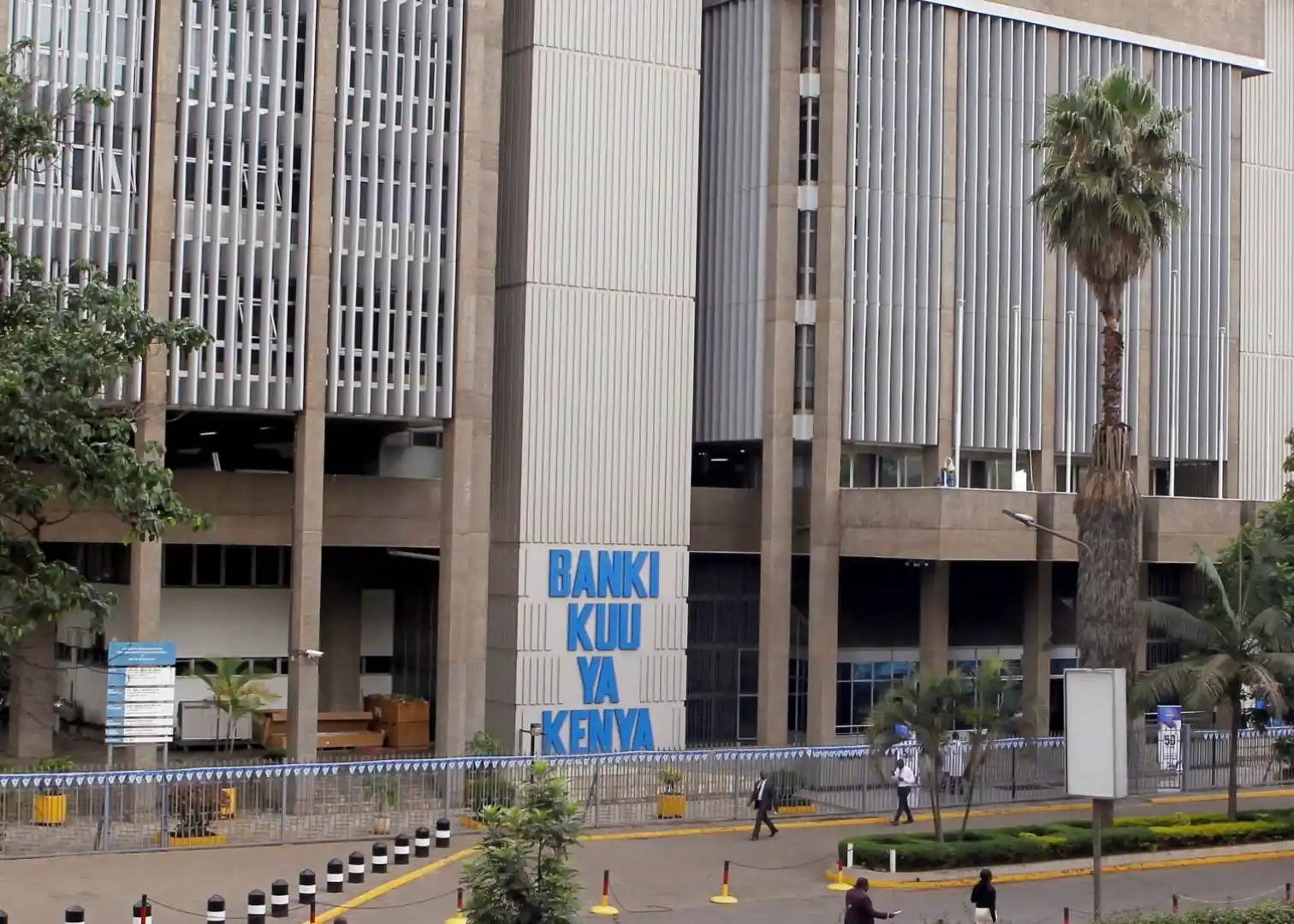
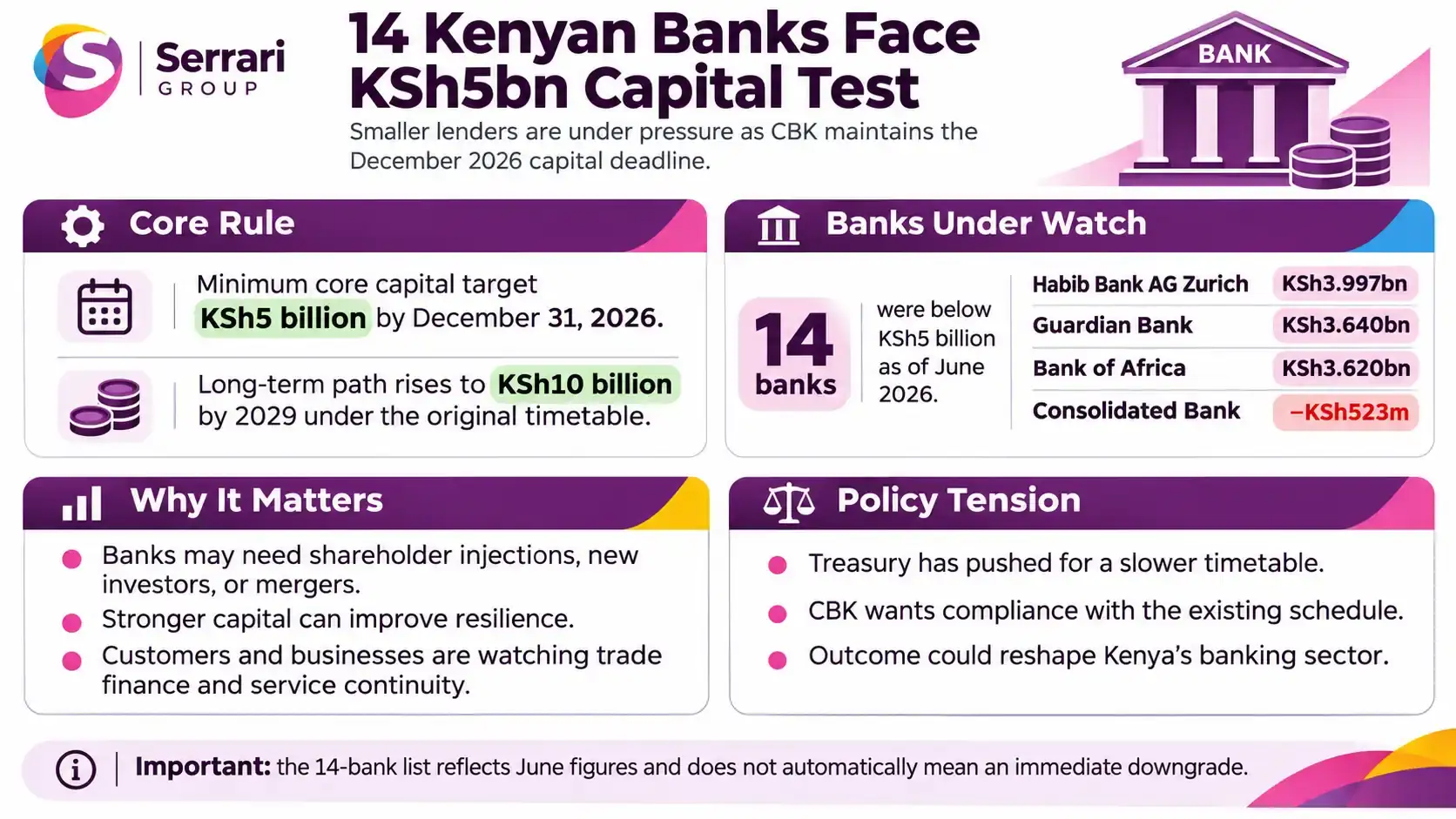
Fourteen Kenyan commercial banks reported core capital below KSh5 billion at the end of June 2026, putting them under scrutiny as the Central Bank of Kenya (CBK) presses lenders to demonstrate how they will meet the December 31 threshold. The dispute is complicated by Treasury Cabinet Secretary John Mbadi’s proposal to extend the final KSh10 billion target to 2032 and remove intermediate milestones, a position CBK Governor Kamau Thugge has challenged. At stake is more than the future classification of small banks: the outcome could determine whether Kenya strengthens financial resilience without choking credit to small businesses, reducing competition or encouraging rushed mergers. June figures are historical, and no automatic downgrade of all 14 institutions has been established.
Key Overview
- Fourteen banks identified: Their June 2026 core capital was below the KSh5 billion year-end threshold; that does not prove they are still below it today.
- Original legal schedule: KSh5 billion is due by December 31, 2026, with staged increases to KSh10 billion by December 2029 under the 2024 amendment.
- Treasury–CBK disagreement: Treasury has advocated a 2032 deadline without annual steps, while CBK has instructed banks to plan against the original milestones.
- Large funding differences: June positions ranged from KSh3.997 billion at Habib Bank AG Zurich to negative KSh523 million at Consolidated Bank.
- Customers are not automatically affected: Falling short of a future threshold does not itself mean a bank has lost its licence or that deposits are frozen.
- Potential consequences: Shareholder injections, retained earnings, acquisitions and tighter lending may follow, depending on each bank’s finances and supervisory decisions.
Why CBK Is Insisting on Higher Core Capital
The Business Laws (Amendment) Act, 2024 established a stepped increase in the minimum core capital for banks and mortgage finance companies. The schedule sets KSh1 billion for the end of 2024, KSh3 billion for 2025, KSh5 billion for 2026, KSh6 billion for 2027, KSh8 billion for 2028 and KSh10 billion for 2029.
Core capital is principally shareholders’ permanent capital and disclosed reserves after relevant deductions, including intangible assets. It differs from deposits collected from customers and from a bank’s total assets. Raising this buffer helps a lender absorb unexpected losses without immediately undermining its ability to meet obligations to depositors. It can also support prudent expansion of loans and other risk-bearing activities.
The change is particularly relevant because credit risk can persist even when the banking system is profitable overall. The regulator’s 2025 supervision findings recorded seven banks that failed to meet the KSh3 billion minimum at the end of that year, alongside other capital-adequacy breaches. Those findings do not mean the sector as a whole was insolvent; they show why an aggregate industry average can hide weaknesses at individual institutions.
At the same time, a larger fixed minimum is an imperfect measure of strength. A bank with KSh5 billion in core capital can still take excessive risks, while a smaller lender may operate a cautious, specialised business. Supervisors therefore also monitor capital relative to risk-weighted assets, liquidity, loan quality and governance. The KSh5 billion test is one part of that oversight, not a complete safety certificate.
Which 14 Banks Were Below KSh5 Billion in June?
The reported June 2026 bank-level figures identify the following positions. The capital shortfall is calculated against KSh5 billion; the negative figure for Consolidated Bank means its arithmetic gap exceeds KSh5 billion.
| Bank | June 2026 core capital | Gap to KSh5bn |
| Habib Bank AG Zurich | KSh3.997bn | KSh1.003bn |
| Guardian Bank | KSh3.640bn | KSh1.360bn |
| Bank of Africa | KSh3.620bn | KSh1.380bn |
| DIB Bank | KSh3.390bn | KSh1.610bn |
| Paramount Bank | KSh3.373bn | KSh1.627bn |
| M-Oriental Bank | KSh3.170bn | KSh1.830bn |
| UBA Kenya Bank | KSh3.123bn | KSh1.877bn |
| Middle East Bank | KSh3.079bn | KSh1.921bn |
| Premier Bank Kenya | KSh3.073bn | KSh1.927bn |
| African Banking Corporation | KSh2.700bn | KSh2.300bn |
| Development Bank of Kenya | KSh2.189bn | KSh2.811bn |
| Credit Bank | KSh1.281bn | KSh3.719bn |
| Access Bank Kenya | KSh0.893bn | KSh4.107bn |
| Consolidated Bank of Kenya | -KSh0.523bn | KSh5.523bn |
These figures are a June snapshot, not a verified register of banks still below the requirement on November 10. Shareholder injections, profits, losses or restructuring after June could change individual positions. They also do not establish that every named bank breached the KSh3 billion minimum at the end of 2025: that is a different threshold and assessment date.
The variation matters. Lenders just over KSh3 billion face a different capital-raising challenge from institutions whose core capital is below KSh2 billion or negative. A parent company might recapitalise a subsidiary relatively quickly, while a bank without a willing shareholder could need a new investor or an ownership restructuring. No single solution suits all 14.
Why Treasury and CBK Disagree Over the Deadline
In his June 2026 budget statement, Treasury Cabinet Secretary John Mbadi proposed moving the final KSh10 billion requirement to December 2032 and eliminating intervening milestones. The rationale was to give banks more time to raise capital without abruptly curtailing loans, especially to micro, small and medium-sized enterprises.
CBK has taken a more immediate supervisory position. In remarks reported in early November, Governor Kamau Thugge said banks below the KSh5 billion target had been directed to explain how they would meet it. Further reporting on talks with Treasury indicated that the two sides were seeking agreement over implementation and that formal amendment of the timetable remained contested.
This is not merely a disagreement about administrative convenience. Treasury is weighing the danger of forcing lenders to protect capital at the expense of new loans, while CBK is concerned that repeated deadline extensions could weaken the credibility of prudential standards. Public accounts of whether later legislation had fully superseded the original milestones conflict, so the prudent position is to distinguish the documented 2024 timetable from the unresolved 2026 implementation dispute rather than assume a definitive legal outcome.
Banks need certainty. An institution considering an equity issue, sale or merger must know both the required amount and the date on which compliance will be judged. Prolonged disagreement can make fundraising more expensive by introducing uncertainty into investor negotiations.
Context is everything. Stay ahead of shifting trends with today’s market updates, and uncover emerging opportunities using the Serrari Group Market Index and Marketplace. Then, take control of your own financial future by exploring our Money & Life Reset Transformation Blueprint ™ to build stronger habits, create better systems, and design a path toward lasting wealth.
Could Banks Be Downgraded to Microfinance Institutions?
A downgrade has been discussed as a possible supervisory consequence, but it should not be treated as an automatic event on January 1. Any restriction, restructuring, licensing change or enforcement measure would depend on the law, the bank’s circumstances and decisions made through applicable regulatory processes. A commercial banking licence does not automatically convert into a microfinance licence simply because a reported capital figure is below a future target.
The distinction is important for businesses that use bank-issued letters of credit, international payments and trade-finance facilities. A material change to an institution’s permitted activities could require affected customers to make alternative arrangements. But there is no basis to tell all customers of the 14 named institutions that those services have already been withdrawn or that they must immediately move their accounts.
For depositors, the appropriate response is to follow official bank and regulatory notices, not equate a historical capital shortfall with the failure of a bank. A bank’s financial condition depends on multiple indicators, and the regulator can require corrective action before deciding on severe measures.
Why Higher Capital Can Both Help and Hurt Lending
A stronger equity base generally increases a bank’s ability to withstand credit losses and support risk-weighted assets. That is valuable in an economy where households, traders and manufacturers depend on access to finance. Better-capitalised banks can also reassure counterparties that provide foreign-currency funding or trade facilities.
But the transition can produce short-term trade-offs. Owners may have to inject fresh equity, accept dilution or retain profits rather than distribute dividends. Banks can also try to slow growth in riskier loans to keep capital ratios manageable. The banking industry’s concerns reflect the possibility that fast implementation could leave smaller lenders with less capacity or appetite to serve borrowers.
This matters particularly for small businesses whose credit needs may not fit standardised products offered by the largest lenders. Consolidation could provide scale, stronger technology and additional funding, yet too much consolidation could reduce competition or eliminate specialist relationships. The policy challenge is to strengthen bank balance sheets without unnecessarily shrinking the range of institutions serving customers.
What Happens Next for the Banking Industry?
The latest financial stability assessment describes an industry that remains broadly resilient: sector-wide capital and liquidity buffers were strong even as some institutions faced individual compliance pressures. That context is essential. The 14-bank figure signals a targeted recapitalisation challenge rather than proof of an economy-wide banking crisis.
The next developments to watch are revised bank-level capital disclosures, formal decisions on the disputed schedule, written recapitalisation plans and any confirmed regulatory directions. Potential responses include rights issues, parent-company capital injections, retained earnings and mergers, but their feasibility will vary by bank.
Ultimately, the December debate is about how Kenya balances three public interests: safer banks, accessible credit and meaningful competition. Strict capital rules can reduce vulnerability to shocks, while a poorly managed transition could limit financing for businesses already struggling with costs. The outcome will be judged not only by how many banks reach KSh5 billion, but also by whether Kenya emerges with a more resilient banking system that can continue funding the real economy.
Sources: Kenya Law / Central Bank of Kenya / National Assembly of Kenya / Business Daily Africa / Bizna Kenya / Kenya Bankers Association
Your financial future isn’t something you wait for—it’s something you build.
The real question is: when do you begin?
Move beyond simply staying informed.
Navigate the markets with clarity—track trends through the Serrari Group Market Index, uncover opportunities in the Serrari Marketplace, and build practical knowledge with our Curated Wealth Builder Platform.
Stay connected to what truly matters.
Get daily insights on macro trends and financial movements across Kenya, Africa, and global markets—delivered through the Serrari Newsletter.
Growth opens doors.
Advance your career through professional programs including ACCA, HESI A2, ATI TEAS 7 , HESI EXIT , NCLEX – RN and NCLEX – PN, Financial Literacy!🌟—designed to move you forward with confidence.
See where money is flowing—clearly and in real time.
Track Money Market Funds, Treasury Bills, Treasury Bonds, Green Bonds, and Fixed Deposits, alongside global and African indexes, key economic indicators, and the evolving Crypto and stablecoin landscape—all within Serrari’s Market Index.