Kenya is targeting a 60% increase in conference tourism in 2027 as the government invests in convention facilities, airport infrastructure and tourism incentives to strengthen the country’s position as a leading African destination for international meetings and business events.
The Kenya Tourism Board (KTB) expects new convention facilities in Nairobi, Kisumu and Mombasa to increase the country’s capacity to host large international conferences, exhibitions and corporate gatherings. Planned expansion at Jomo Kenyatta International Airport (JKIA) is also intended to improve connectivity and accommodate growing passenger traffic.
The strategy reflects Kenya’s efforts to diversify tourism beyond traditional wildlife safaris and beach holidays by attracting business travellers who generate demand for hotels, transport, restaurants and professional services.
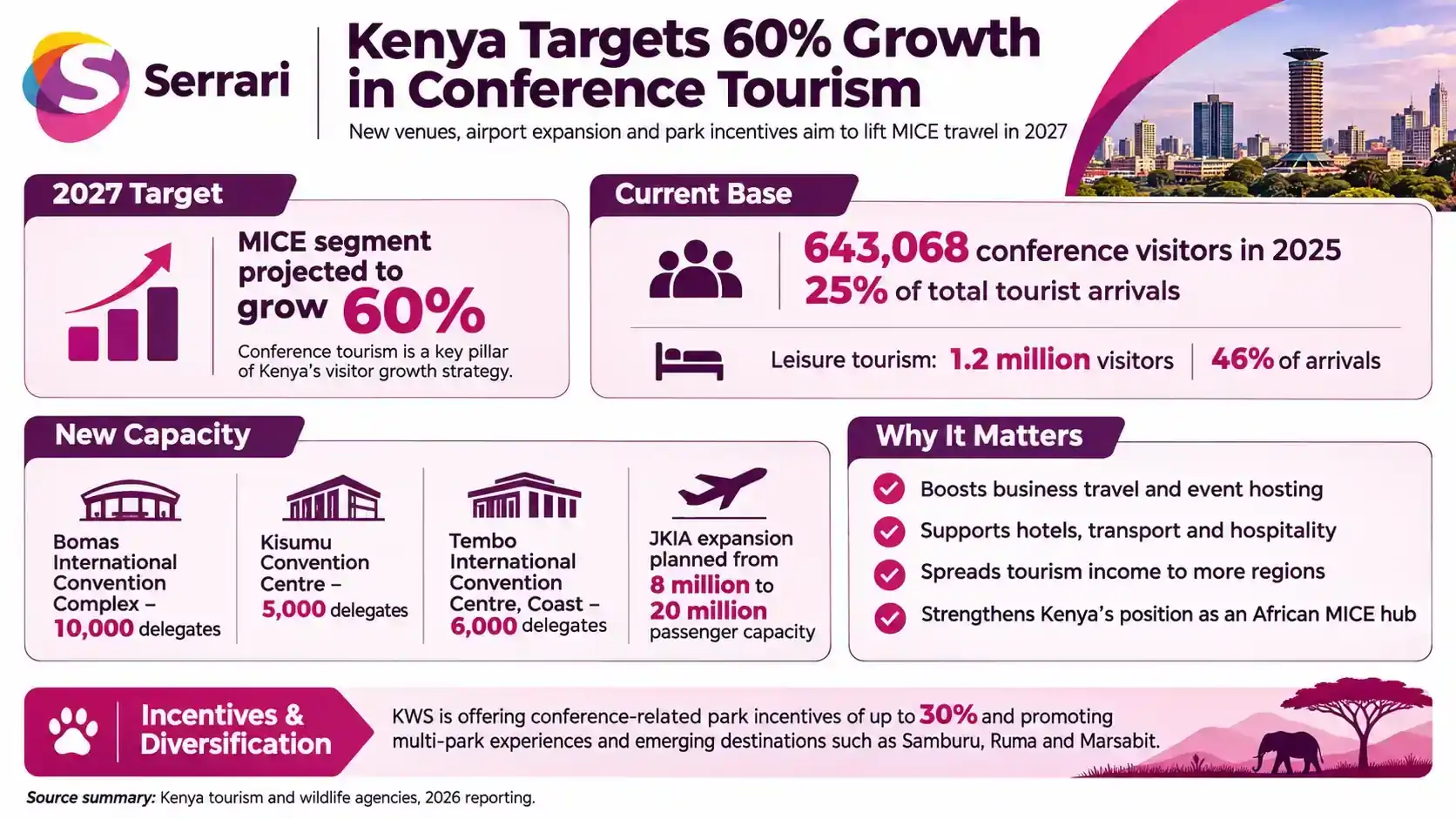
In 2025, conference tourism accounted for 643,068 international visitor arrivals, representing approximately 25% of the country’s total. However, achieving the ambitious growth target will depend on timely infrastructure delivery, competitive event pricing, reliable air connectivity and Kenya’s ability to attract international conference organisers.
Key Overview
- 60% growth target: Kenya aims to expand its Meetings, Incentives, Conferences and Exhibitions (MICE) tourism segment significantly in 2027.
- 643,068 conference visitors: Business and conference tourism accounted for approximately 25% of Kenya’s international arrivals in 2025.
- New convention infrastructure: Planned facilities include a 10,000-delegate complex at Bomas, a 5,000-capacity centre in Kisumu and a 6,000-capacity facility in Mombasa.
- JKIA expansion: The government plans to increase the airport’s annual passenger-handling capacity from approximately eight million to 20 million.
- National park incentives: Kenya Wildlife Service is offering eligible organised groups discounts of up to 30% on applicable park entry fees.
- Samburu tourism incentives: The county is promoting a 50% waiver on applicable park entry fees for selected visitor categories.
- Tourism diversification: The strategy promotes conference travel, wildlife experiences, cultural tourism, adventure activities and lesser-known destinations.
- Economic impact: Expanded business tourism could increase hospitality investment, create employment and distribute tourism earnings across more counties.
Why Kenya Is Targeting 60% Growth in Conference Tourism
Kenya is pursuing a major expansion of its conference tourism industry as competition intensifies among African destinations seeking to attract international business events.
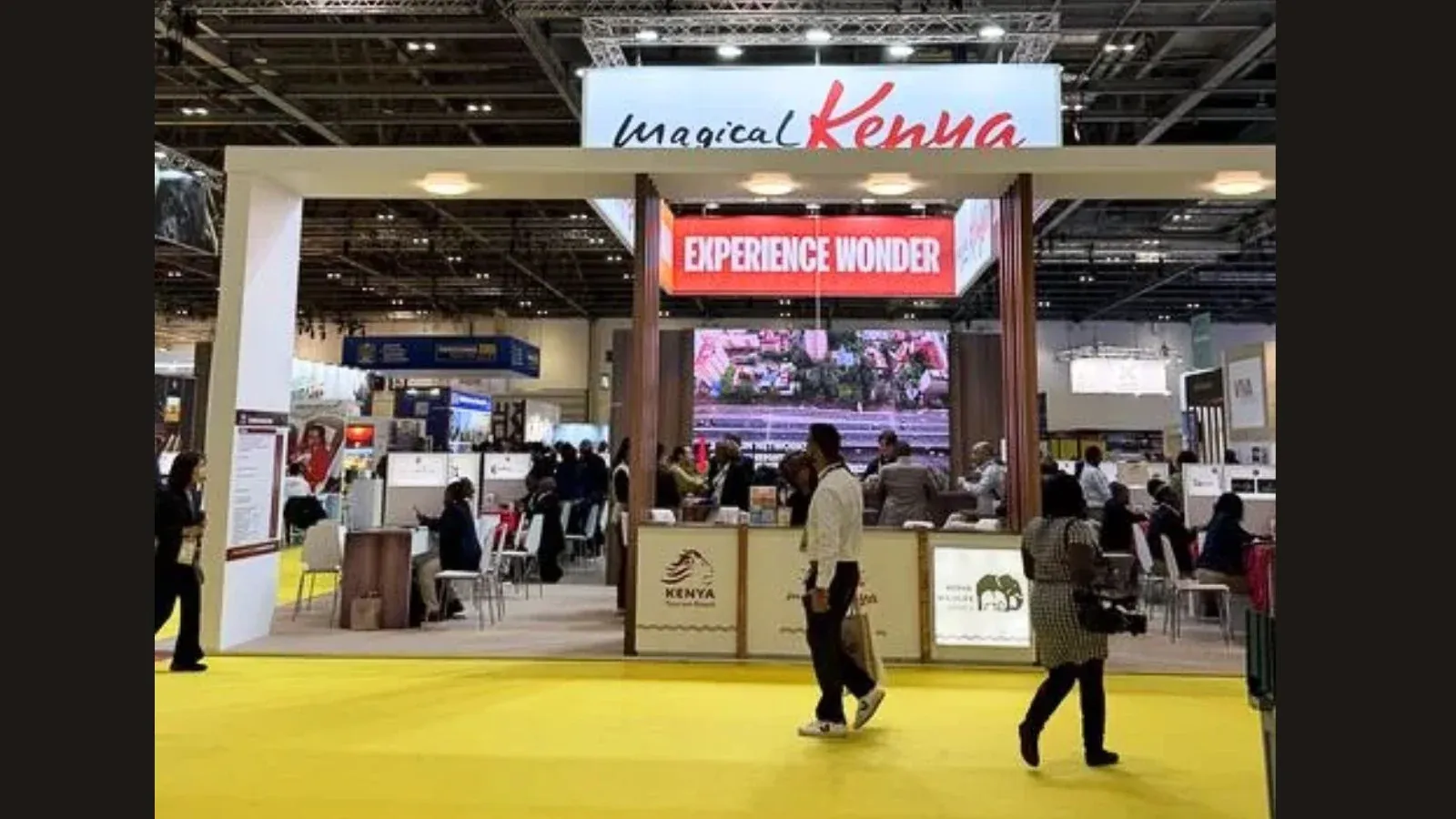
Speaking at the World Travel Market in London, KTB Chief Executive Officer June Chepkemei said the government expects investments in convention infrastructure and airport connectivity to support a 60% increase in the MICE segment in 2027.
According to the government’s tourism growth announcement, the planned facilities will allow Kenya to compete for larger conferences while expanding its capacity to accommodate delegates outside Nairobi.
The target reflects a broader effort to develop tourism products capable of generating more consistent demand throughout the year.
Traditional leisure tourism can be influenced by holiday seasons, weather conditions and international travel preferences.
Conference tourism offers an additional source of demand because business events are organised around professional, institutional and commercial schedules.
International conferences can attract delegates requiring accommodation, meeting facilities, airport transfers, catering and other services.
However, the benefits extend beyond the duration of the event.
Successful conferences can introduce international visitors to Kenya’s tourism attractions, encourage return travel and create opportunities for business partnerships.
The economic objective is therefore to position conference tourism as both a direct source of visitor spending and a platform for wider investment.
New Convention Centres Could Transform Kenya’s Event Capacity
The proposed expansion includes three major facilities intended to strengthen Kenya’s ability to host international gatherings.
The Bomas International Convention Complex in Nairobi is expected to accommodate up to 10,000 delegates, making it a potential venue for large conventions and exhibitions.
The proposed Kisumu Convention Centre would accommodate approximately 5,000 delegates, while the Tembo International Convention Centre at the Coast is expected to host around 6,000.
Together, the proposed facilities would provide capacity for approximately 21,000 delegates if all three operated simultaneously at their stated maximum capacities.
However, the figures represent planned capacities rather than facilities confirmed as completed and operational.
The announced convention-centre programme signals an intention to expand Kenya’s conference industry beyond its established facilities.
Nairobi already benefits from international air connections, accommodation infrastructure and the Kenyatta International Convention Centre.
Expanding capacity could allow the capital to bid for events requiring larger venues or additional exhibition space.
Kisumu and Mombasa offer opportunities to distribute business tourism activity more widely.
For Kisumu, a convention centre could generate demand for accommodation, transportation and hospitality services while strengthening its position as a regional commercial destination.
Mombasa could combine conference activity with beach tourism and coastal experiences, potentially encouraging delegates to extend their visits.
Nevertheless, constructing convention centres does not automatically guarantee increased visitor numbers.
The facilities must attract event organisers, maintain competitive operating costs and provide reliable services.
Their commercial performance will depend on occupancy, event bookings and the expenditure generated by visiting delegates.
Airport Expansion Is Central to the Tourism Strategy
International air connectivity is another major component of Kenya’s conference tourism ambitions.
The government plans to increase JKIA’s annual passenger-handling capacity from approximately eight million to 20 million.
The expansion is intended to support growing international passenger traffic while strengthening Nairobi’s position as an aviation hub.
For conference organisers, airport accessibility can influence destination selection.
Large international events require efficient flight connections, manageable arrival procedures and reliable transportation between airports, hotels and conference venues.
Insufficient airport capacity can create congestion, inconvenience travellers and reduce a destination’s competitiveness.
The planned expansion could therefore support Kenya’s ability to accommodate larger numbers of international visitors.
However, the proposed 20-million-passenger capacity is a future infrastructure objective, not the airport’s current operational capacity.
The effectiveness of the expansion will depend on implementation schedules, financing arrangements and improvements across the passenger travel experience.
Additional airport capacity must also be supported by sufficient airline connectivity and ground transportation.
Without these complementary improvements, larger terminals alone may not produce the expected increase in international business travel.
Conference Tourism Builds on Kenya’s Existing Visitor Market
Kenya’s conference tourism strategy builds on an already significant market.
In 2025, the country recorded 643,068 arrivals attributed to the conferencing segment, representing approximately one-quarter of international tourist arrivals.
Leisure travel accounted for approximately 1.2 million visitors, equivalent to about 46% of arrivals.
The figures illustrate why conference tourism is receiving greater attention from policymakers.
Business travel already represents a substantial component of Kenya’s tourism market, providing a foundation for further expansion.
If the 60% target were applied directly to the 2025 conference visitor figure, it would imply approximately 1.03 million conference-related arrivals.
However, this is an illustrative calculation rather than an official forecast, because the government has not established whether the 2027 target uses 2025 or 2026 as its baseline.
Kenya’s wider tourism sector has also experienced stronger international demand.
The 2025 tourism performance assessment records approximately 2.7 million international arrivals, compared with around 2.47 million in 2024.
The recovery provides a favourable environment for developing additional tourism products.
Nevertheless, conference tourism growth will depend on the country’s ability to convert its existing international visibility into confirmed business events and repeat bookings.
Context is everything. Stay ahead of shifting trends with today’s market updates, and uncover emerging opportunities using the Serrari Group Market Index and Marketplace. Then, take control of your own financial future by exploring our Money & Life Reset Transformation Blueprint ™ to build stronger habits, create better systems, and design a path toward lasting wealth.
National Parks Become Part of the Conference Tourism Offering
Kenya is also using its wildlife attractions to differentiate its conference tourism products.
The Kenya Wildlife Service (KWS) is encouraging corporate organisations, international institutions and event planners to hold meetings, retreats and other organised activities within protected areas.
The initiative combines traditional business events with nature-based experiences.
According to the official conference group packages, eligible groups receive discounts on applicable park entry fees based on the number of participants.
Groups of 10–29 participants qualify for a 5% discount, groups of 30–49 receive 10%, groups of 50–99 receive 20%, and groups of at least 100 qualify for 30%.
These incentives could make wildlife destinations more attractive for corporate retreats, team-building activities and specialised conferences.
The approach also creates opportunities for accommodation providers, transport businesses and tourism operators serving protected areas.
However, discounts represent a reduction in applicable entry fees rather than a guarantee of lower overall conference costs.
Organisers must still consider accommodation, transport, meeting facilities and other expenses.
The government is also promoting multi-park tourism packages incorporating destinations such as Amboseli, Tsavo East and Tsavo West.
This could encourage visitors attending conferences to extend their trips and spend more on leisure activities.
Tourism Investment Expands Beyond Established Safari Circuits
A major objective of Kenya’s tourism strategy is to spread economic activity beyond destinations that already attract substantial visitor traffic.
KWS is encouraging investment in accommodation facilities, camps, lodges and visitor amenities in lesser-visited national parks and reserves.
Targeted destinations include Meru, Mount Longonot, Marsabit, Sibiloi, Aberdare, Mwea, Saiwa Swamp, Ruma, Ndere Island and Mount Elgon.
The strategy seeks to address the geographical concentration of tourism revenue.
Established destinations benefit from stronger international recognition and more developed hospitality infrastructure, while smaller attractions may struggle to attract investment and visitors.
Developing alternative destinations could create opportunities for local employment, tourism businesses and supporting services.
KWS is also working with WildEarth through the Safari Kenya Live initiative to showcase wildlife destinations to international audiences.
Digital promotion may help introduce lesser-known attractions to potential visitors before they make travel decisions.
However, investment in emerging destinations must be accompanied by reliable infrastructure and environmental safeguards.
New accommodation facilities and increased visitor traffic can create economic opportunities, but poorly managed development could place pressure on sensitive ecosystems.
Long-term tourism growth therefore requires balancing commercial development with wildlife conservation and community participation.
Samburu Uses Incentives to Attract Visitors and Investors
Samburu County is pursuing a related strategy aimed at increasing visitor numbers and attracting tourism investment to Northern Kenya.
County Tourism Executive Raphael Lenayiarra said the county is offering targeted incentives to filmmakers, travel agents, tour operators and organised visitor groups.
The measures include a 50% waiver on applicable park entry fees for selected categories visiting Samburu National Reserve.
The incentive is intended to improve the destination’s competitiveness while raising its visibility among domestic and international travellers.
Improved road connectivity is also supporting access to Northern Kenya.
The Great North Road linking Kenya and Ethiopia has strengthened transport connections through the region, creating opportunities for tourism operators and supporting businesses.
Better accessibility can reduce travel difficulties and encourage visitors to consider destinations beyond traditional safari routes.
Nevertheless, attracting investment requires more than reduced park fees.
Investors also assess visitor demand, infrastructure quality, operational costs and the availability of reliable utilities.
The effectiveness of Samburu’s incentives will therefore depend on whether they generate sustained bookings and encourage viable hospitality investment.
What Conference Tourism Growth Could Mean for Kenya’s Economy
Expanding conference tourism could provide benefits across several sectors of the Kenyan economy.
Hotels may experience increased demand for rooms and meeting facilities, while restaurants, transport operators and event-management companies could benefit from additional business.
International exhibitions may also generate demand for local suppliers, exhibition contractors, technology services and professional support.
For county economies, distributing conferences beyond Nairobi could help increase spending in regional hospitality markets.
The potential benefits extend to employment, particularly in accommodation, catering, transport and event operations.
However, increased visitor numbers do not automatically translate into proportional increases in tourism earnings.
The economic return depends on visitor expenditure, length of stay, local procurement and the costs of delivering events.
Large public investments in convention facilities must therefore be evaluated against realistic demand projections.
A facility that hosts limited events may struggle to generate sufficient revenue to justify construction and maintenance costs.
Kenya must also compete with other African destinations offering modern conference venues, international air connections and established business tourism services.
Maintaining competitiveness will require coordinated marketing, reliable infrastructure and commercially attractive event packages.
The Bigger Picture: Kenya Seeks a More Diversified Tourism Economy
Kenya’s 2027 conference tourism target reflects a wider shift toward diversifying the country’s visitor economy.
Wildlife safaris and coastal tourism remain important attractions, but relying heavily on traditional leisure travel can expose the industry to seasonal demand and changes in international travel patterns.
Business tourism provides an opportunity to broaden the market while connecting visitor spending with investment and professional activities.
The expansion also reflects growing competition among African destinations seeking to attract international conferences, exhibitions and corporate events.
Kenya’s advantage lies in combining business infrastructure, international connectivity and distinctive leisure attractions.
The challenge is turning those strengths into confirmed event bookings and sustainable commercial activity.
The planned convention centres, airport expansion and wildlife incentives represent complementary elements of that strategy.
However, delivery schedules and infrastructure costs will influence how quickly the expected benefits materialise.
Conclusion
Kenya’s target of 60% growth in conference tourism in 2027 represents an ambitious effort to strengthen the country’s position in the international meetings and events industry.
The planned convention facilities in Nairobi, Kisumu and Mombasa could increase event-hosting capacity, while airport expansion and improved transport connectivity are intended to support international visitor growth.
Wildlife tourism incentives and investment in emerging destinations could further diversify the sector and distribute economic opportunities across more counties.
However, achieving the target will require more than constructing venues and introducing discounts.
Kenya must secure international event bookings, maintain competitive operating costs, complete planned infrastructure and ensure that increased tourism activity benefits local businesses.
The success of the strategy will ultimately be measured not only by conference visitor numbers, but by the tourism earnings, employment opportunities and private investment generated across the economy.
If implemented effectively, the expansion could strengthen Kenya’s position as a regional business tourism hub while reducing its dependence on traditional leisure travel.
Sources: Kenya News Agency / Kenya Tourism Board / Kenya Wildlife Service / Ministry of Tourism and Wildlife / The Standard / Kenya Association of Travel Agents / The Star / Citizen Digital
Your financial future isn’t something you wait for—it’s something you build.
The real question is: when do you begin?
Move beyond simply staying informed.
Navigate the markets with clarity—track trends through the Serrari Group Market Index, uncover opportunities in the Serrari Marketplace, and build practical knowledge with our Curated Wealth Builder Platform.
Stay connected to what truly matters.
Get daily insights on macro trends and financial movements across Kenya, Africa, and global markets—delivered through the Serrari Newsletter.
Growth opens doors.
Advance your career through professional programs including ACCA, HESI A2, ATI TEAS 7 , HESI EXIT , NCLEX – RN and NCLEX – PN, Financial Literacy!🌟—designed to move you forward with confidence.
See where money is flowing—clearly and in real time.
Track Money Market Funds, Treasury Bills, Treasury Bonds, Green Bonds, and Fixed Deposits, alongside global and African indexes, key economic indicators, and the evolving Crypto and stablecoin landscape—all within Serrari’s Market Index.