Saudi Arabia has reported more than $145 billion in cumulative humanitarian and development assistance to 175 countries, reinforcing its position as a major international financing partner at a time when traditional donor governments are reducing foreign aid budgets.
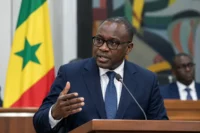
The announcement was made by Dr Abdullah Al Rabeeah, adviser to the Saudi Royal Court and supervisor general of the King Salman Humanitarian Aid and Relief Centre (KSrelief), during a World Economic Forum discussion in Brussels on November 6, 2026.
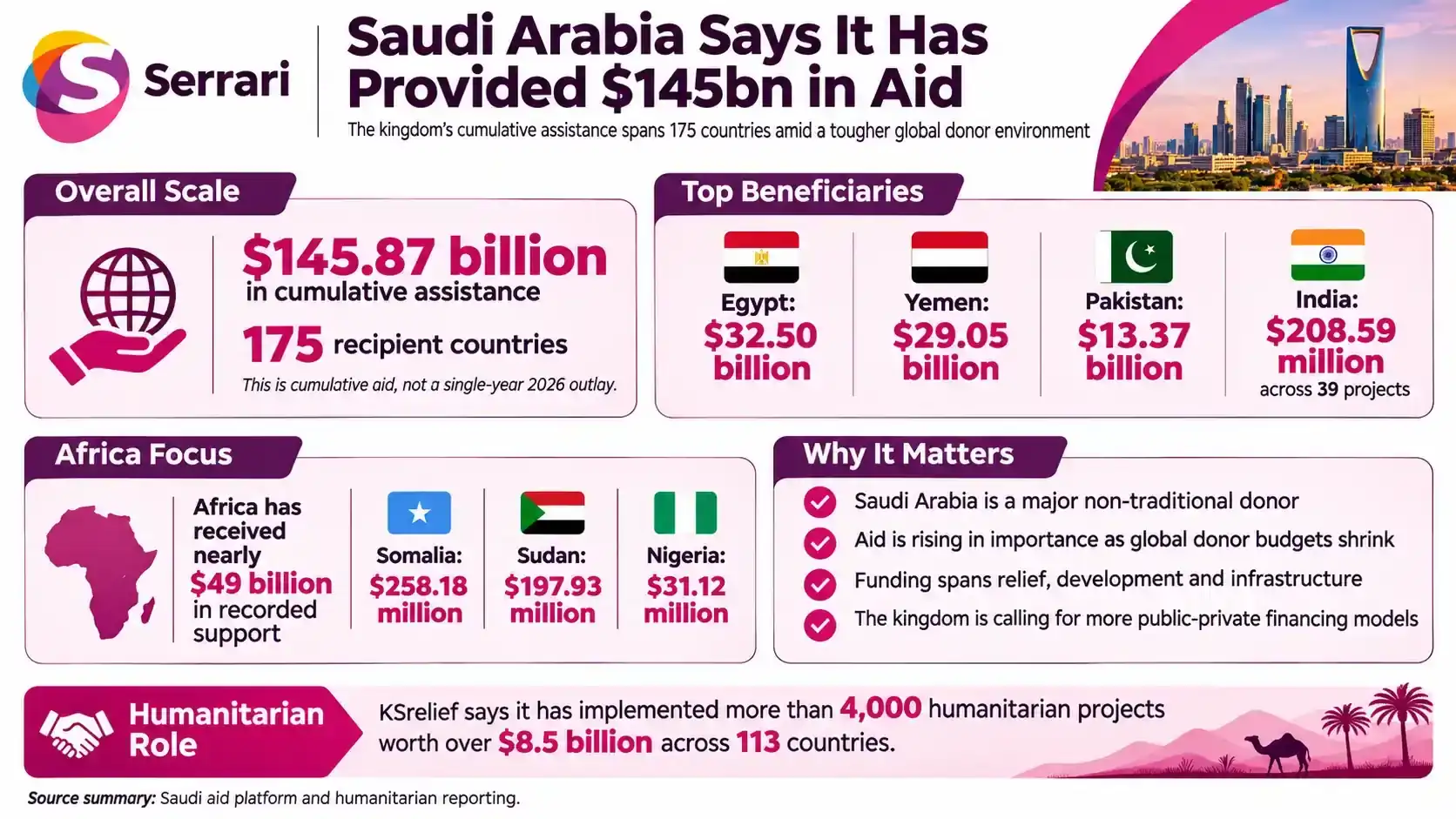
According to Saudi Arabia’s official assistance records, total documented support stands at approximately $145.87 billion, with Egypt, Yemen and Pakistan accounting for the largest recorded allocations. African countries have received nearly $49 billion through recorded development and humanitarian projects, although Egypt accounts for most of that regional amount.
The announcement comes as global development financing faces mounting pressure. Traditional donor assistance is projected to decline by another 6.9% in 2026, intensifying concerns about funding for humanitarian relief, healthcare and economic recovery in vulnerable countries.
However, Saudi Arabia’s expanding international assistance also raises important questions about the sustainability of donor financing, the relationship between aid and geopolitical influence, and whether emergency assistance can support lasting economic development.
Key Overview
- $145.87 billion in cumulative assistance: Saudi Arabia’s official records document humanitarian, development and other support provided to 175 countries, rather than expenditure in 2026 alone.
- Largest beneficiaries: Egypt leads with approximately $32.50 billion, followed by Yemen at $29.05 billion and Pakistan at $13.37 billion.
- Africa receives nearly $49 billion: The continent has attracted approximately $48.97 billion in recorded Saudi humanitarian and development projects, heavily concentrated in Egypt.
- KSrelief operations: The humanitarian centre has implemented more than 4,000 projects worth over $8.5 billion across 113 countries.
- India receives $208.59 million: Recorded assistance spans 39 projects, primarily in energy, transportation and education.
- Humanitarian support across Africa: Somalia, Sudan, Chad, Nigeria, Niger and Burkina Faso are among countries benefiting from Saudi-supported programmes.
- Global aid financing contracts: Traditional donor assistance is projected to decline by 6.9% in 2026, following substantial reductions in 2024 and 2025.
- New financing approach: Saudi officials are advocating public-private partnerships, blended finance and locally led development to reduce long-term dependence on humanitarian grants.
Why Saudi Arabia Has Provided More Than $145 Billion in Global Aid
Saudi Arabia’s international assistance has reached approximately $145.87 billion across 175 beneficiary countries, reflecting decades of humanitarian engagement, development financing and support for countries facing conflict, economic instability and natural disasters.
The figures were highlighted during a November 6 international development discussion, where Dr Abdullah Al Rabeeah outlined the scale of Saudi assistance and called for a different approach to financing recovery in fragile economies.
The announcement is significant because it comes during a period of shrinking international aid budgets and growing humanitarian needs.
Saudi Arabia’s official assistance records show that the cumulative total includes humanitarian and development projects, contributions to international institutions and services provided to refugees and other displaced populations hosted within the kingdom.
These categories are important because the headline figure does not represent a single annual aid budget or exclusively direct financial transfers to foreign governments.
The total reflects different forms of assistance documented over multiple years, making it unsuitable for direct comparison with annual official development assistance reported by individual donor countries.
Saudi Arabia’s involvement in international assistance serves several objectives.
Humanitarian programmes provide emergency relief and essential services to populations affected by conflict, food insecurity and displacement.
Development financing supports infrastructure, education and economic activities that can strengthen long-term economic capacity.
At the same time, assistance can reinforce diplomatic relationships and economic cooperation with countries of strategic importance to Riyadh.
The scale of the programme demonstrates how development financing has become an increasingly important component of Saudi Arabia’s international engagement.
Egypt, Yemen and Pakistan Dominate Saudi Aid Allocations
A significant proportion of Saudi Arabia’s recorded assistance has been directed toward a small group of countries with longstanding political, economic and security relationships with Riyadh.
Egypt is the largest recipient, with approximately $32.50 billion in documented support.
Yemen follows with $29.05 billion, while Pakistan has received about $13.37 billion.
Together, the three countries account for approximately $74.92 billion, representing just over half of Saudi Arabia’s recorded global assistance.
The concentration highlights how international aid allocations reflect different combinations of humanitarian needs, development priorities and bilateral relationships.
Egypt’s position is particularly notable.
The country is a major Arab economy with close economic and political ties to Saudi Arabia. Financial assistance has historically formed part of broader Gulf support for Egypt’s economic stability and development.
Such support can help recipient governments manage financing pressures, although its long-term effectiveness depends on how resources are used and whether domestic economic conditions improve.
Yemen presents a substantially different situation.
Years of conflict have damaged public infrastructure, disrupted livelihoods and created extensive humanitarian needs.
Saudi Arabia has supported relief programmes while also remaining a major political and military actor in Yemen’s conflict, including through its intervention against the Houthi movement beginning in 2015.
This dual role makes the relationship between humanitarian assistance, conflict dynamics and regional security particularly complex.
The $29.05 billion recorded for Yemen also includes categories beyond conventional project funding. The country-level breakdown distinguishes humanitarian and development projects from other forms of assistance, including services provided to displaced Yemeni populations.
Pakistan’s position reflects another longstanding partnership covering financial cooperation, labour migration, investment and security relationships.
In September 2025, Saudi Arabia and Pakistan signed a strategic mutual defence agreement, reinforcing an already established bilateral relationship.
However, the cumulative aid figures should not be interpreted as evidence that assistance was provided solely because of that agreement.
Africa Receives Nearly $49 Billion, but Funding Is Uneven
African countries have received approximately $48.97 billion in recorded Saudi humanitarian and development projects, according to the regional project statistics.
The figure demonstrates Saudi Arabia’s substantial financing presence on the continent, particularly in North Africa.
However, the distribution is highly concentrated.
Egypt’s $32.50 billion accounts for roughly two-thirds of the recorded African project total, leaving a considerably smaller amount distributed among other African countries.
This distinction matters because a continent-wide financing figure can conceal substantial differences in country-level allocations.
Saudi Arabia has also supported humanitarian activities in countries affected by armed conflict, displacement and economic insecurity.
Recorded KSrelief projects include approximately $258.18 million for Somalia and $197.93 million for Sudan, alongside smaller allocations to Chad, Nigeria, Niger and Burkina Faso.
The reported allocations include $35.91 million for Chad, $31.12 million for Nigeria, $24.79 million for Niger and $20.44 million for Burkina Faso.
These figures relate to humanitarian projects administered through the centre and should not be confused with the total Saudi assistance received by each country through all government institutions.
The distinction is important when assessing Saudi Arabia’s development footprint.
Humanitarian projects generally respond to immediate needs such as food insecurity, healthcare shortages, displacement and emergency shelter.
Broader financial assistance may involve infrastructure financing, development programmes or contributions administered through other channels.
For African governments, the opportunity is to connect emergency assistance with programmes that strengthen domestic economic capacity and reduce repeated dependence on external support.
India Highlights Saudi Arabia’s Broader Development Role
Saudi assistance also extends to economies that are not generally associated with large-scale dependence on humanitarian financing.
India has received approximately $208.59 million across 39 recorded projects, according to the country-specific assistance breakdown.
The largest allocations include approximately $118.46 million for energy, $48.52 million for transportation and storage, and $40.29 million for education.
These projects illustrate how Saudi assistance can support development infrastructure rather than exclusively addressing humanitarian emergencies.
The emphasis on energy and transport is economically significant because investment in these sectors can improve productivity and support commercial activity.
Reliable energy infrastructure can reduce operational disruptions for businesses, while better transport connectivity can lower logistics costs and improve access to markets.
Education investment can also strengthen human capital, although its eventual impact depends on programme quality, accessibility and employment opportunities.
India’s inclusion among Saudi assistance beneficiaries underscores the diversity of the kingdom’s international financing activities.
It also highlights why assessing aid effectiveness requires examining individual sectors and projects rather than relying solely on national allocation totals.
Context is everything. Stay ahead of shifting trends with today’s market updates, and uncover emerging opportunities using the Serrari Group Market Index and Marketplace. Then, take control of your own financial future by exploring our Money & Life Reset Transformation Blueprint ™ to build stronger habits, create better systems, and design a path toward lasting wealth.
Why Saudi Arabia Is Calling for a New Development Financing Model
During the Brussels discussion, Al Rabeeah argued that humanitarian grants alone cannot provide sustainable solutions to the challenges facing fragile and economically vulnerable countries.
His remarks centred on the need to move beyond repeated emergency assistance toward financing arrangements capable of supporting long-term economic recovery.
The proposed financing approach emphasises public investment, private-sector participation, blended finance and locally led programmes.
Blended finance combines development-oriented capital with commercial financing, using instruments such as guarantees, concessional loans or risk-sharing arrangements to make investments more attractive.
The rationale is that public and philanthropic resources alone may be insufficient to meet the enormous financing requirements facing developing economies.
Private investment can potentially expand the resources available for productive businesses, infrastructure and economic development.
However, commercially motivated capital is not a direct substitute for humanitarian grants.
Emergency food assistance, protection services and healthcare programmes often operate in environments where beneficiaries cannot pay enough to generate commercial returns.
Private investors may also avoid countries experiencing active conflict, severe political instability or uncertain legal enforcement.
Blended finance must therefore be designed carefully to avoid shifting excessive financial risks onto already vulnerable governments.
The effectiveness of such arrangements depends on whether they mobilise genuinely additional investment while protecting public resources and delivering measurable development outcomes.
Saudi Arabia’s Announcement Comes as Global Aid Budgets Shrink
The timing of Saudi Arabia’s announcement is particularly important because international development assistance is undergoing a substantial contraction.
According to the June 2026 development financing projections, net official development assistance from traditional donor countries is expected to fall by 6.9% in 2026.
The projected decline follows reductions of 8.5% in 2024 and 23.3% in 2025, marking a third consecutive year of contraction.
The reduction reflects fiscal pressures, changing political priorities, geopolitical tensions and increased domestic spending demands in major donor economies.
The consequences are expected to be especially severe for countries with limited domestic resources and high dependence on development assistance.
Bilateral assistance to sub-Saharan Africa is projected to fall by 11.6% in 2026, while support for least-developed countries is expected to decline by 10.9%.
Healthcare and humanitarian programmes face particularly significant funding pressures.
The projections suggest that humanitarian assistance could fall by approximately 40.3% between 2024 and 2026.
This creates a difficult environment for governments and development organisations seeking to maintain essential services.
Saudi Arabia’s cumulative assistance figure does not mean it has committed an equivalent amount of new funding to compensate for these reductions.
Nevertheless, its international financing activities illustrate the growing importance of donor countries outside the traditional Western development assistance system.
The broader challenge is whether alternative financing sources can help reduce emerging gaps without increasing debt burdens or creating new forms of financial dependency.
What the Aid Shift Means for Vulnerable African Economies
For African countries facing declining assistance, the changing donor environment presents immediate risks to public services and development programmes.
Humanitarian funding supports food distribution, healthcare, emergency shelter and protection services in areas affected by conflict and displacement.
Development assistance also contributes to education, infrastructure and institutional capacity.
When funding declines, governments and implementing organisations may be forced to reduce programme coverage, delay projects or redirect limited resources away from longer-term development priorities.
Countries already experiencing fiscal stress have limited capacity to replace large external financing losses through domestic taxation or additional borrowing.
This is particularly important in fragile economies where economic activity has been disrupted and public revenue collection remains weak.
Saudi support can help address selected humanitarian and development needs, but the scale and distribution of assistance must be evaluated against each country’s financing requirements.
A relatively small humanitarian allocation may provide meaningful relief to targeted communities without materially changing a government’s wider fiscal position.
Likewise, a large development financing commitment may improve infrastructure but create limited immediate benefits for displaced populations requiring emergency services.
Effective development cooperation therefore requires a balance between immediate humanitarian relief and investment in longer-term economic resilience.
For recipient governments, financing diversification may offer some protection against reductions by individual donors.
However, diversification must be accompanied by stronger public financial management, transparency and realistic assessments of debt sustainability.
The Bigger Picture: Development Finance and Diplomatic Influence
Saudi Arabia’s international assistance also reflects a wider shift in the global development financing landscape.
Countries outside the traditional donor group have become increasingly important sources of infrastructure investment, humanitarian funding and bilateral financial support.
China, Gulf economies and regional development institutions are among the actors influencing how emerging economies finance development priorities.
For Saudi Arabia, assistance strengthens relationships with countries across the Middle East, Africa and Asia while supporting its wider international engagement.
However, humanitarian objectives and diplomatic interests should not automatically be treated as interchangeable.
Some assistance responds directly to urgent human needs, while other financing may be connected to longer-term development partnerships or strategic relationships.
Understanding the difference requires examining the terms, beneficiaries and implementation arrangements associated with individual projects.
The kingdom’s official assistance platform provides a substantial record of its activities, but the database itself describes the figures as preliminary and subject to revision.
Its totals should therefore be understood as documented Saudi assistance rather than a complete independent assessment of development effectiveness.
The ultimate measure of success is not simply how much financing is recorded.
It is whether assistance improves living conditions, strengthens essential services, supports economic recovery and reduces vulnerability to future crises.
Conclusion
Saudi Arabia’s reported $145.87 billion in cumulative assistance to 175 countries highlights its significant role in international humanitarian relief and development financing.
The concentration of funding in Egypt, Yemen and Pakistan reflects the diverse economic, humanitarian and strategic relationships shaping the kingdom’s international engagement.
For Africa, the nearly $49 billion in recorded project assistance represents substantial financial involvement, although the concentration in Egypt demonstrates the importance of looking beyond regional totals to assess country-level benefits.
The announcement arrives at a critical moment as traditional donor assistance contracts and vulnerable economies face increasing pressure to maintain essential services.
Saudi Arabia’s call for greater private-sector participation and locally led development reflects recognition that emergency grants alone cannot provide lasting economic resilience.
However, private investment cannot replace humanitarian assistance in environments where commercial returns are limited and immediate human needs remain severe.
The challenge for Saudi Arabia, recipient governments and development partners will be ensuring that financing supports both urgent relief and sustainable recovery.
Ultimately, the significance of Saudi Arabia’s global assistance will depend less on the cumulative value reported than on whether the resources help vulnerable countries reduce humanitarian needs, strengthen economic capacity and achieve greater financial independence.
Sources: Saudi Aid Platform / Saudi Press Agency / Saudi Gazette / Arab News / Business Insider Africa / King Salman Humanitarian Aid and Relief Centre / OECD
Your financial future isn’t something you wait for—it’s something you build.
The real question is: when do you begin?
Move beyond simply staying informed.
Navigate the markets with clarity—track trends through the Serrari Group Market Index, uncover opportunities in the Serrari Marketplace, and build practical knowledge with our Curated Wealth Builder Platform.
Stay connected to what truly matters.
Get daily insights on macro trends and financial movements across Kenya, Africa, and global markets—delivered through the Serrari Newsletter.
Growth opens doors.
Advance your career through professional programs including ACCA, HESI A2, ATI TEAS 7 , HESI EXIT , NCLEX – RN and NCLEX – PN, Financial Literacy!🌟—designed to move you forward with confidence.
See where money is flowing—clearly and in real time.
Track Money Market Funds, Treasury Bills, Treasury Bonds, Green Bonds, and Fixed Deposits, alongside global and African indexes, key economic indicators, and the evolving Crypto and stablecoin landscape—all within Serrari’s Market Index.