Abu Dhabi’s real estate market recorded transactions worth AED171.26 billion ($46.63 billion) in the first nine months of 2026, a 76.1% increase year-on-year. Foreign investment in designated investment zones rose 131% to AED86.11 billion, accounting for 81% of investment value in those areas. The growth comes amid geopolitical uncertainty in the Middle East, highlighting the emirate’s continued appeal to international investors. Strong sales, mortgage activity and regulatory developments are supporting the market, although the delivery of new developments will be an important test of its sustainability.
Key Takeaways
- Abu Dhabi recorded AED171.26 billion ($46.63 billion) in real estate transactions between January and September 2026.
- Transaction numbers increased 32.8% to 38,483.
- Foreign investment in designated investment zones climbed 131% to AED86.11 billion.
- Non-resident individual property investment reached AED17.22 billion, already more than double the full-year 2025 figure.
- Al Reem Island recorded the highest transaction value among the emirate’s districts.
- Greater transparency, new development projects and broker licensing reforms are supporting the market’s expansion.
Why Is Abu Dhabi’s Property Market Growing Despite Regional Uncertainty?
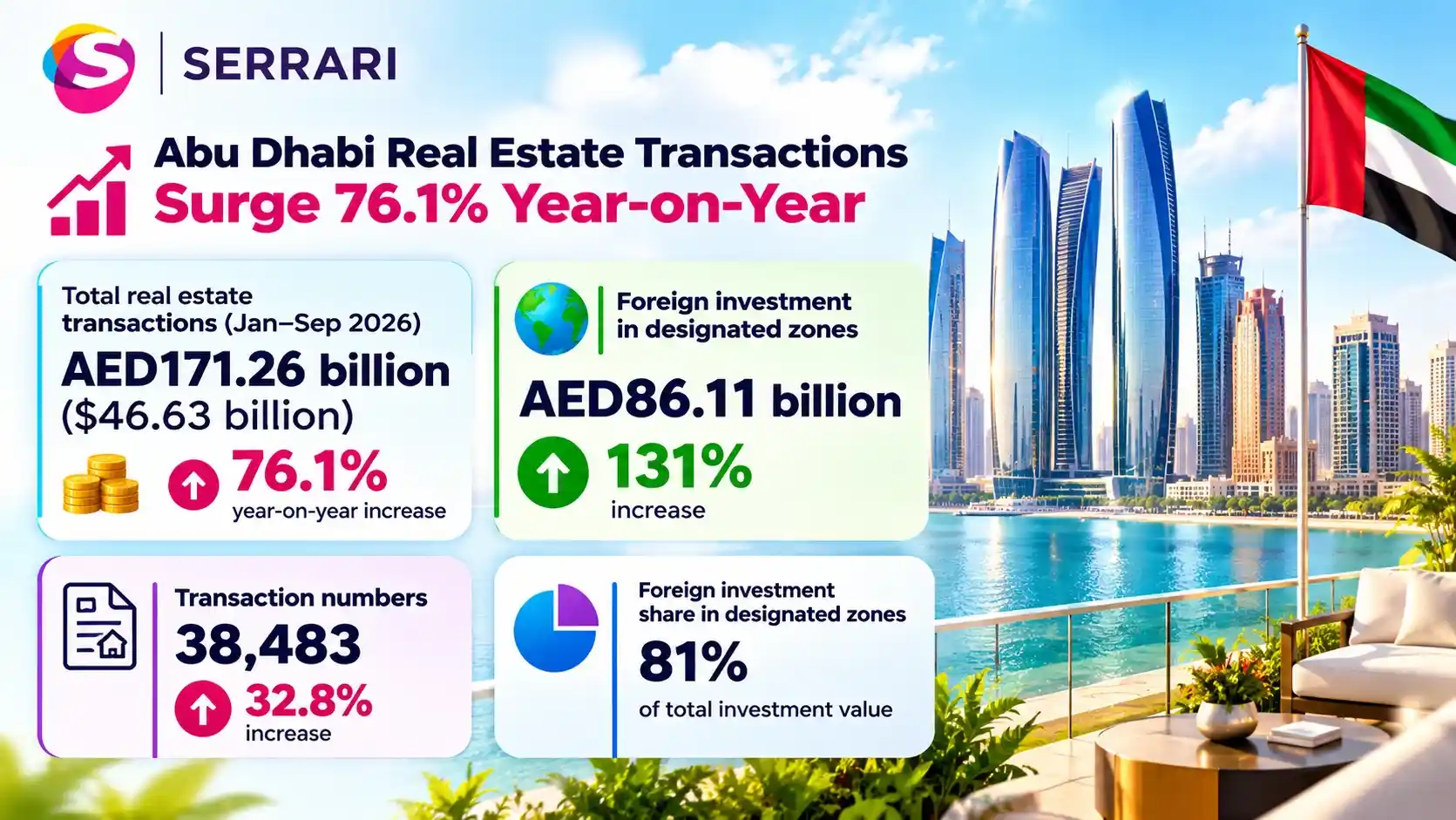
Abu Dhabi’s real estate transactions surged 76.1% year-on-year to AED171.26 billion ($46.63 billion) in the first nine months of 2026, as stronger property sales and foreign investment fuelled growth.
The number of transactions rose 32.8% to 38,483, compared with 28,977 during the same period in 2025.
The growth is particularly notable because it comes amid heightened geopolitical uncertainty across the Middle East, including the US-Israeli war against Iran that began on February 28.
Despite the regional conflict, foreign capital continues to flow into Abu Dhabi’s property market. Investors from 121 nationalities participated, with the UK, China, Russia, the US, France and Germany among the leading sources of investment.
This suggests that international buyers continue to see opportunities in the emirate despite wider regional risks.
The appeal is not simply about purchasing property. Investors are also assessing the potential for long-term returns, the regulatory environment, development opportunities and the stability of the market in which they commit their capital.
Rashed Al Omaira, Director General of the Abu Dhabi Real Estate Centre (ADREC), said:
“The scale of investment shows how many people and businesses are making a long-term commitment to Abu Dhabi. That commitment extends well beyond the transaction itself.”
What Is Driving Foreign Investment Into Abu Dhabi?
Foreign investment in Abu Dhabi’s designated investment zones climbed 131% to AED86.11 billion, accounting for 81% of total investment value in those areas.
These zones allow non-national buyers to own property, making them important destinations for international real estate investment.
Foreign direct investment by non-resident individuals reached 17.22 billion dirhams in the first nine months of 2026. This was already more than double the 8.2 billion dirhams recorded for the whole of 2025.
The figures point to growing international participation in the emirate’s property market.
Several factors help explain why foreign investors are paying attention to Abu Dhabi. Its designated investment zones provide access to property ownership, while the expansion of residential and commercial developments creates opportunities for different types of buyers.
The regulatory environment is also developing. Abu Dhabi climbed eight places in JLL’s 2026 Global Real Estate Transparency Index, moving from 41st in 2024 to 33rd globally. It also moved from the semi-transparent to the transparent category, ranking second in the Middle East and North Africa region.
Improved transparency matters because investors need confidence in property transactions, market information, professional standards and the rules governing ownership.
However, strong investment figures do not automatically guarantee future returns. Property performance will still depend on prices, rental demand, supply and the successful completion of developments.
Which Areas Are Attracting the Most Property Investment?
Property sales accounted for the largest share of Abu Dhabi’s real estate activity, with 23,749 deals worth 119.33 billion dirhams.
Sales value more than doubled from 58.20 billion dirhams in the first nine months of 2025, while transaction volume increased 49.2%.
The strongest activity was concentrated in several districts.
- Al Reem Island: AED29.86 billion in transactions.
- Al Hudayriyat Island: AED28.62 billion.
- Al Saadiyat Island: AED18.69 billion.
- Yas Island: AED13.4 billion.
- Zayed City: AED5.36 billion.
Al Reem Island recorded the highest transaction value, followed by Al Hudayriyat Island and Al Saadiyat Island.
These locations are also important to the emirate’s future development pipeline. Together with Khalifa City, the six districts are expected to account for 77% of incremental real estate supply through 2030.
For investors, this concentration provides an indication of where a substantial share of future development activity is expected. For residents and businesses, it points to areas where housing, commercial space and supporting infrastructure may expand.
The important question is whether new developments will meet actual demand. If supply grows faster than occupancy and buyer demand, some areas could face greater competition and pressure on prices or rents.
Why Are Property Sales and Mortgage Activity Important?
The increase in property sales shows that the market’s growth is being supported by completed transactions rather than investment announcements alone.
Mortgage activity also expanded. Mortgage transaction value increased 30.2% to AED45.92 billion, while the number of mortgage deals rose 13.2% to 14,390.
This indicates that borrowing continues to play an important role in property purchases.
For buyers, access to mortgage financing can make property ownership possible without requiring the full purchase price upfront. For lenders, rising mortgage activity creates opportunities to expand property-related lending.
Other transaction categories also recorded changes. Gift transactions increased 145% in number to 76, while their combined value rose 389% to AED440 million.
Musataha and long-lease transactions totalled 268 deals worth AED5.57 billion. Their combined value increased 52.9%, even as the number of transactions declined 18.7%.
These figures show that Abu Dhabi’s property market includes several forms of investment and ownership activity beyond conventional property sales.
Context is everything. Stay ahead of shifting trends with today’s market updates, and uncover emerging opportunities using the Serrari Group Market Index and Marketplace. Then, take control of your own financial future by exploring our Money & Life Reset Transformation Blueprint ™ to build stronger habits, create better systems, and design a path toward lasting wealth.
How Are Regulation and Transparency Supporting Market Growth?
As investment increases, maintaining confidence in the property market becomes increasingly important.
During the first nine months of 2026, ADREC registered 54 new real estate development projects and issued 3,677 licences to real estate professionals, a 32% increase from the previous year.
The centre also introduced the Abu Dhabi Real Estate Broker Transformation Course, a mandatory licensing curriculum replacing the previous broker course.
The programme aims to strengthen brokers’ regulatory knowledge, advisory capabilities and professional conduct.
These changes matter because property buyers and investors rely on accurate information and professional guidance when making significant financial commitments.
A stronger licensing framework can help improve standards across the industry, while greater transparency can make it easier for investors to assess market conditions and understand the rules governing transactions.
The regulator’s challenge is to ensure that market growth is matched by effective oversight, professional conduct and reliable project delivery.
The Bigger Picture: Can Abu Dhabi Sustain Its Real Estate Growth?
Abu Dhabi’s property performance reflects a wider trend of international capital seeking opportunities in established and developing real estate markets across the Gulf.
The emirate’s ability to attract buyers from 121 nationalities, despite regional geopolitical uncertainty, highlights its growing international reach.
However, the next stage of growth will depend on more than attracting investment.
Buyers expect projects to be delivered, businesses need space to grow, and residents want communities that work well over time.
This is particularly important given the concentration of future supply in six districts expected to account for 77% of incremental development through 2030.
If projects are completed successfully and supported by demand, they could strengthen Abu Dhabi’s residential and commercial property market. If supply outpaces demand, developers and investors may face greater competition.
The rise in transparency rankings and the introduction of stronger broker licensing requirements are steps towards building a more structured market. But sustained confidence will ultimately depend on whether regulations are enforced and developments meet buyers’ and residents’ expectations.
Why Does This Matter Now?
Abu Dhabi’s real estate market is attracting substantial foreign investment at a time when geopolitical uncertainty continues to affect the wider Middle East.
The AED86.11 billion invested in designated zones and the AED17.22 billion in non-resident individual investment demonstrate the scale of international participation.
For investors, the figures highlight opportunities in a market experiencing strong transaction growth. For buyers and residents, the expansion of property development could bring more housing and commercial space, although affordability and future supply will remain important considerations.
The next test is delivery: whether the emirate can convert strong investment and transaction activity into completed developments, functioning communities and sustainable long-term demand.
Frequently Asked Questions
1. How much was Abu Dhabi’s real estate market worth in the first nine months of 2026?
Real estate transactions reached AED171.26 billion ($46.63 billion), representing a 76.1% increase compared with the same period in 2025.
2. How much foreign investment did Abu Dhabi attract?
Foreign investment in designated investment zones reached AED86.11 billion, an increase of 131%. Non-resident individual property investment totalled AED17.22 billion.
3. Which areas recorded the highest real estate transaction values?
Al Reem Island led with AED29.86 billion, followed by Al Hudayriyat Island at AED28.62 billion and Al Saadiyat Island at AED18.69 billion.
4. What could affect the future growth of Abu Dhabi’s property market?
Future growth will depend on continued investor demand, successful project delivery, effective regulation, mortgage activity and whether new property supply is matched by demand from buyers, residents and businesses.
Your financial future isn’t something you wait for—it’s something you build.
The real question is: when do you begin?
Move beyond simply staying informed.
Navigate the markets with clarity—track trends through the Serrari Group Market Index, uncover opportunities in the Serrari Marketplace, and build practical knowledge with our Curated Wealth Builder Platform.
Stay connected to what truly matters.
Get daily insights on macro trends and financial movements across Kenya, Africa, and global markets—delivered through the Serrari Newsletter.
Growth opens doors.
Advance your career through professional programs including ACCA, HESI A2, ATI TEAS 7 , HESI EXIT , NCLEX – RN and NCLEX – PN, Financial Literacy!🌟—designed to move you forward with confidence.
See where money is flowing—clearly and in real time.
Track Money Market Funds, Treasury Bills, Treasury Bonds, Green Bonds, and Fixed Deposits, alongside global and African indexes, key economic indicators, and the evolving Crypto and stablecoin landscape—all within Serrari’s Market Index.