




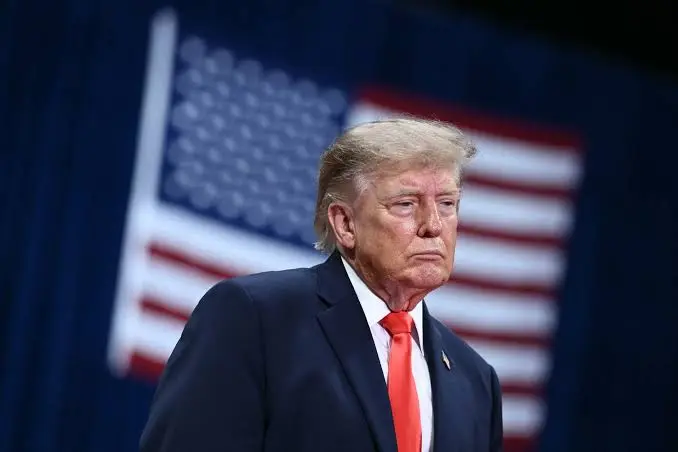
Donald Trump faces a fundamentally different political landscape after Democrats won control of the US House of Representatives and Senate in the November 3, 2026 midterm elections. The result weakens his ability to pass new legislation during the final two years of his presidency, but it does not eliminate his powers over tariffs, diplomacy and executive policy. For the global economy, that distinction matters: political gridlock could restrain deficit-financed initiatives, while greater confrontation between Congress and the White House could produce new uncertainty.
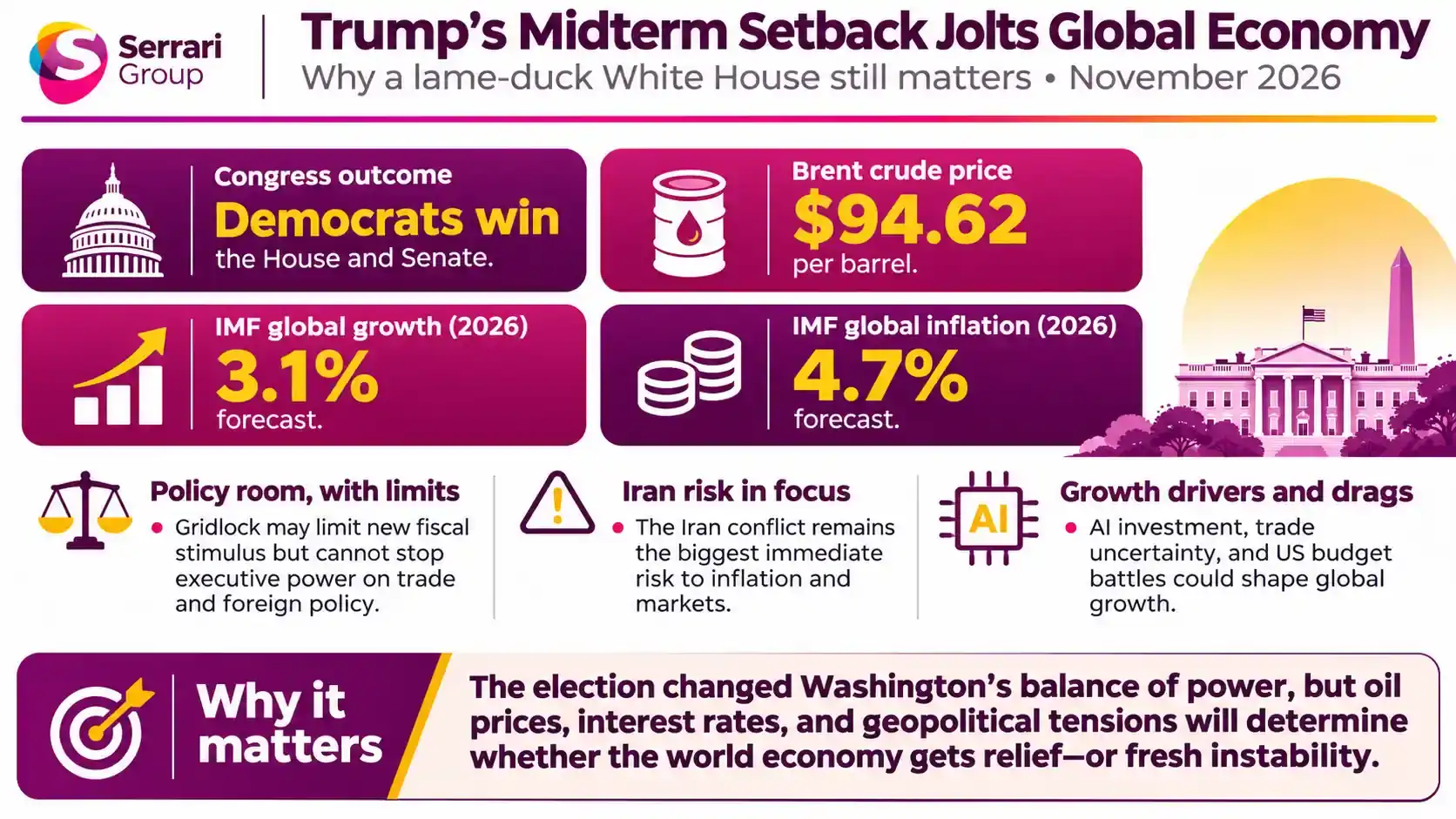
Markets initially responded with relief. On November 4, the Dow Jones Industrial Average jumped 1,569 points, US Treasury yields fell and Brent crude dropped to $94.62 a barrel as investors considered whether the electoral backlash against the Iran war might increase pressure for a diplomatic resolution. But the repricing was conditional. Global inflation, interest rates, AI investment and economic growth still depend heavily on whether energy supply stabilizes, trade policy becomes more predictable and Washington can agree on government funding.
Key Overview
- Congress changes hands: Democrats won majorities in both chambers, positioning them to block legislation and intensify oversight when the new Congress convenes in January 2027.
- Immediate market relief: The Dow gained 1,569 points on November 4 while oil prices and US government bond yields declined, reflecting expectations rather than guaranteed policy changes.
- Iran remains central: Brent crude settled at $94.62, but renewed military escalation could reverse the decline and reignite inflation.
- Trade policy remains contested: Congress can investigate, legislate and scrutinize tariffs, but the president retains veto authority and important executive powers.
- A December test looms: Existing government funding runs through December 11, leaving the outgoing Congress with a near-term budget deadline before the new majority takes office.
- Global growth at stake: The IMF forecasts 3.1% global growth and 4.7% global inflation in 2026, highlighting the economic cost of energy disruption and uncertainty.
Why Trump’s Electoral Defeat Matters Economically
The Democratic takeover of both congressional chambers was driven in part by public dissatisfaction over the Iran war, living costs and trade policy. Voters’ concerns have a direct economic explanation: expensive energy erodes purchasing power, tariffs can increase import costs and uncertainty makes it more difficult for companies to plan investments. The result therefore reflects pressure generated by economic conditions as well as dissatisfaction with the administration’s political choices.
A president is often described as a lame duck when political influence wanes toward the end of a term. In this case, however, diminished legislative influence should not be confused with an inability to act. Trump can still use executive authority, shape foreign policy and veto bills passed by Congress. Democrats can block much of his legislative agenda but cannot simply replace it with their own without confronting the presidential veto and procedural hurdles in the Senate.
Crucially, the election does not immediately transfer congressional control. The new Congress is scheduled to convene on January 3, 2027, leaving an intervening period in which outgoing lawmakers can act. That distinction sets up two different phases: immediate negotiations over unfinished business, followed by a more difficult governing environment once Democrats formally assume control.
Why Wall Street Rallied Despite the Political Shock
The immediate financial-market reaction appeared paradoxical. A dramatic defeat for the president’s party could have increased uncertainty, yet US stocks surged on November 4, with the Dow rising 1,569 points, or roughly 3%, and the S&P 500 gaining about 1.6%. Investors were not necessarily endorsing Democratic economic policies. They were reassessing the likelihood of abrupt legislation, additional fiscal stimulus and an escalation of costly geopolitical commitments.
Markets often prefer clarity to prolonged political uncertainty. Once the result became clear and Trump acknowledged the defeat, some investors saw a stronger system of checks and balances and a reduced probability of sweeping new policy measures. That can lower the risk premium embedded in share prices, especially where business forecasts depend heavily on regulations, taxes and government borrowing.
The gains were far from universal. AI infrastructure companies faced renewed questions over data-center approvals and environmental impacts, while some oil and defense-related stocks weakened alongside energy prices. A broad stock-market rally therefore concealed a sectoral reassessment. Investors viewed some businesses as beneficiaries of cheaper fuel and lower borrowing costs, while others confronted the possibility of tougher regulation or reduced wartime spending.
The lesson is that one election can simultaneously reduce certain risks and intensify others. Corporate earnings, real interest rates and capital expenditure will ultimately determine whether the rally develops into a sustained advance rather than a short-lived reaction.
Iran and Oil: The Most Immediate Global Transmission Channel
The election’s most consequential international effect may come through the war with Iran. Both Trump and Vice President JD Vance acknowledged the conflict’s role in the Republican defeat, encouraging traders to consider whether domestic political pressure could accelerate diplomacy. Brent crude fell around 8.7% to $94.62 a barrel on November 4, while US crude settled at $88.12.
Why does this matter beyond the United States? Oil enters the cost of transport, electricity generation, manufacturing and agricultural distribution. When energy prices rise sharply, import-dependent economies pay more for essential supplies, businesses face pressure on margins and households spend more of their income on basic goods. The resulting inflation can force central banks to keep interest rates elevated, making credit more expensive even where domestic demand is weak.
Cheaper oil could relieve some of those pressures, but only if the fall persists. A market price reflects expectations about future supply and demand; it is not proof that a peace agreement has been reached. International reactions to the election show how governments are assessing the possibility of altered US foreign policy, but the White House retains substantial influence over military decisions. An escalation could quickly restore a geopolitical premium to crude.
For oil-importing African economies, sustained lower prices could help contain fuel costs, imported inflation and pressure on foreign-exchange reserves. For exporters, the same decline could reduce revenues and fiscal space. The impact is therefore uneven, and domestic currencies, taxes and fuel-pricing systems determine how much of a global price change reaches consumers.
Inflation and Interest Rates Could Move in Opposite Directions
The IMF’s October 2026 global outlook projects headline inflation of 4.7% in 2026 before an easing to 4.1% in 2027. It identifies conflict, trade tensions and fiscal vulnerabilities as major risks. Those projections predate the midterm result, and the direction of oil prices over the coming months could cause actual inflation to diverge from the forecast.
Lower oil prices could temper inflation expectations and support government bonds. On November 4, the US 10-year Treasury yield declined by roughly six basis points to around 4.89%. Bond prices generally move in the opposite direction to yields, so the decline indicated stronger demand for Treasuries and changing expectations about inflation, economic growth and fiscal policy.
However, declining market yields are not equivalent to an immediate central-bank rate cut. The Federal Reserve determines policy based on inflation, employment and the broader economy, not election outcomes alone. If oil prices rebound or tariffs keep goods prices elevated, monetary authorities could remain restrictive even while financial markets initially price in relief.
For households, persistent high rates raise the cost of mortgages, consumer credit and business borrowing. For governments with large debt burdens, they increase the expense of refinancing maturing obligations. That makes the path of global inflation particularly important for developing countries whose debt service already competes with spending on public services and investment.
Context is everything. Stay ahead of shifting trends with today’s market updates, and uncover emerging opportunities using the Serrari Group Market Index and Marketplace. Then, take control of your own financial future by exploring our Money & Life Reset Transformation Blueprint ™ to build stronger habits, create better systems, and design a path toward lasting wealth.
Trade: Congress Can Challenge Trump, but Not Simply Erase Tariffs
Trade policy is another area where political change may have a complicated effect. Democrats could use committee hearings and legislation to challenge the administration’s tariff strategy, particularly where higher import costs have hurt consumers or businesses. But the president retains a veto, and any attempt to overturn tariffs through legislation faces significant obstacles.
This limits expectations of an immediate return to predictable trading rules. Some tariff authorities derive from existing statutes and executive actions, while changes may require legal challenges, negotiations or congressional agreement. US trading partners could welcome closer scrutiny of trade measures, but they cannot assume that a Democratic Congress will deliver rapid tariff reductions.
For companies, uncertainty itself carries costs. Businesses may delay investment when they cannot estimate import duties, sourcing expenses or access to export markets. Smaller firms often have less capacity to absorb these shocks than large multinationals. A confrontational Washington could leave trade partners facing frequent announcements without a clear path to durable agreements.
The bigger opportunity is for compromise around predictable trade rules. Yet compromise would require cooperation between political institutions that have just fought a deeply divisive election. For global manufacturers and exporters, the eventual direction of policy matters considerably more than symbolic parliamentary confrontation.
Government Debt and the December 11 Budget Deadline
Divided government can make it harder to enact large new tax cuts or spending initiatives, potentially easing fears of additional federal borrowing. That helps explain part of the bond-market response. But it does not eliminate the US deficit or reduce debt already outstanding. Nor does political gridlock guarantee fiscal restraint; it can produce shutdowns, delayed budgets and uncertainty over public services.
The first test arrives before Democrats formally take control. The current funding extension runs through December 11, 2026. The outgoing Congress must agree on spending legislation or another temporary measure to avert a lapse in funding. Because that deadline falls during the post-election transition, it cannot be described as an immediate test of the incoming Democratic majority alone.
If negotiations fail, some government operations could be disrupted, affecting contractors, public employees and economic activity. Even if lawmakers reach a short-term agreement, repeated confrontations could reduce business confidence. Meanwhile, federal debt-service obligations will continue regardless of which party controls Congress.
For international markets, US fiscal uncertainty matters because Treasury securities are a benchmark for global borrowing costs. Any lasting shift in their yields can influence corporate credit, emerging-market bond pricing and capital flows. A lower US yield may create breathing room elsewhere, but investors will still demand compensation for country-specific credit and currency risks.
AI Investment: A New Divide in the Growth Story
Artificial intelligence has become an important source of US investment spending, but the election raises questions about how fast infrastructure can expand. Data centers need electricity, water, land and extensive connections to transmission networks. Local opposition to those demands has turned some projects into political flashpoints, potentially increasing regulatory attention under the new congressional balance.
That does not mean AI investment will stop. Demand for computing power and automation may continue, while existing projects remain subject to their own commercial and local regulatory arrangements. Nevertheless, stricter oversight, higher compliance costs or delayed approvals could change the expected returns of companies pursuing rapid data-center expansion.
There is also a wider concern about whether AI spending is producing enough revenue and productivity to justify its scale. A slower rollout could reduce near-term investment and weigh on technology shares, but more disciplined development might also prevent wasteful capacity expansion. The economic consequences depend on whether regulation improves accountability without choking off worthwhile innovation.
The IMF’s outlook identifies AI investment as both an opportunity and a vulnerability. Productivity gains could strengthen medium-term growth, while a sharp reassessment of expected returns could unsettle asset prices and investment plans. This makes the technology sector one of the clearest examples of why the market impact of the midterms cannot be reduced to a simple Democrat-versus-Republican narrative.
What the Outcome Means for Growth and the Rest of the World
The global economy enters this political transition with little room for another major shock. The IMF forecasts global growth of 3.1% in 2026 and 3.4% in 2027, while warning of uneven resilience and downside risks. The US outlook matters because American demand, financial conditions and technology investment influence activity across trading partners.
A diplomatic easing of the Iran conflict could support consumption by lowering energy costs and reducing inflation pressure. Stable trade rules could encourage companies to resume investment. On the other hand, a prolonged fiscal confrontation, renewed tariff uncertainty or an abrupt correction in AI spending could weaken confidence and growth at the same time.
For African and other emerging economies, the transmission channels include fuel imports, commodity export revenues, dollar borrowing costs and currency movements. A stronger global risk appetite can help attract portfolio investment, but the gains may disappear quickly if geopolitical tensions intensify. Countries with weaker external balances or large refinancing needs are particularly exposed to such swings.
The key distinction is between the election’s political symbolism and its economic consequences. The November result signals that voters have imposed constraints on Trump’s legislative agenda. It does not by itself settle the Iran war, lower tariffs, cure inflation or repair public finances.
Why this matters now is that the final two years of Trump’s presidency could either reduce several sources of global instability or amplify them through political confrontation. Investors and households should watch the December funding negotiations, the start of the new Congress in January, the trajectory of oil prices, Federal Reserve decisions and the pace of AI investment. These developments, not the election result in isolation, will determine whether the current market relief becomes a sustained improvement in economic conditions.
Sources: Reuters / Associated Press / International Monetary Fund / Bipartisan Policy Center / Harvard University Office of Federal Relations / Fidelity
Your financial future isn’t something you wait for—it’s something you build.
The real question is: when do you begin?
Move beyond simply staying informed.
Navigate the markets with clarity—track trends through the Serrari Group Market Index, uncover opportunities in the Serrari Marketplace, and build practical knowledge with our Curated Wealth Builder Platform.
Stay connected to what truly matters.
Get daily insights on macro trends and financial movements across Kenya, Africa, and global markets—delivered through the Serrari Newsletter.
Growth opens doors.
Advance your career through professional programs including ACCA, HESI A2, ATI TEAS 7 , HESI EXIT , NCLEX – RN and NCLEX – PN, Financial Literacy!🌟—designed to move you forward with confidence.
See where money is flowing—clearly and in real time.
Track Money Market Funds, Treasury Bills, Treasury Bonds, Green Bonds, and Fixed Deposits, alongside global and African indexes, key economic indicators, and the evolving Crypto and stablecoin landscape—all within Serrari’s Market Index.