Hong Kong’s Legislative Council has passed legislation implementing the Organisation for Economic Co-operation and Development’s (OECD) Crypto-Asset Reporting Framework (CARF) and an amended Common Reporting Standard (CRS). From 2027, covered crypto service providers must collect customer and transaction information for reporting to the Inland Revenue Department. Automatic exchanges of qualifying crypto tax data with eligible partner jurisdictions are scheduled to begin in 2028.
The law aims to strengthen tax transparency and help authorities address cross-border tax evasion as digital assets become more widely used. It also updates financial account reporting rules: the amended CRS takes effect in 2028, with information exchanges under the updated standard beginning in 2029. The legislation introduces reporting duties, not a new cryptocurrency tax rate.
Key Takeaways
- Hong Kong passed its crypto reporting law on November 4, 2026.
- Covered providers must collect customer and transaction data from 2027.
- International exchanges of qualifying crypto tax information begin in 2028.
- The rules cover exchanges, brokers, dealers and certain crypto ATM operators.
- The amended CRS takes effect in 2028, with exchanges under the updated standard beginning in 2029.
- The law is designed to improve tax transparency and combat cross-border tax evasion, rather than introduce a new crypto tax rate.
Why Hong Kong Is Introducing Crypto Reporting Rules
The legislation responds to a gap in international tax reporting: crypto transactions can take place across borders and through digital asset service providers, making it harder for tax authorities to identify taxable activity involving their residents.
The OECD developed CARF to standardize the collection and exchange of tax information on crypto-asset transactions. By adopting the framework, Hong Kong is aligning its reporting system with international efforts to improve visibility into cross-border digital asset activity.
Hong Kong’s Financial Services and the Treasury Secretary, Christopher Hui, said the changes support international efforts to address tax evasion and help preserve the city’s standing as an international financial and commercial centre.
“Implementing the latest international standards for automatic exchange of information in tax matters is crucial” to maintaining Hong Kong’s reputation, Hui said.
The policy matters now because the reporting framework is moving from international standards into local compliance requirements. Crypto businesses will need to build systems for customer identification, due diligence, transaction tracking and reporting before the collection period begins in 2027.
What the New Law Requires
The law implements two international reporting standards: Crypto-Asset Reporting Framework and Amended Common Reporting Standard for financial account information.
Crypto Businesses Must Collect Customer and Transaction Data
The CARF requirements apply to businesses facilitating crypto transactions for customers, including exchanges, brokers, dealers and certain operators of crypto ATMs.
Providers with a reporting connection to Hong Kong must meet registration, customer due diligence, recordkeeping and reporting obligations. They will need to collect identifying information about reportable customers, including names, addresses, tax residences and taxpayer identification numbers.
The framework covers transactions such as:
- Exchanges between cryptocurrencies and fiat currencies
- Trades between different crypto assets
- Certain transfers involving external wallets
It applies to qualifying fungible and non-fungible crypto assets used for payments or investment. Central bank digital currencies, specified electronic money products and certain assets that cannot be used for payments or investment are excluded from CARF.
“Companies with a reporting connection to Hong Kong will be subject to registration, customer due diligence, recordkeeping and reporting obligations.”
Implementation Timeline
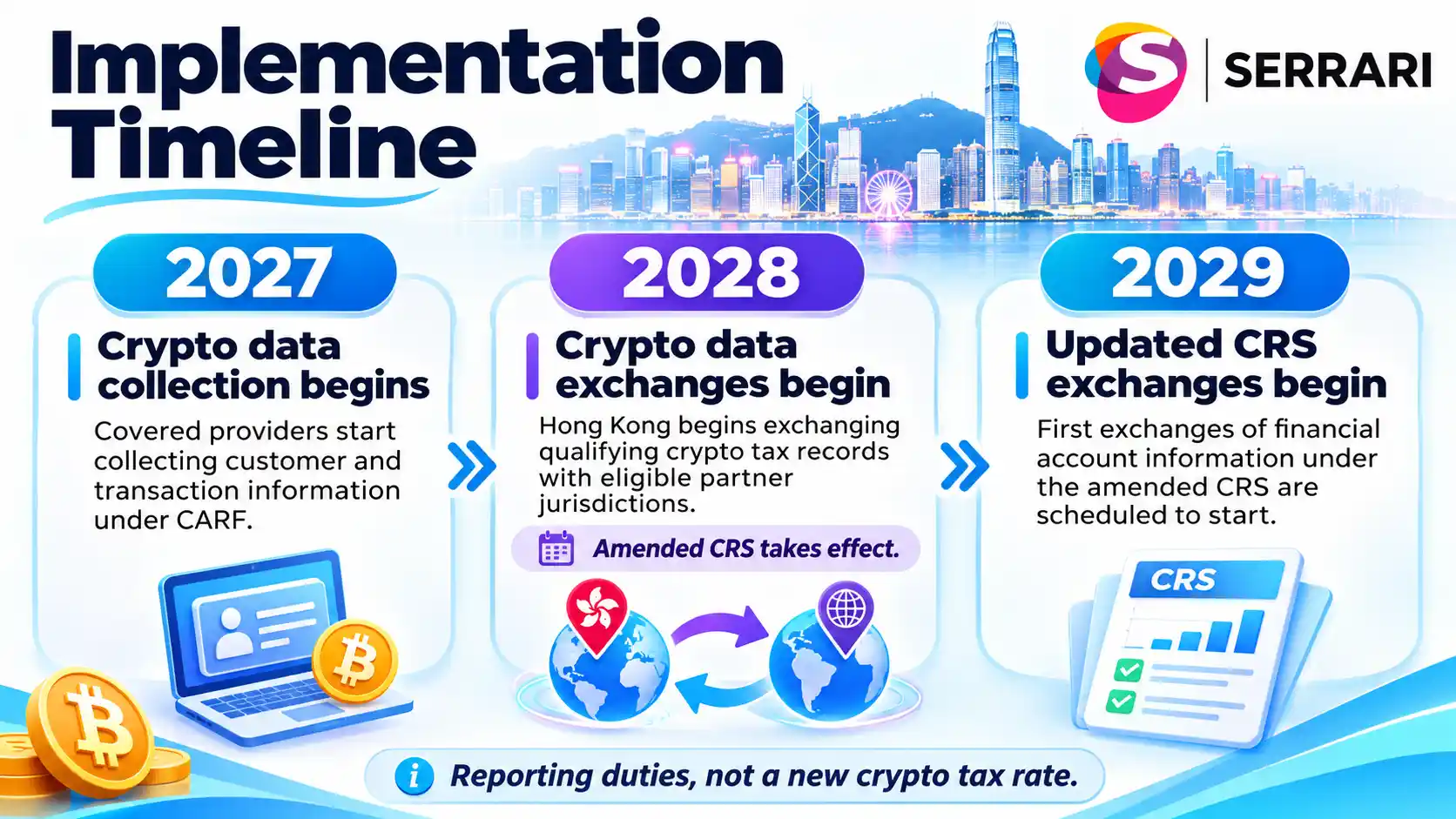
2027: Crypto data collection begins
Covered providers begin collecting customer and transaction information under CARF.
2028: Crypto data exchanges begin
Hong Kong’s Inland Revenue Department begins exchanging qualifying crypto tax records with eligible partner jurisdictions. The amended CRS also takes effect.
2029: Updated CRS exchanges begin
The first exchanges of financial account information under the amended CRS are scheduled to start.
How International Tax Data Sharing Will Work
Under CARF, crypto service providers submit required information to Hong Kong’s Inland Revenue Department. The department will then exchange qualifying records annually with partner jurisdictions.
Tax residence information will help authorities determine which jurisdictions should receive relevant records. Exchanges will operate on a reciprocal basis and are subject to confidentiality and data security requirements.
“Hong Kong will share information only through reciprocal arrangements with eligible partners that meet confidentiality and data security requirements.”
This creates a standardized channel through which participating tax authorities can obtain information about residents’ reportable crypto activity abroad. The law does not mean that all crypto transactions will automatically be disclosed to every foreign authority; exchanges depend on the reporting rules and eligible partner arrangements.
The Amended CRS Extends Financial Reporting
The legislation also updates the Common Reporting Standard, which Hong Kong has used to exchange financial account information with partner jurisdictions since 2018.
The amended CRS expands reporting and due diligence requirements to include certain digital financial products, such as central bank digital currencies, specified electronic money products and financial instruments linked to crypto assets. Financial institutions will need to provide additional details about account holders, controlling persons and relevant accounts.
The updated standard takes effect in 2028, with the first exchanges under the revised rules scheduled for 2029.
The government plans to issue further implementation guidance and technical reporting specifications. It has also established a dedicated team to assist affected businesses with compliance questions.
Context is everything. Stay ahead of shifting trends with today’s market updates, and uncover emerging opportunities using the Serrari Group Market Index and Marketplace. Then, take control of your own financial future by exploring our Money & Life Reset Transformation Blueprint ™ to build stronger habits, create better systems, and design a path toward lasting wealth.
What the Rules Mean for Crypto Businesses and Users
For crypto service providers, the new framework means additional operational and compliance responsibilities. Businesses will need processes to identify reportable customers, verify tax residence information, maintain records and report covered transactions.
For users, the rules mean that certain crypto activity conducted through covered providers may become visible to tax authorities in their jurisdiction of residence. The legislation does not itself create a new tax rate, but it increases the information available to authorities for applying existing tax rules.
The reporting framework also has implications for the industry’s relationship with regulators. Standardized disclosure may support confidence in Hong Kong’s digital asset market by bringing crypto reporting closer to established international financial account practices. At the same time, businesses will need to manage compliance costs and protect sensitive customer data.
The Bigger Picture: Crypto Is Being Brought Into International Tax Reporting
Hong Kong’s law is part of a wider move to apply international tax transparency standards to digital assets. CARF was developed by the OECD in response to the growth of crypto markets and the cross-border nature of many transactions.
The framework seeks to reduce information gaps between jurisdictions by requiring covered service providers to collect standardized data and enabling tax authorities to exchange it.
However, reporting coverage has limits. One estimate cited in the source reporting suggests that transactions within CARF’s practical reach represented approximately 14% of potentially taxable onchain activity in 2025. This highlights that the framework is an important reporting mechanism, but not a complete view of all crypto activity.
Outlook
Hong Kong’s legislation establishes a phased transition toward international crypto tax reporting. The immediate task for covered providers is to prepare for customer and transaction data collection from 2027, while the Inland Revenue Department and financial institutions prepare for the new exchange schedules.
The broader significance will depend on how effectively the system improves tax transparency while protecting data and supporting compliance. For Hong Kong, implementation is also tied to maintaining its role as an international financial centre as digital assets become more integrated into the financial system.
FAQs
Does Hong Kong’s new law introduce a crypto tax?
No. The law establishes reporting and information-sharing obligations. It does not introduce a separate cryptocurrency tax rate.
When must crypto businesses start collecting information?
Covered service providers must begin collecting customer and transaction data from 2027.
When will Hong Kong share crypto tax information internationally?
Automatic exchanges of qualifying crypto tax data with eligible partner jurisdictions are scheduled to begin in 2028.
Which businesses are covered?
The framework includes crypto exchanges, brokers, dealers and certain crypto ATM operators that meet Hong Kong’s reporting connection criteria.
What is the amended Common Reporting Standard?
The CRS is an international framework for exchanging financial account information. Hong Kong’s amended version expands reporting to certain digital financial products, takes effect in 2028 and begins exchanges under the updated rules in 2029.
Sources: Crypto News/ Incrypted/ Kucoin/ PrimeXBT
Your financial future isn’t something you wait for—it’s something you build.
The real question is: when do you begin?
Move beyond simply staying informed.
Navigate the markets with clarity—track trends through the Serrari Group Market Index, uncover opportunities in the Serrari Marketplace, and build practical knowledge with our Curated Wealth Builder Platform.
Stay connected to what truly matters.
Get daily insights on macro trends and financial movements across Kenya, Africa, and global markets—delivered through the Serrari Newsletter.
Growth opens doors.
Advance your career through professional programs including ACCA, HESI A2, ATI TEAS 7 , HESI EXIT , NCLEX – RN and NCLEX – PN, Financial Literacy!🌟—designed to move you forward with confidence.
See where money is flowing—clearly and in real time.
Track Money Market Funds, Treasury Bills, Treasury Bonds, Green Bonds, and Fixed Deposits, alongside global and African indexes, key economic indicators, and the evolving Crypto and stablecoin landscape—all within Serrari’s Market Index.