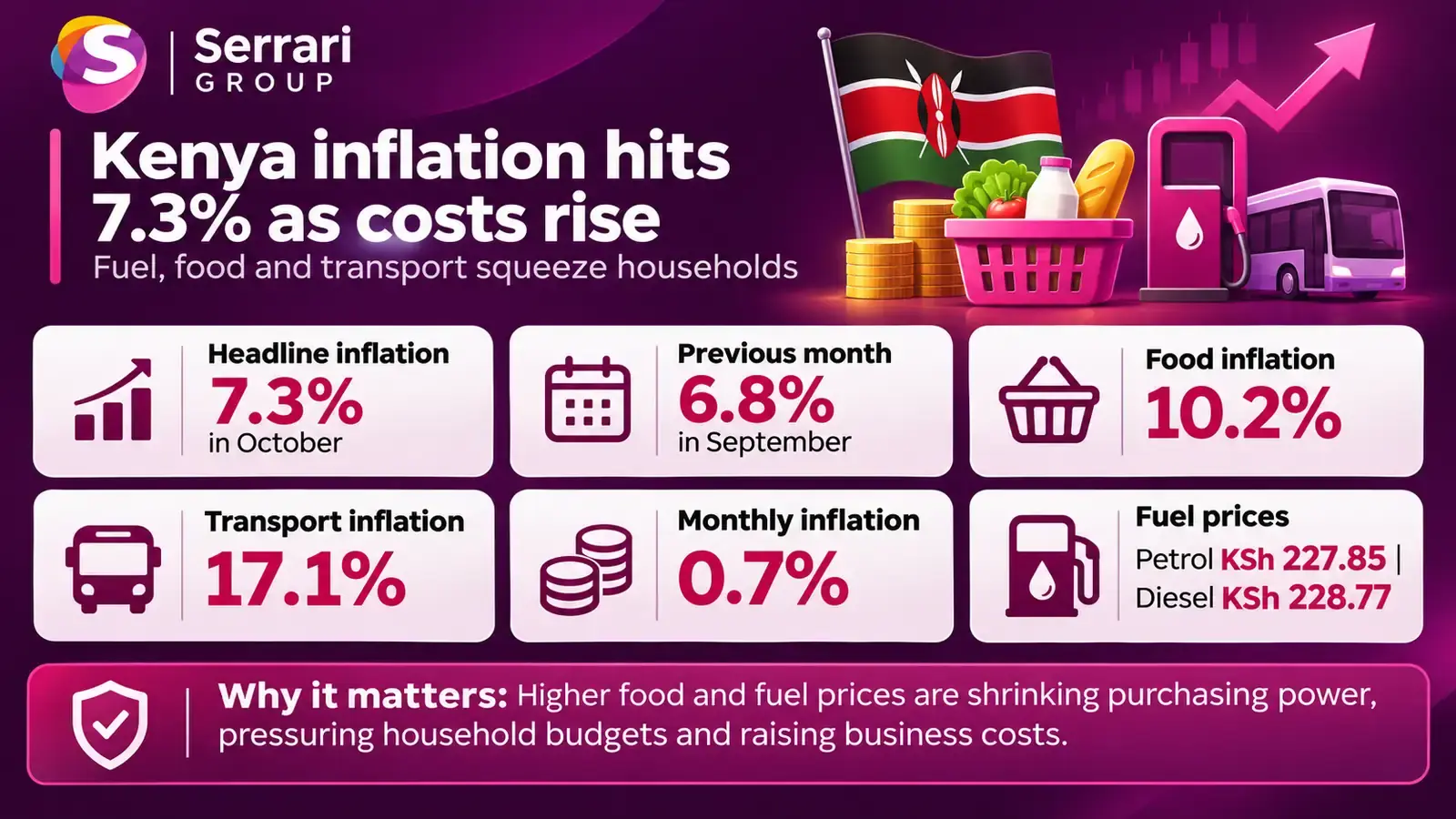
Kenya’s annual inflation accelerated to 7.3% in October 2026, from 6.8% in September, as higher food, fuel and transport prices squeezed household purchasing power. The increase, the highest annual reading since July 2023, places renewed pressure on family budgets and businesses already managing costly transport and distribution.
Key Overview
- Headline inflation: Rose to 7.3% in October from 6.8% in September; monthly inflation was 0.7%.
- Food prices: Food and non-alcoholic beverages were 10.2% more expensive than a year earlier.
- Transport: Annual inflation reached 17.1%, the fastest increase among major spending categories.
- Fuel: National average petrol, diesel and kerosene prices rose to KSh 227.85, KSh 228.77 and KSh 220.88 per litre, respectively.
- Underlying pressure: Core inflation reached 4.3%, while non-core inflation climbed to 15.1%.
Food and Transport Drive Inflation Higher
The October consumer price report shows prices across the economy were 7.3% higher than in October 2025. The Consumer Price Index rose from 156.47 in September to 157.60 in October, equivalent to a 0.7% increase in one month.
Food and non-alcoholic beverages recorded a 10.2% annual price increase, transport rose 17.1%, and housing, water, electricity, gas and other fuels increased 3.7%. Together, these three categories account for more than 57% of the expenditure weights in the inflation basket, making them especially influential in the headline rate.
Inflation has generally accelerated during 2026, rising from 4.4% in January to 7.3% in October, although it briefly eased in June. A higher inflation rate means prices are increasing faster than a year earlier; it does not mean every product increased by 7.3%.
Context is everything. Stay ahead of shifting trends with today’s market updates, and uncover emerging opportunities using the Serrari Group Market Index and Marketplace. Then, take control of your own financial future by exploring our Money & Life Reset Transformation Blueprint ™ to build stronger habits, create better systems, and design a path toward lasting wealth.
Petrol, Diesel and Kerosene Add to Household Costs
The official commodity price data show national average petrol prices increased 6.0% between September and October, from KSh 214.95 to KSh 227.85 per litre. Diesel rose 4.4%, from KSh 219.04 to KSh 228.77, while kerosene jumped 14.7% to KSh 220.88.
These are surveyed national average prices rather than the maximum retail pump price for any single town. The October–November regulated price schedule, for example, lists Nairobi prices of KSh 226.96 for petrol, KSh 227.76 for diesel and KSh 219.87 for kerosene.
Higher fuel costs can feed into freight charges, public transport fares and the prices businesses charge consumers. The survey recorded a rise in the Westlands–Kangemi matatu fare from KSh 40 to KSh 50, while a Kabarnet–Nakuru journey increased from KSh 600 to KSh 650. The Siaya town–Awelo boda boda fare rose from KSh 50 to KSh 70.
Milk, Potatoes and Cooking Oil Become Costlier
Among household staples, a 500ml packet of fresh milk increased 4.7% month on month to KSh 64.13, while unpacketed milk rose 3.9% to KSh 80.58 per litre. Cabbages increased 4.1% to KSh 82.38 per kilogram, and Irish potatoes rose 2.5% to KSh 125.06.
A two-kilogram packet of white wheat flour reached KSh 184.88, while cooking oil edged up to KSh 361.04 per litre. Not every food item became dearer: sugar fell 1.2% to KSh 163.84 per kilogram, and oranges declined 1.1% to KSh 125.81.
These diverging changes underline why individual households may experience inflation differently, depending on their consumption patterns and exposure to fuel and fresh-food prices.
Core Inflation Rises as the Policy Margin Narrows
The October monetary update shows core inflation increased to 4.3% from 4.0%, while non-core inflation rose to 15.1% from 14.0%. The central bank attributed the latter largely to fresh produce and higher pump prices.
Headline inflation of 7.3% is near the top of Kenya’s 2.5%–7.5% target band. This heightens attention on future food harvests, international oil prices and the shilling, all of which can influence import and consumer costs.
For households, the immediate impact is less disposable income after essential spending. For businesses, higher input and transport costs can squeeze margins or prompt price increases, particularly when consumers are already cutting discretionary purchases.
Sources: Kenya National Bureau of Statistics / Central Bank of Kenya / Energy and Petroleum Regulatory Authority / Business Today
Your financial future isn’t something you wait for—it’s something you build.
The real question is: when do you begin?
Move beyond simply staying informed.
Navigate the markets with clarity—track trends through the Serrari Group Market Index, uncover opportunities in the Serrari Marketplace, and build practical knowledge with our Curated Wealth Builder Platform.
Stay connected to what truly matters.
Get daily insights on macro trends and financial movements across Kenya, Africa, and global markets—delivered through the Serrari Newsletter.
Growth opens doors.
Advance your career through professional programs including ACCA, HESI A2, ATI TEAS 7 , HESI EXIT , NCLEX – RN and NCLEX – PN, Financial Literacy!🌟—designed to move you forward with confidence.
See where money is flowing—clearly and in real time.
Track Money Market Funds, Treasury Bills, Treasury Bonds, Green Bonds, and Fixed Deposits, alongside global and African indexes, key economic indicators, and the evolving Crypto and stablecoin landscape—all within Serrari’s Market Index.