India’s climate-tech sector could attract approximately $1.9 billion in equity funding in 2026, according to Ostara Research’s Ostara Climate Tech and Deep Tech Review 2026. Companies raised $791 million across 74 equity rounds between January and May, with five late-stage transactions accounting for 71% of the total. The report identifies deep technology, energy storage, green asset financing and energy-efficient data-centre infrastructure as potential investment opportunities for 2027. However, limited growth capital between Series B and Series C remains a constraint, while battery manufacturing and energy infrastructure present significant opportunities for domestic investment.
Key Takeaways
- Funding momentum: Indian climate-tech companies raised $791 million across 74 equity rounds in the first five months of 2026.
- Capital concentration: Five late-stage transactions accounted for 71% of the funding total.
- Potential growth areas: Deep technology, energy storage, green asset financing and energy-efficient data-centre infrastructure could attract investment in 2027.
- Scaling challenge: The shortage of growth capital between Series B and Series C remains a constraint for deep-tech companies.
Funding is flowing, but unevenly
India’s climate-tech market is entering a more selective phase, where a handful of large transactions are shaping the direction of capital even as the broader ecosystem searches for the next wave of scale-up financing.
Between January and May 2026, Indian climate-tech companies raised $791 million across 74 equity rounds. Five late-stage transactions accounted for 71% of the total, highlighting the growing concentration of capital in larger deals.
If the funding pace recorded during the first five months continues, full-year climate-tech equity funding could reach approximately $1.9 billion. This is an indicative run-rate projection rather than a forecast.
The concentration of capital matters because investors are still willing to back mature businesses with clearer commercial pathways, while earlier and mid-stage ventures continue to face a tougher climb. For companies building capital-intensive climate businesses, the gap between developing a commercially viable product and deploying it at scale remains a significant challenge.
The missing middle remains a key constraint
The shortage of growth capital between Series B and Series C remains a key constraint for Indian deep-tech companies. At this stage, businesses may need substantial follow-on funding to expand manufacturing capacity, build supply chains, hire specialised talent and commercialise products at scale.
The report identified the emergence of domestic investment vehicles as a potential source of improvement over the next 12 to 18 months. Greater availability of scale-up financing could help companies seeking to expand operations and bridge the gap between proving a technology and bringing it to a larger market.
Climate-tech businesses often require patient capital because factories, storage systems, supply chains and energy infrastructure can involve long development periods before revenues become predictable. The availability of growth equity and other financing options will therefore be important to the sector’s next phase.
Four investment opportunities for 2027
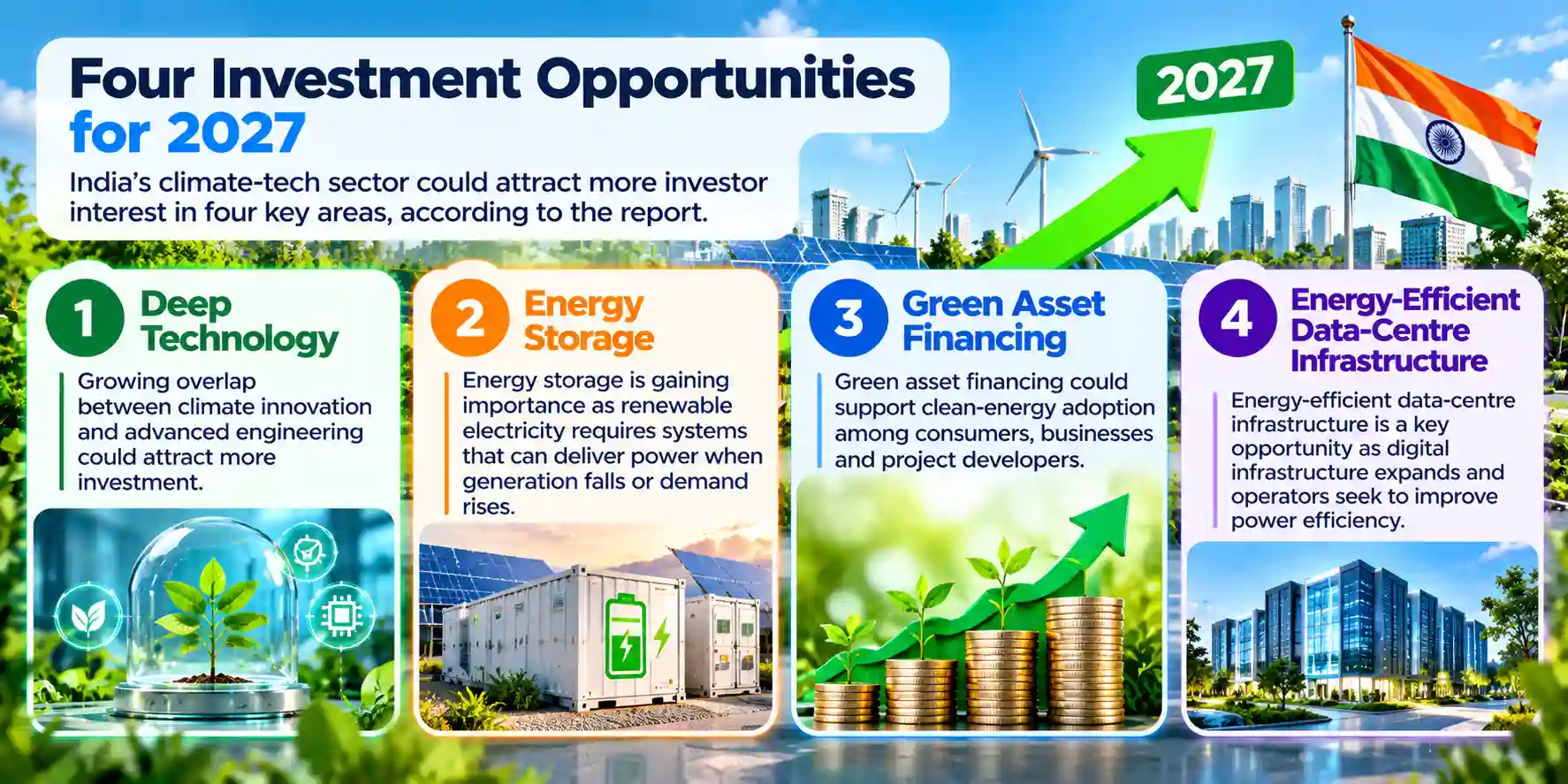
The report highlighted four areas that could attract greater investor interest in 2027: deep technology, energy storage, green asset financing and energy-efficient data-centre infrastructure.
Deep technology could benefit from the growing overlap between climate innovation and advanced engineering. Energy storage is gaining importance as renewable electricity requires systems capable of delivering power when generation falls or demand rises.
Green asset financing could support clean-energy adoption among consumers, businesses and project developers. Energy-efficient data-centre infrastructure is another potential opportunity as digital infrastructure expands and operators face pressure to improve power efficiency.
Together, these areas point to a broader market in which investment is needed not only for developing new technologies but also for making them commercially viable and available at scale.
Context is everything. Stay ahead of shifting trends with today’s market updates, and uncover emerging opportunities using the Serrari Group Market Index and Marketplace. Then, take control of your own financial future by exploring our Money & Life Reset Transformation Blueprint ™ to build stronger habits, create better systems, and design a path toward lasting wealth.
Energy security is reshaping the investment case
India’s climate investment priorities have increasingly shifted towards energy security and reducing import dependence, alongside decarbonisation. Disruptions to supplies through the Strait of Hormuz have reinforced the importance of developing domestic alternatives and strengthening manufacturing capabilities in solar cells, batteries and critical minerals.
This broader focus means the investment opportunity extends beyond clean technologies with environmental benefits. Businesses that strengthen domestic supply chains and reduce vulnerability to external supply shocks could also play a role in India’s industrial and energy priorities.
Battery manufacturing faces a substantial capacity gap
India’s battery manufacturing sector illustrates both the opportunity and the challenge. While 40 gigawatt-hours (GWh) of capacity has been awarded under the advanced chemistry cell production-linked incentive scheme, only 1.4 GWh had been commissioned.
Meanwhile, battery demand is projected to rise from 28 GWh in 2025 to 272 GWh by FY30. The gap between awarded capacity and commissioned output points to the scale of the manufacturing challenge.
Building battery production at scale requires capital, supply-chain depth, access to raw materials and the ability to deliver commercially competitive products. The projected rise in demand also creates potential opportunities for suppliers, storage-system integrators and businesses supporting the wider battery ecosystem.
Energy storage is particularly important as renewable power expands. Storing electricity and delivering it when required can help address the mismatch between when renewable energy is generated and when consumers need it.
Government-backed financing is gaining traction
Public financing is becoming more significant in the climate-tech landscape. The ₹1 lakh crore Research, Development and Innovation Fund has begun disbursing capital, while the Technology Development Board had approved 22 projects by July 2026.
Government-backed financing can help support technologies that are too early for conventional private capital and may encourage additional investment in sectors with longer development periods. It could also help bridge the gap between innovation and commercial deployment.
The report also identified opportunities in financing clean-energy adoption among consumers and micro, small and medium enterprises (MSMEs). Such financing can help make clean technologies accessible beyond technology developers and large industrial projects.
Outlook
India’s climate-tech funding could reach approximately $1.9 billion in 2026 if the pace recorded during the first five months continues, although the figure remains an indicative projection. For 2027, the report points to opportunities across deep technology, energy storage, green asset financing and energy-efficient data-centre infrastructure.
The next phase of India’s climate transition will depend on capital reaching not only technology developers but also manufacturing, infrastructure deployment and financing businesses that make clean technologies commercially viable. Whether domestic growth funds and government-backed financing can help address the scale-up funding gap will be an important factor in determining how widely investment reaches across the sector.
FAQs
1. How much could India’s climate-tech sector raise in 2026?
Funding could reach approximately $1.9 billion if the pace recorded between January and May continues. This is an indicative run-rate projection, not a formal forecast.
2. How much did Indian climate-tech companies raise in the first five months of 2026?
They raised $791 million across 74 equity funding rounds, with five late-stage transactions accounting for 71% of the total.
3. Which climate-tech areas could attract investment in 2027?
The four areas identified are deep technology, energy storage, green asset financing and energy-efficient data-centre infrastructure.
4. What is the main funding challenge for Indian climate-tech companies?
The shortage of growth capital between Series B and Series C makes it harder for companies to expand manufacturing, develop supply chains and commercialise technologies at scale.
Your financial future isn’t something you wait for—it’s something you build.
The real question is: when do you begin?
Move beyond simply staying informed.
Navigate the markets with clarity—track trends through the Serrari Group Market Index, uncover opportunities in the Serrari Marketplace, and build practical knowledge with our Curated Wealth Builder Platform.
Stay connected to what truly matters.
Get daily insights on macro trends and financial movements across Kenya, Africa, and global markets—delivered through the Serrari Newsletter.
Growth opens doors.
Advance your career through professional programs including ACCA, HESI A2, ATI TEAS 7 , HESI EXIT , NCLEX – RN and NCLEX – PN, Financial Literacy!🌟—designed to move you forward with confidence.
See where money is flowing—clearly and in real time.
Track Money Market Funds, Treasury Bills, Treasury Bonds, Green Bonds, and Fixed Deposits, alongside global and African indexes, key economic indicators, and the evolving Crypto and stablecoin landscape—all within Serrari’s Market Index.