
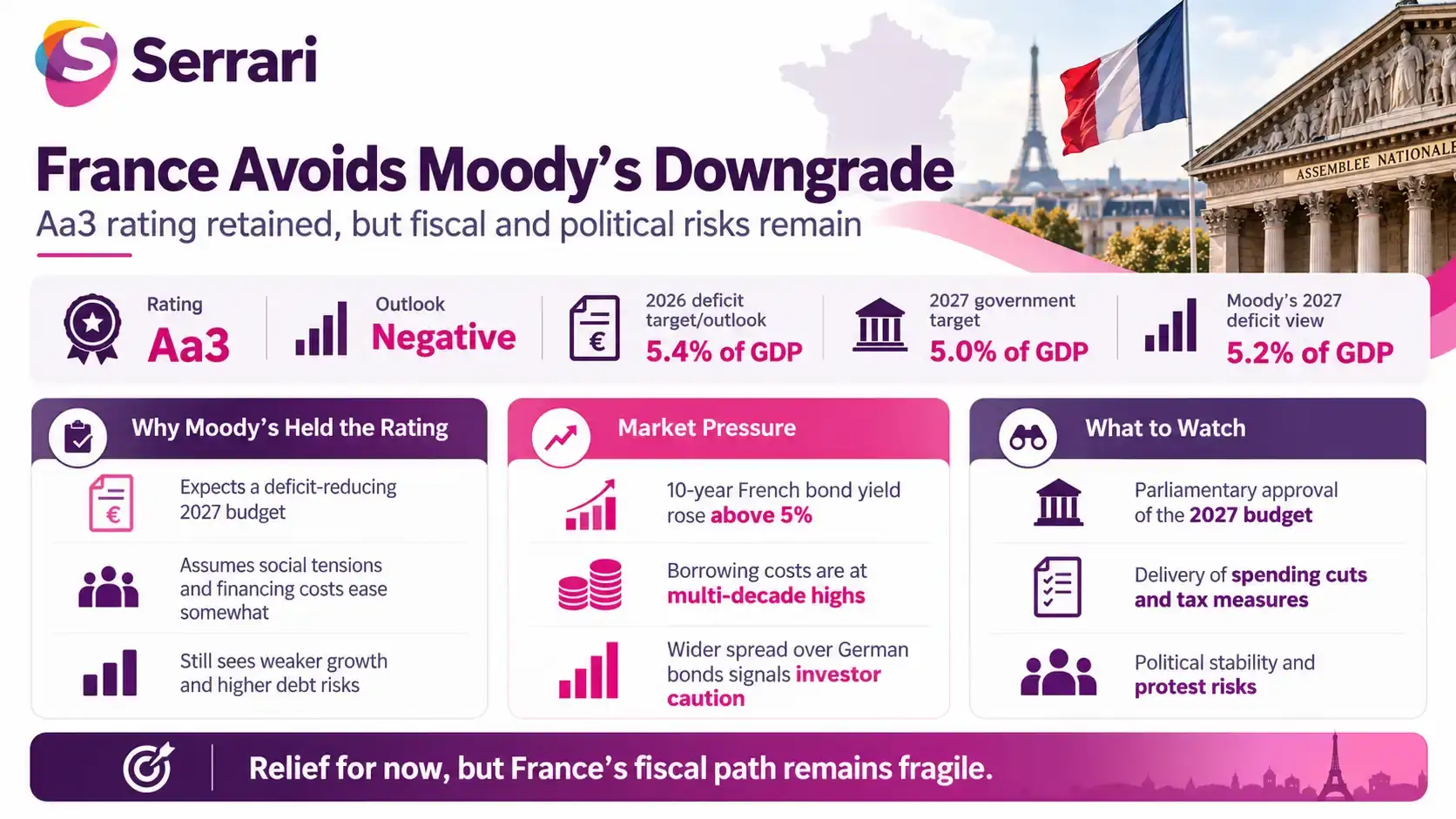
France has avoided another sovereign credit downgrade after Moody’s maintained its Aa3 rating with a negative outlook on October 23, 2026. The decision offers temporary relief to President Emmanuel Macron’s government, which faces mounting borrowing costs, public protests and difficult negotiations over the 2027 budget.
The rating decision rests partly on expectations that lawmakers will approve measures to reduce the budget deficit. However, the negative outlook signals that further deterioration in public finances or political stability could still lead to a downgrade.
Key Overview
- Credit rating: Moody’s retained France’s Aa3 sovereign rating and negative outlook on October 23.
- Borrowing costs: The benchmark 10-year French government bond yield reached 5.14% during the preceding week, its highest since July 2002.
- Budget deficit: France expects a deficit of 5.4% of GDP in 2026, while the government targets 5% in 2027.
- Fiscal measures: The 2027 budget proposal includes €43 billion in new corrective measures, within a total €54 billion adjustment effort.
- Main risk: Political opposition, social unrest and higher interest costs could disrupt the planned deficit reduction.
Why Moody’s Held France’s Credit Rating
Moody’s decision came despite worsening economic conditions and an increasingly difficult political environment. The agency expects France to adopt a budget that narrows its deficit in 2027, accompanied by some easing in financing costs and social tensions.
The decision provided a reprieve rather than a declaration that France’s debt problems have been resolved. A negative outlook indicates the rating remains vulnerable if government borrowing continues rising faster than the economy’s capacity to support it.
France’s finance minister, Roland Lescure, welcomed the unchanged rating as recognition of the government’s fiscal plans. But the assessment remains conditional on decisions that lawmakers have yet to finalise.
French Bond Yields Surge as Investors Demand Higher Returns
Investor concerns have already pushed France’s borrowing costs sharply higher. The 10-year government bond yield reached 5.14% on October 22, its highest level in more than two decades. The yield premium over equivalent German government bonds also widened to around 1.7 percentage points.
A widening yield spread means investors demand a greater return to hold French bonds instead of debt issued by Germany, which is generally considered a safer eurozone borrower.
Higher yields make it more expensive for France to refinance maturing debt and issue new bonds. The government’s 2027 budget presentation projects interest costs of €91.2 billion in 2027, compared with €79.2 billion in 2026. This reduces the money available for public services, investment and other priorities.
Context is everything. Stay ahead of shifting trends with today’s market updates, and uncover emerging opportunities using the Serrari Group Market Index and Marketplace. Then, take control of your own financial future by exploring our Money & Life Reset Transformation Blueprint ™ to build stronger habits, create better systems, and design a path toward lasting wealth.
France’s 2027 Budget Faces Parliamentary Resistance
Prime Minister Sébastien Lecornu’s government is seeking to bring the public deficit down from an expected 5.4% of GDP in 2026 to 5% in 2027.
The proposed fiscal package comprises €43 billion in new measures and another €11 billion from previously adopted measures that continue taking effect. The government expects economic growth of 1% in 2027 after a weaker 2026.
Achieving those targets will be difficult without a stable parliamentary majority. Opposition lawmakers have challenged spending reductions and tax proposals, while protests over living costs and public services have added pressure on the government.
Moody’s reportedly expects a 2027 deficit of 5.2% of GDP, slightly worse than the government’s 5% goal. Slower growth could weaken tax receipts, while political resistance could prevent spending restraint from being implemented in full.
What the Rating Decision Means for Investors
The unchanged Aa3 rating reduces the immediate risk of an additional ratings-driven selloff, but it does not guarantee lower bond yields or a sustained improvement in investor confidence.
Markets will focus on whether France can pass a credible 2027 budget, contain social unrest and stabilise government debt. The upcoming presidential election in April and May 2027 adds another layer of uncertainty to medium-term fiscal policy.
If borrowing costs remain elevated while deficits persist, France could face growing debt-servicing pressure and a renewed threat of credit downgrades. Conversely, a credible budget agreement and easing political tensions could support a recovery in confidence.
For now, France has gained time, but the country’s fiscal outlook remains under significant strain.
Sources: Reuters / Moody’s Ratings / French Ministry of Economy and Finance / Government of France / Euronews
Your financial future isn’t something you wait for—it’s something you build.
The real question is: when do you begin?
Move beyond simply staying informed.
Navigate the markets with clarity—track trends through the Serrari Group Market Index, uncover opportunities in the Serrari Marketplace, and build practical knowledge with our Curated Wealth Builder Platform.
Stay connected to what truly matters.
Get daily insights on macro trends and financial movements across Kenya, Africa, and global markets—delivered through the Serrari Newsletter.
Growth opens doors.
Advance your career through professional programs including ACCA, HESI A2, ATI TEAS 7 , HESI EXIT , NCLEX – RN and NCLEX – PN, Financial Literacy!🌟—designed to move you forward with confidence.
See where money is flowing—clearly and in real time.
Track Money Market Funds, Treasury Bills, Treasury Bonds, Green Bonds, and Fixed Deposits, alongside global and African indexes, key economic indicators, and the evolving Crypto and stablecoin landscape—all within Serrari’s Market Index.