African companies raised $13.3 billion through hard-currency bond sales during the first nine months of 2026, marking the fastest issuance pace in five years. The total included $3.25 billion in private placements. Improving corporate credit quality and investor demand have supported the rebound, but rising debt repayments and sovereign risks could challenge the momentum.
Key Overview
- Total bond sales: $13.3 billion in January–September 2026.
- Private placements: $3.25 billion of the total.
- Countries represented: 11, compared with eight in 2021.
- Expected annual issuance: $8 billion–$12 billion in coming years.
- Corporate maturities: Nearly $7 billion projected for 2028.
- Main risks: Higher borrowing costs, refinancing pressure and sovereign debt stress.
African Corporate Bond Sales Reach a Five-Year High
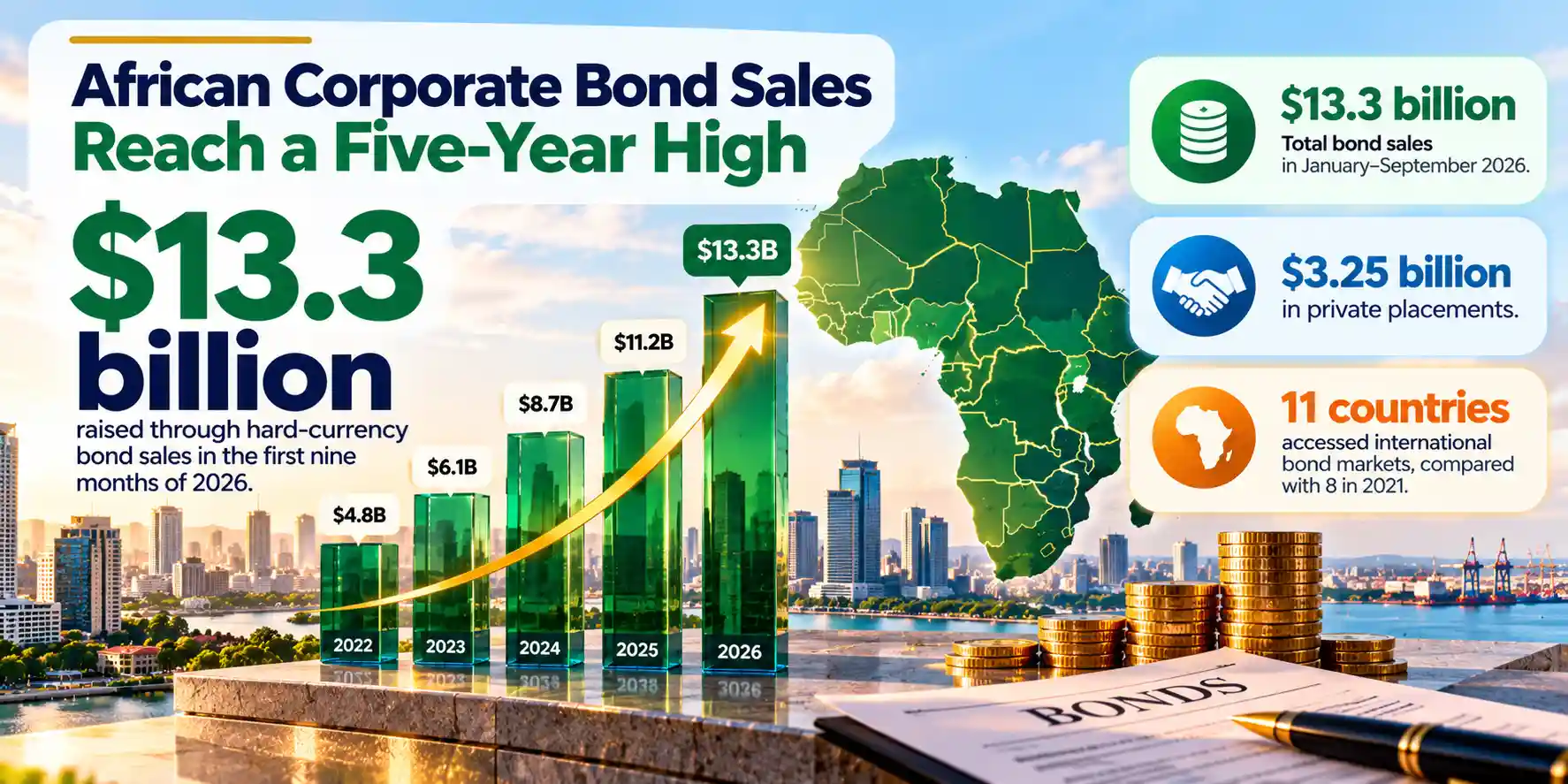
African-linked companies raised $13.3 bn through hard-currency bond sales in the first nine months of 2026, putting corporate issuance on track for its strongest pace in five years. The figures, highlighted in the latest report on African corporate bond sales, point to renewed access to international capital markets as investors seek opportunities offering attractive returns.
The total includes $3.25bn through private placements, where securities are sold directly to selected investors rather than through a broadly marketed public offering. The pace is approaching the $17 billion raised over the whole of 2021, a year that remains a benchmark for African corporate bond issuance.
The market has also expanded geographically. Companies linked to 11 African countries accessed international bond markets during the period, compared with eight in 2021. This wider participation suggests that international debt financing is reaching a broader group of African businesses, although access remains dependent on each issuer’s credit profile, financing needs and market conditions.
The increase is significant for companies that need foreign-currency funding to finance operations, manage liabilities or refinance existing borrowing. However, the headline figure does not represent entirely new investment capital: some major transactions were primarily designed to replace older debt with new securities.
Major Issuers Drive Market Activity
Companies from the mining, energy and industrial sectors featured prominently in this year’s issuance. Among them were First Quantum Minerals, which operates major copper mines in Zambia, Azule Energy in Angola and South African petrochemical producer Sasol.
First Quantum Minerals completed a $1.5bn bond offering in February 2026, increasing the deal from an initially planned $1.35 billion. The notes carry a coupon of 6.375% and mature in 2036. The company used the proceeds, alongside available cash, to redeem $1.35 billion of older notes carrying a higher 9.375% coupon, with the remaining funds earmarked for revolving credit facilities.
Azule Energy’s financing vehicle issued $1.5 billion in January, comprising $850 mn of notes maturing in 2031 with an 8.25% coupon and $650 million maturing in 2033 with an 8.625% coupon. The proceeds were designated for general corporate purposes.
Sasol raised $750 million in April through dollar-denominated bonds carrying an 8.75% coupon and maturing in 2033. The company used the proceeds to buy back existing notes due in 2028 and 2029. This transaction largely refinanced existing obligations rather than generating an equivalent amount of new funding for expansion.
These transactions illustrate how international debt markets can help companies restructure liabilities, extend repayment timelines and manage financing costs. They also show why the value of bond sales needs to be considered alongside the purpose of each issuance.
Improving Credit Quality Supports Investor Confidence
One factor supporting African corporate bond issuance is the reported improvement in credit quality. Bank of America says credit rating upgrades are outnumbering downgrades in the market covered by its analysis. It also estimates that outstanding corporate debt rated CCC, among the lowest speculative-grade categories, has declined to approximately $2.1 billion from $3.2 billion five years ago.
The analysis also reported no payment defaults in its covered market since 2020. This finding should be understood within the scope of the bank’s analysis and does not mean every African corporate borrower is free from financial distress or refinancing difficulties.
Investors are attracted to African corporate debt partly because it can offer higher yields than some alternatives in global markets. If credit spreads narrow further, stronger borrowers and companies with established international market access may find it easier to issue new bonds.
Bank of America expects annual African corporate bond issuance to reach 8billion–12 billion in the coming years. This forecast suggests that the recent activity could represent a more sustained period of market access rather than a one-off surge.
Nevertheless, improving credit indicators do not eliminate the risks associated with foreign-currency borrowing. Companies that earn revenues in local currencies but owe dollars or euros can face additional pressure when exchange rates move unfavourably.
Context is everything. Stay ahead of shifting trends with today’s market updates, and uncover emerging opportunities using the Serrari Group Market Index and Marketplace. Then, take control of your own financial future by exploring our Money & Life Reset Transformation Blueprint ™ to build stronger habits, create better systems, and design a path toward lasting wealth.
Refinancing Pressure Is Building Towards 2028
Despite stronger issuance, African companies face a growing schedule of debt repayments. The amount of corporate bond debt maturing across the market covered by the analysis is expected to rise from relatively limited obligations in 2026 to $2.2 bn across four issuers in 2027.
The pressure is projected to increase substantially in 2028, when nearly $7 bn across nine issuers is expected to mature. The largest obligations identified include approximately $1.5bn for South African electricity utility Eskom, $1.2bn for Tullow Oil and $1bn for South African logistics group Transnet.
These maturities will require companies to repay debt, secure refinancing or use other funding sources. If global borrowing costs remain high or investor appetite weakens, refinancing could become more expensive and potentially limit funds available for investment and operations.
Some borrowers may respond by turning to domestic debt markets, bank loans or financing from Gulf-based investors. The choice will depend on the cost, availability and currency of each funding option.
Sovereign Debt Risks Remain a Concern
Corporate credit conditions cannot be separated entirely from the financial health of the countries in which companies operate. Government debt distress can weaken investor confidence, raise borrowing costs and limit the credit ratings available to businesses based in affected countries.
Bank of America’s analysis indicates that 7% of the $149 billion sovereign bond stock covered in its assessment was rated CCC or CC. Senegal’s debt-treatment efforts were also identified as a source of concern.
Sovereign rating ceilings can constrain corporate ratings even when individual companies have stronger financial positions. Investors may still accept these risks in pursuit of higher returns, but deteriorating public finances can make companies more vulnerable to market volatility and restricted access to credit.
The outlook for African corporate bonds will therefore depend on both company-level improvements and broader financial stability.
Outlook
African corporate bond sales of $13.3 billion in the first nine months of 2026 highlight renewed investor participation and improved access to international debt markets. A broader range of issuing countries and improving credit indicators provide grounds for cautious optimism.
However, the approaching repayment burden, elevated funding costs and sovereign risks could test the durability of the recovery. The key measure of success will not simply be how much debt African companies issue, but whether they can secure affordable financing, manage maturities and use capital productively without accumulating unsustainable liabilities.
FAQs
1. How much did African companies raise through corporate bonds in 2026?
African-linked corporate issuers raised $13.3 billion through hard-currency bond sales in the first nine months of 2026, including $3.25 billion in private placements.
2. Which companies featured in the bond market?
Notable issuers included First Quantum Minerals, Azule Energy and Sasol, representing mining, energy and industrial activities across Zambia, Angola and South Africa.
3. What is driving the increase in African corporate bond sales?
Improving credit quality, rating upgrades and investor demand for higher returns have supported issuance. Access has also widened to companies linked to 11 African countries.
4. What are the main risks facing African corporate bond issuers?
The main risks include higher borrowing costs, substantial debt maturities expected in 2027 and 2028, foreign-currency exposure and sovereign debt distress that can affect corporate credit ratings.
Your financial future isn’t something you wait for—it’s something you build.
The real question is: when do you begin?
Move beyond simply staying informed.
Navigate the markets with clarity—track trends through the Serrari Group Market Index, uncover opportunities in the Serrari Marketplace, and build practical knowledge with our Curated Wealth Builder Platform.
Stay connected to what truly matters.
Get daily insights on macro trends and financial movements across Kenya, Africa, and global markets—delivered through the Serrari Newsletter.
Growth opens doors.
Advance your career through professional programs including ACCA, HESI A2, ATI TEAS 7 , HESI EXIT , NCLEX – RN and NCLEX – PN, Financial Literacy!🌟—designed to move you forward with confidence.
See where money is flowing—clearly and in real time.
Track Money Market Funds, Treasury Bills, Treasury Bonds, Green Bonds, and Fixed Deposits, alongside global and African indexes, key economic indicators, and the evolving Crypto and stablecoin landscape—all within Serrari’s Market Index.