
UK banks faced 10,092 complaints about blocked or restricted cryptocurrency transfers between May and August 2026. The complaints, submitted by 9,803 people, highlight concerns about payment limits, outright bans and unclear banking policies as the UK prepares a new crypto regulatory framework for 2027.
Key Overview
- 10,092 complaints were submitted over a 90-day period.
- 9,803 people reported difficulties with crypto transfers.
- Lloyds Banking Group: 2,297 complaints.
- Barclays: 1,569 complaints.
- NatWest Group: 1,278 complaints.
- Restrictions range from daily and monthly limits to outright bans on transfers to cryptocurrency platforms.
UK Banks Face Growing Complaints Over Crypto Payments
Major UK banks are facing renewed scrutiny over their treatment of cryptocurrency customers after thousands of people reported difficulties transferring money to digital asset platforms. Between May and August 2026, customers submitted 10,092 complaints about blocked or restricted crypto transfers, according to figures collected by crypto advocacy group Stand With Crypto.
The complaints came from 9,803 individuals using the group’s online reporting tool and covered customers in all of the UK’s 650 parliamentary constituencies. The findings suggest that difficulties accessing cryptocurrency exchanges through traditional bank accounts are widespread, although they do not establish the overall proportion of UK banking customers affected.
The issue centres on payments from bank accounts to cryptocurrency exchanges, including platforms registered with the Financial Conduct Authority, the UK’s financial regulator. Customers have reported encountering transaction limits, blocked payments and difficulties completing transfers even when their banks do not clearly publish restrictions.
The figures have renewed debate over whether banks are striking the right balance between protecting customers from fraud and allowing them to access legitimate financial services.
Lloyds, Barclays and NatWest Lead Complaint Numbers
Lloyds Banking Group recorded 2,297 complaints, the highest total among the banks examined. The group includes Lloyds, Halifax and Bank of Scotland. Barclays followed with 1,569, while NatWest Group received 1,278.
HSBC UK also received more than 1,000 complaints, although the reported figures did not specify its exact total. At the other end of the list, Virgin Money received 103 complaints and the Co-operative Bank received 76.
These figures should be interpreted carefully. They reflect complaints voluntarily submitted through an advocacy group’s online tool, rather than a representative survey of all bank customers. The totals were also not adjusted for the size of each bank’s customer base. Consequently, a higher complaint count does not necessarily mean a bank has a higher rate of restrictions or customer dissatisfaction.
Nevertheless, the number of complaints involving large banking groups highlights the practical difficulties some customers face when attempting to move money into the crypto market.
Transfer Limits and Outright Bans
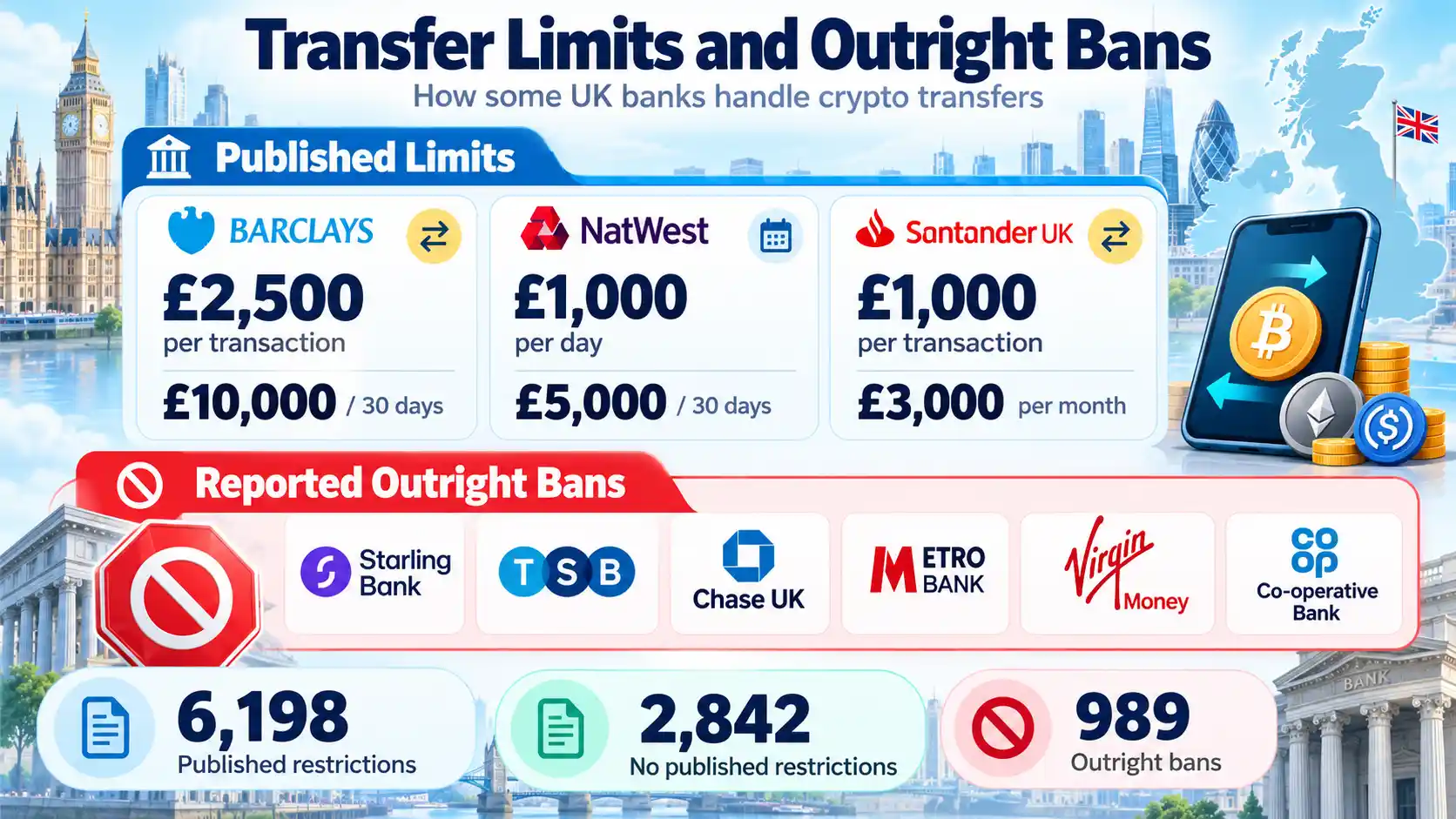
UK banks take different approaches to cryptocurrency payments. Some permit transfers subject to daily or monthly limits, while others block crypto-related payments altogether.
Under the reported policies, Barclays limits crypto transfers to £2,500 per transaction and £10,000 over 30 days. NatWest sets limits of £1,000 per day and £5,000 over 30 days, while Santander UK caps transfers at a £1,000 transaction ceiling and a £3,000 monthly limit. These restrictions are intended to reduce customers’ exposure to crypto-related scams and financial losses.
Other banks have adopted more restrictive policies. The findings identify Starling Bank, TSB, Chase UK, Metro Bank, Virgin Money and the Co-operative Bank among providers that block crypto transfers. Customers have also reported problems with institutions that do not publicly state a blanket restriction.
Complaints were not limited to banks with explicit limits. Institutions with published restrictions accounted for 6,198 complaints, compared with 2,842 involving banks without published restrictions and 989 involving banks with outright bans. The differences suggest that customers may struggle to predict whether a payment will be accepted, even when they have reviewed their bank’s stated policy.
The central concern is not simply that restrictions exist, but that policies may be inconsistent, difficult to understand or applied in ways customers cannot easily challenge.
Context is everything. Stay ahead of shifting trends with today’s market updates, and uncover emerging opportunities using the Serrari Group Market Index and Marketplace. Then, take control of your own financial future by exploring our Money & Life Reset Transformation Blueprint ™ to build stronger habits, create better systems, and design a path toward lasting wealth.
Fraud Prevention Versus Customer Access
Banks have legitimate reasons to scrutinise cryptocurrency transfers. Crypto-related scams, impersonation fraud and money laundering can expose customers to substantial losses, and transfers to digital asset platforms may require additional checks.
However, Stand With Crypto argues that blanket restrictions can prevent legitimate customers from accessing regulated platforms. The group has called for banks to move towards risk-based, case-by-case assessments rather than applying broad limits or prohibitions across the entire cryptocurrency sector.
It has also called for clearer explanations of when transfers may be blocked and practical ways for customers to challenge decisions. Better communication could help people understand whether a payment failed because of a published limit, a transaction-specific security check or a wider restriction.
The debate also raises questions about transparency. If a bank does not clearly explain its crypto policy, customers may find it difficult to choose a provider that meets their needs or understand why a transfer has been rejected.
Pressure Ahead of the UK’s 2027 Crypto Rules
The complaints come as the UK prepares to introduce a more comprehensive regulatory framework for cryptoasset businesses. The FCA’s new authorisation regime is scheduled to take effect on 25 October 2027, with applications opening in September 2026 and a transition process for firms seeking authorisation.
The regulatory changes are intended to establish clearer requirements for businesses operating in the sector. However, authorisation of crypto firms does not automatically oblige banks to process every payment to those businesses. Bank-level restrictions could therefore remain an obstacle even as the regulatory framework develops.
The issue has also attracted parliamentary attention. The Crypto and Digital Assets All-Party Parliamentary Group has examined access to banking services for crypto businesses, including how banks handle accounts and payments linked to digital assets.
The wider concern is that banking restrictions could undermine the UK’s ambition to become a leading global cryptocurrency hub. Crypto businesses need reliable banking services to operate, while customers need practical ways to fund accounts and move money between traditional financial institutions and regulated platforms.
Stand With Crypto has urged the FCA and HM Treasury to clarify how sector-wide restrictions fit with financial crime prevention obligations, particularly where transfers involve registered or authorised providers.
Outlook
The 10,092 complaints recorded over 90 days have intensified scrutiny of how UK banks manage cryptocurrency payments. While banks must protect customers against fraud and financial crime, inconsistent policies and unexplained restrictions can create uncertainty for legitimate users.
The next challenge will be finding a workable balance between effective safeguards and access to regulated crypto services. Clearer policies, proportionate transaction checks and meaningful appeal processes could improve customer confidence without removing essential fraud protections.
As the UK moves towards its 2027 regulatory framework, the relationship between banks and cryptocurrency businesses will remain an important test of whether the country can support digital asset innovation while maintaining financial security.
FAQs
1. How many complaints did UK banks receive over crypto transfers?
UK banks received 10,092 complaints from 9,803 individuals between May and August 2026 through Stand With Crypto’s online reporting tool.
2. Which UK bank received the most complaints?
Lloyds Banking Group received the most, with 2,297 complaints, followed by Barclays with 1,569 and NatWest Group with 1,278.
3. Why are UK banks restricting cryptocurrency transfers?
Banks cite concerns about scams, fraud and financial losses. Critics argue that blanket restrictions can also prevent legitimate customers from accessing regulated cryptocurrency platforms.
4. Will the UK’s 2027 crypto regulations end bank transfer restrictions?
Not necessarily. The new framework will regulate cryptoasset businesses, but it does not automatically require banks to process all transfers to cryptocurrency platforms.
SOURCES: Crypto.news | Yahoo Finance | Traders Union | BigGo Finance
Your financial future isn’t something you wait for—it’s something you build.
The real question is: when do you begin?
Move beyond simply staying informed.
Navigate the markets with clarity—track trends through the Serrari Group Market Index, uncover opportunities in the Serrari Marketplace, and build practical knowledge with our Curated Wealth Builder Platform.
Stay connected to what truly matters.
Get daily insights on macro trends and financial movements across Kenya, Africa, and global markets—delivered through the Serrari Newsletter.
Growth opens doors.
Advance your career through professional programs including ACCA, HESI A2, ATI TEAS 7 , HESI EXIT , NCLEX – RN and NCLEX – PN, Financial Literacy!🌟—designed to move you forward with confidence.
See where money is flowing—clearly and in real time.
Track Money Market Funds, Treasury Bills, Treasury Bonds, Green Bonds, and Fixed Deposits, alongside global and African indexes, key economic indicators, and the evolving Crypto and stablecoin landscape—all within Serrari’s Market Index.