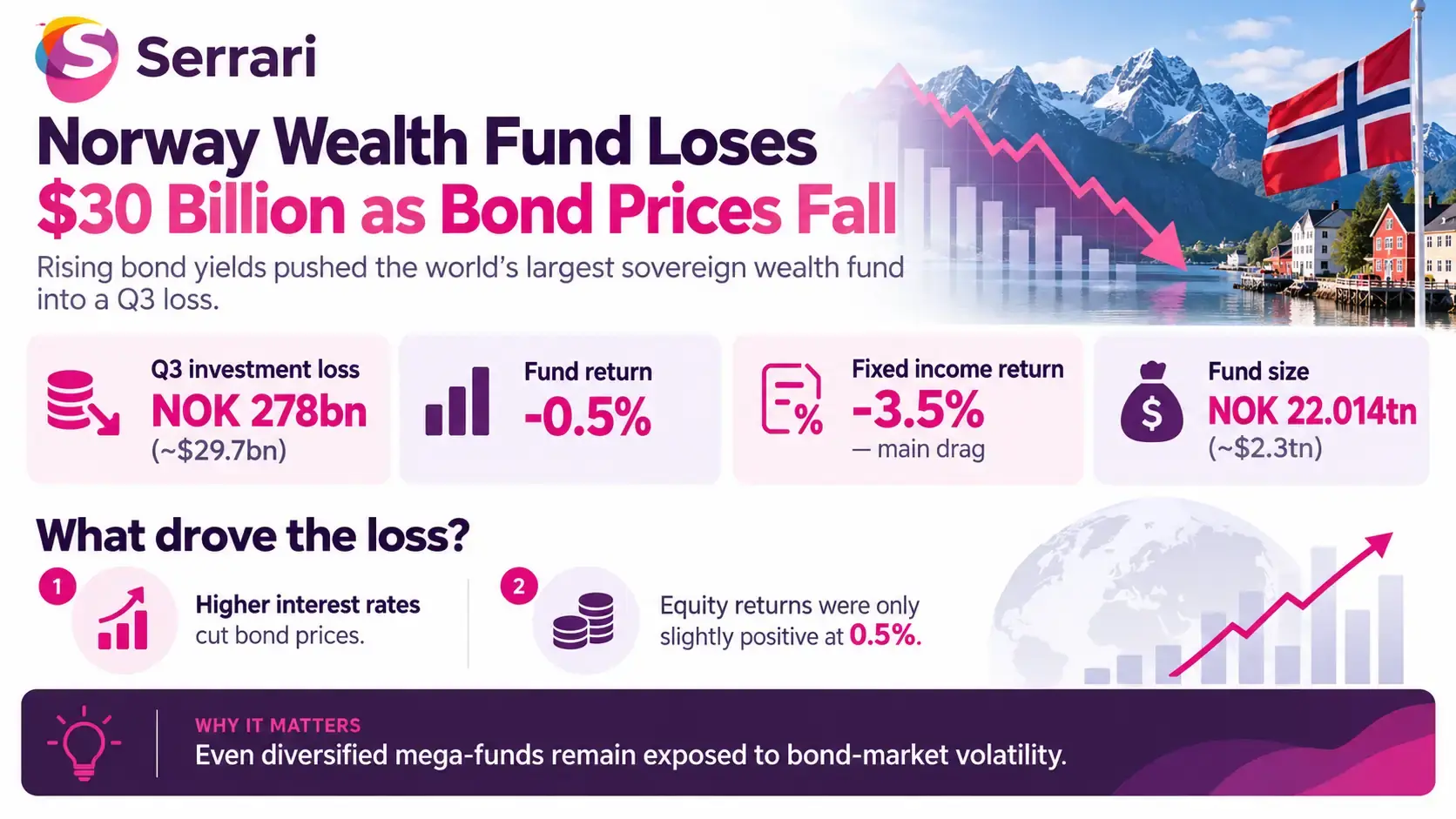
Norway’s $2.3 trillion sovereign wealth fund recorded an investment loss of 278 billion Norwegian kroner (approximately $29.7 billion) in the third quarter of 2026. Rising interest rates weakened bond prices, driving the fund’s overall return to -0.5%, even as its equity investments posted modest gains. The results highlight how higher borrowing costs can affect even the world’s largest diversified investment portfolio.
Key Overview
- Investment loss: NOK 278 billion (approximately $30 billion) in the three months ended September 2026.
- Overall return: -0.5%, mainly reflecting losses on fixed-income assets.
- Bond performance: Fixed-income investments returned -3.5%, compared with a 0.5% gain for equities.
- Portfolio size: NOK 22.014 trillion (approximately $2.3 trillion) as of September 30, 2026.
- Other assets: Unlisted real estate returned 0.4%, while renewable energy infrastructure gained 7.5%.
Rising Bond Yields Drive Third-Quarter Losses
The Government Pension Fund Global, managed by Norges Bank Investment Management (NBIM), reported that fixed-income investments fell 3.5% during the third quarter as market interest rates rose.
Higher bond yields generally reduce the market value of existing bonds, particularly longer-duration securities. As newly issued debt offers more attractive yields, older bonds with lower coupons become less valuable in secondary markets.
This mattered significantly because fixed-income assets represented 25.8% of the fund’s portfolio at quarter-end. Although equities account for a much larger share of its assets, their modest gains were insufficient to offset the bond losses.
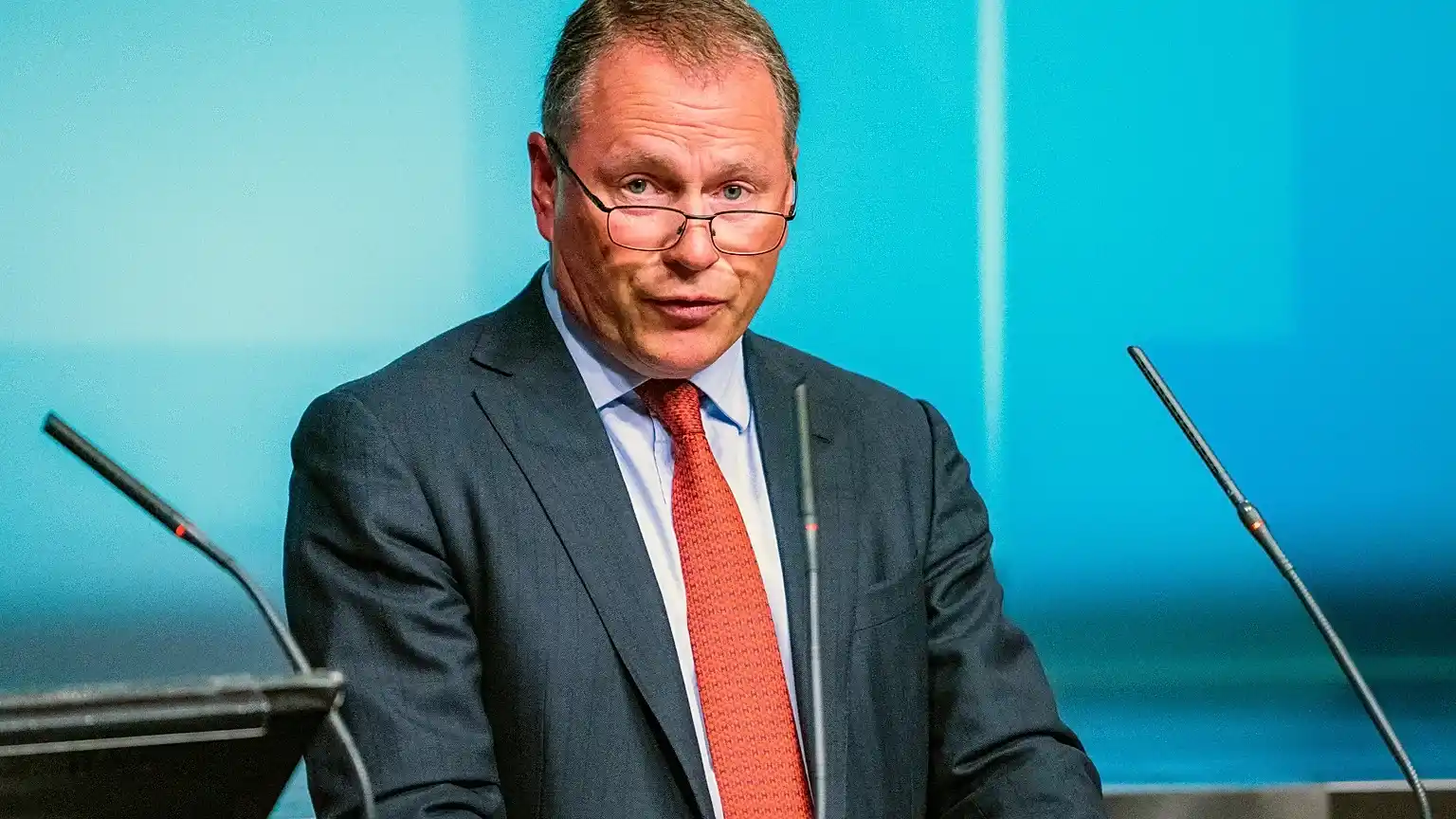
Deputy CEO Trond Grande attributed the slightly negative overall result to rising interest rates, while also noting substantial differences in performance across equity sectors.
Equities Remain Resilient Despite Market Volatility
The fund’s equity portfolio returned 0.5% in the quarter, offering some protection against the decline in bond holdings. According to the official third-quarter investment figures, equities accounted for 72.1% of total assets at the end of September.
Energy companies were among the strongest performers, while interest-rate-sensitive industries, including utilities and real estate, faced greater pressure. These differences show how higher interest rates and changing energy prices can produce sharply contrasting outcomes across sectors.
The fund holds stakes in thousands of businesses around the world, including major technology and energy companies. Its broad international exposure helps diversify risks, but does not eliminate losses when several global asset classes come under pressure simultaneously.
Context is everything. Stay ahead of shifting trends with today’s market updates, and uncover emerging opportunities using the Serrari Group Market Index and Marketplace. Then, take control of your own financial future by exploring our Money & Life Reset Transformation Blueprint ™ to build stronger habits, create better systems, and design a path toward lasting wealth.
Currency Movements Deepen the Decline in Fund Value
The reported $30 billion loss represents the fund’s investment performance, not its entire decline in market value.
The quarterly financial breakdown shows that the fund’s Norwegian-krone value fell by NOK 670 billion. A stronger krone reduced its reported value by NOK 472 billion, while net inflows after management costs contributed NOK 80 billion.
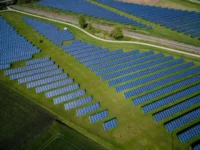
By September 30, the fund stood at NOK 22.014 trillion, with 1.6% allocated to unlisted real estate and 0.5% to unlisted renewable energy infrastructure. These smaller holdings returned 0.4% and 7.5%, respectively.
What the Results Mean for Global Investors
The quarterly setback follows a stronger first half of 2026, when the fund generated an overall return of 9.44%, according to its half-year financial report. That contrast illustrates how quickly investment conditions can shift when interest rates and asset valuations change.
For investors, the results reinforce the importance of monitoring bond duration, interest-rate exposure and portfolio diversification. Government bonds may offer relatively predictable income when held to maturity, but their market prices can still experience substantial short-term volatility.
Despite the quarterly loss, Norway’s sovereign wealth fund remains a major global investor, designed to preserve and grow the country’s petroleum wealth over generations rather than maximise returns in any single quarter.
Sources: Norges Bank Investment Management / Reuters / CNBC / Euronews
Your financial future isn’t something you wait for—it’s something you build.
The real question is: when do you begin?
Move beyond simply staying informed.
Navigate the markets with clarity—track trends through the Serrari Group Market Index, uncover opportunities in the Serrari Marketplace, and build practical knowledge with our Curated Wealth Builder Platform.
Stay connected to what truly matters.
Get daily insights on macro trends and financial movements across Kenya, Africa, and global markets—delivered through the Serrari Newsletter.
Growth opens doors.
Advance your career through professional programs including ACCA, HESI A2, ATI TEAS 7 , HESI EXIT , NCLEX – RN and NCLEX – PN, Financial Literacy!🌟—designed to move you forward with confidence.
See where money is flowing—clearly and in real time.
Track Money Market Funds, Treasury Bills, Treasury Bonds, Green Bonds, and Fixed Deposits, alongside global and African indexes, key economic indicators, and the evolving Crypto and stablecoin landscape—all within Serrari’s Market Index.