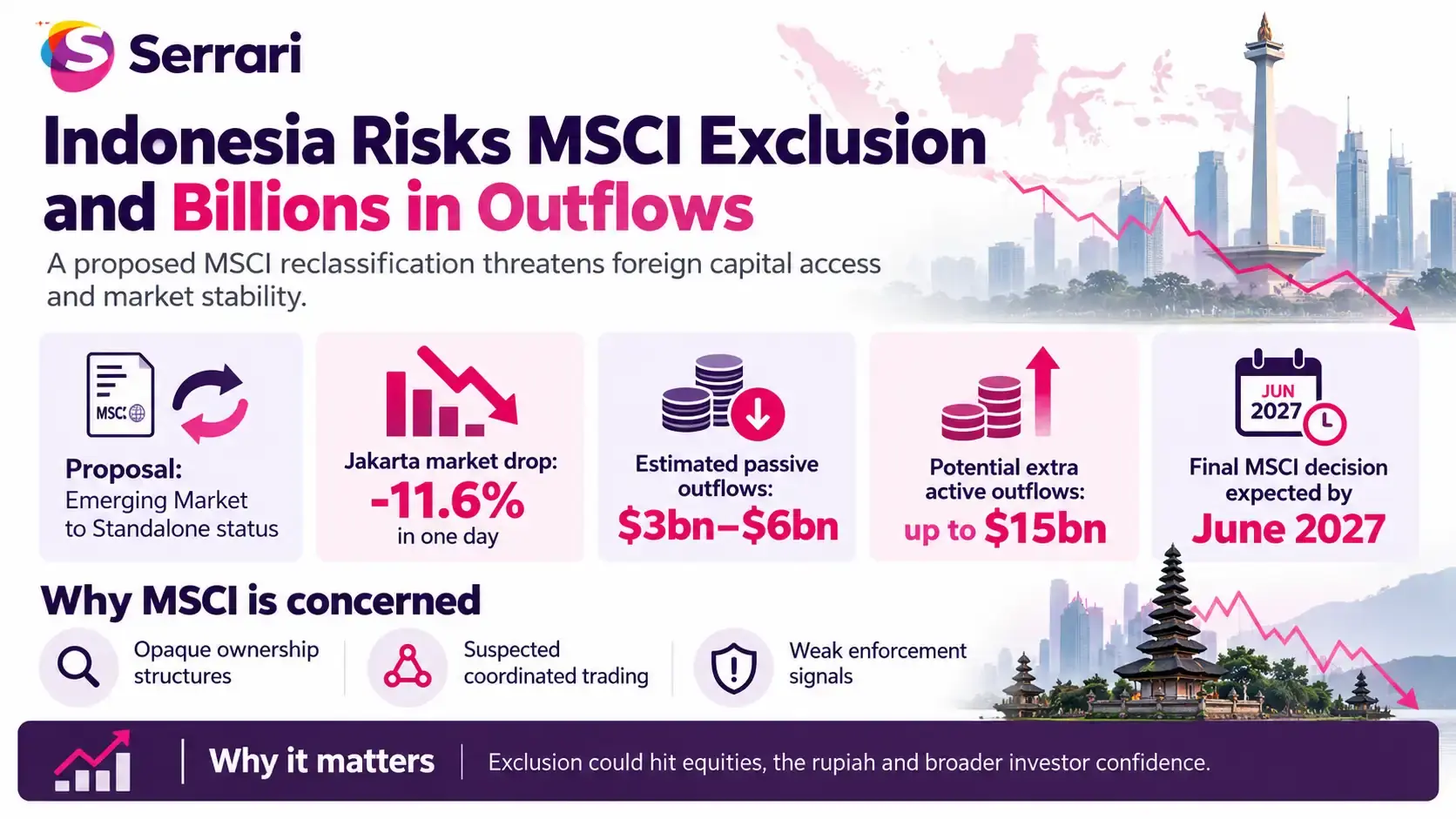
Indonesia faces a potential downgrade from emerging-market to standalone status after MSCI raised concerns about opaque share ownership, suspected coordinated trading and weak enforcement. The October 15, 2026 proposal rattled investors, triggering a sharp stock market selloff and renewed worries about foreign capital leaving Southeast Asia’s largest economy. A final decision is expected by June 2027, giving authorities time to demonstrate meaningful improvements.
Key Overview
- Proposed downgrade: MSCI is considering moving Indonesia directly from emerging-market to standalone classification, bypassing frontier-market status.
- Market reaction: Indonesian equities lost around $65 billion in value as the Jakarta Composite Index plunged 11.6% on October 16.
- Capital outflow risk: Estimates suggest 3billion–6 billion in passive investment withdrawals, with additional potential selling by active funds.
- Underlying concerns: Opaque ownership structures, suspected coordinated trading and insufficient evidence of effective enforcement.
- Decision timeline: Consultation feedback closes April 30, 2027, with a decision due by June 30, 2027.
Why MSCI Is Considering Indonesia’s Exclusion
In its October 15 classification proposal, MSCI argued that market reforms had not yet delivered consistent improvements in transparency and market integrity. It cited persistent uncertainty about companies’ true publicly tradable shares, commonly called free float, and concerns that coordinated trading could distort market prices.
Indonesia has belonged to MSCI’s emerging-market universe since 1989. Removing it from both emerging- and frontier-market benchmarks would be an unusually severe setback, because many international investment funds use these indexes to decide where to allocate money.
MSCI had previously flagged Indonesia’s governance problems in its June 2026 market classification review. The new proposal signals that the index provider considers the progress made so far insufficient.
Stock Market Rout Raises Capital Flight Fears
The announcement triggered an 11.6% market plunge on October 16, the Jakarta benchmark’s biggest one-day fall since the 1998 Asian financial crisis. Approximately $65 billion in stock market value was erased, while the rupiah weakened amid concern about potential foreign selling.
Analysts estimate that removing Indonesia from widely followed indexes could force $3 billion to $6 billion in passive fund outflows. JPMorgan estimated $4.8 billion, while UBS warned that active investors could withdraw a further $15 billion. These figures are forecasts, not withdrawals already completed.
The risk is amplified by Indonesia’s declining weighting in emerging-market benchmarks. Its index share reportedly fell from approximately 1.2% at the end of 2025 to 0.46% in October 2026, yet a complete exclusion could still prompt substantial portfolio adjustments.
Context is everything. Stay ahead of shifting trends with today’s market updates, and uncover emerging opportunities using the Serrari Group Market Index and Marketplace. Then, take control of your own financial future by exploring our Money & Life Reset Transformation Blueprint ™ to build stronger habits, create better systems, and design a path toward lasting wealth.
Why Standalone Status Matters for the Economy
A move to frontier-market status could attract investment from funds tracking frontier indexes. Standalone classification, however, would exclude Indonesia from both main categories, potentially shrinking its accessible international investor base.
The implications could extend beyond equities. Reduced foreign investment may put additional pressure on the rupiah, increase borrowing costs and complicate fundraising for private businesses and state-linked companies. Such consequences remain possible scenarios rather than inevitable outcomes.
Indonesia is a major exporter of nickel, coal and palm oil, making access to investment capital important for expanding production, infrastructure and industrial development.
Government Reforms and the Road to June 2027
Indonesian regulators have announced measures including enhanced disclosure of shareholders holding more than 1%, additional reporting on concentrated ownership and a roadmap to raise minimum free-float requirements to 15%.
Nevertheless, MSCI’s consultation announcement says reforms must demonstrate sustained, measurable improvements. Existing restrictions on certain Indonesian index additions and increases in index weights will remain in place until further notice.
The consultation runs until April 30, 2027, with a final determination due no later than June 30, 2027. Until then, Indonesia remains classified as an emerging market, but its ability to maintain that position will depend on restoring investor confidence and demonstrating credible regulatory enforcement.
Sources: MSCI / Reuters
Your financial future isn’t something you wait for—it’s something you build.
The real question is: when do you begin?
Move beyond simply staying informed.
Navigate the markets with clarity—track trends through the Serrari Group Market Index, uncover opportunities in the Serrari Marketplace, and build practical knowledge with our Curated Wealth Builder Platform.
Stay connected to what truly matters.
Get daily insights on macro trends and financial movements across Kenya, Africa, and global markets—delivered through the Serrari Newsletter.
Growth opens doors.
Advance your career through professional programs including ACCA, HESI A2, ATI TEAS 7 , HESI EXIT , NCLEX – RN and NCLEX – PN, Financial Literacy!🌟—designed to move you forward with confidence.
See where money is flowing—clearly and in real time.
Track Money Market Funds, Treasury Bills, Treasury Bonds, Green Bonds, and Fixed Deposits, alongside global and African indexes, key economic indicators, and the evolving Crypto and stablecoin landscape—all within Serrari’s Market Index.