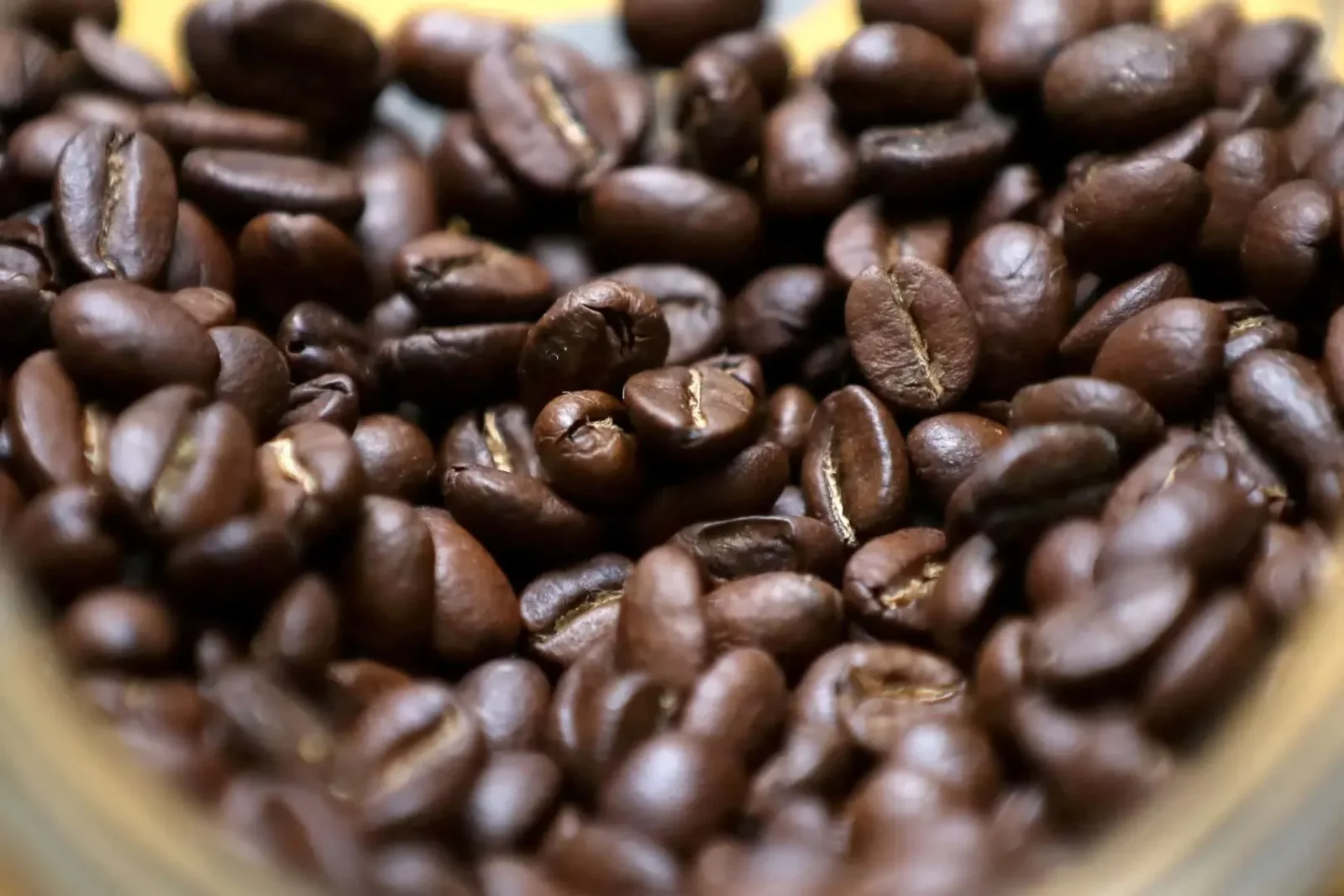
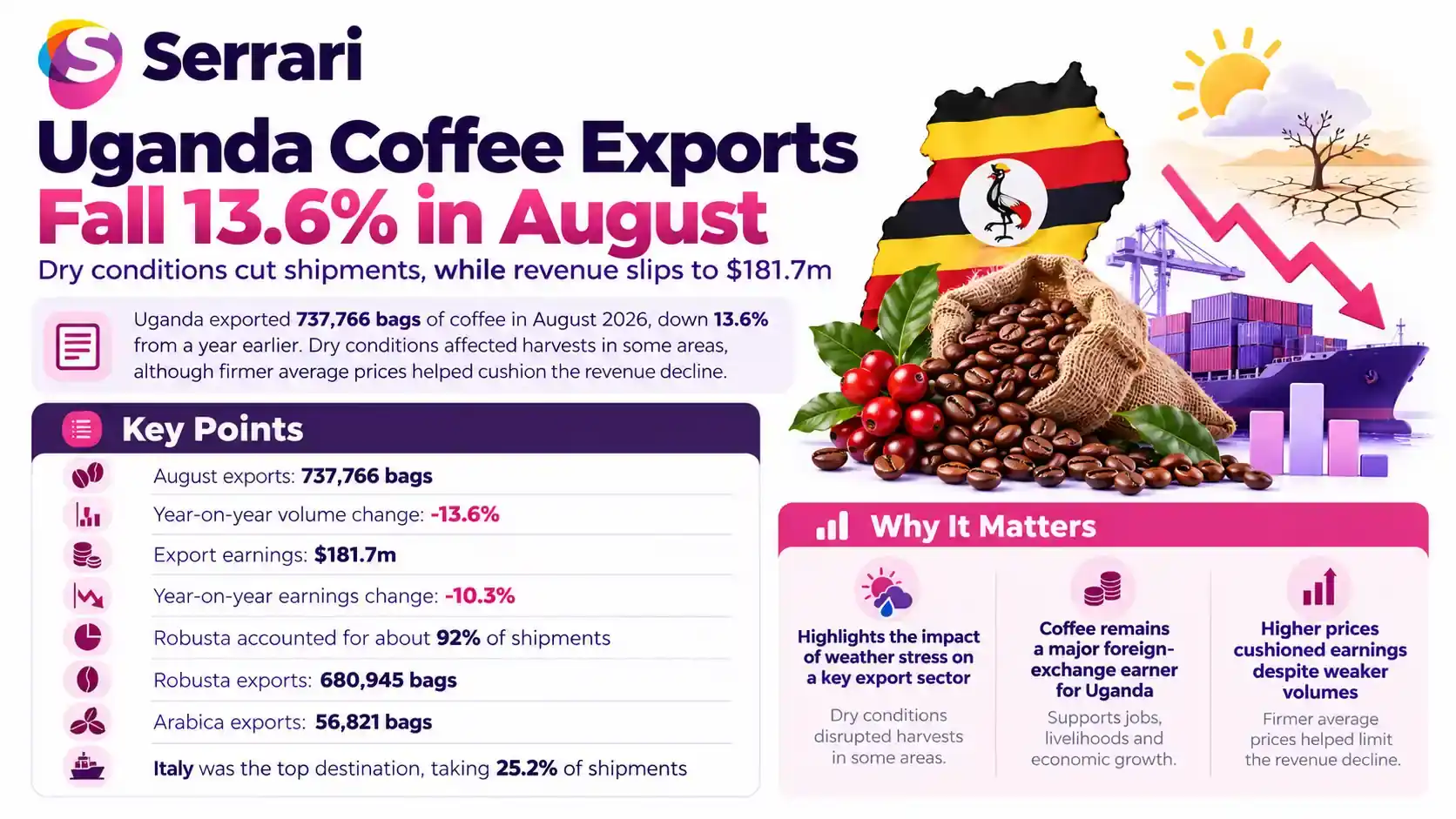
Uganda’s coffee exports fell 13.6% by volume in August 2026, with shipments declining to 737,766 bags of 60 kilograms each, from 853,543 bags a year earlier. Earnings dropped 10.3% to $181.7 million, compared with approximately $202.6 million in August 2025, according to the official monthly coffee export report.
Industry participants have linked weaker harvests in parts of Uganda to prolonged drought. However, the government export report does not attribute the entire decline to drought, and comparisons with unusually strong exports in the previous year also require caution.
Key Overview
- Export volume: 737,766 bags, down 13.6% from August 2025.
- Export earnings: $181.7 million, a 10.3% annual decline.
- Robusta shipments: 680,945 bags, representing approximately 92% of total exports.
- Arabica shipments: 56,821 bags, down 5.2% year on year.
- Average export value: Approximately $4.10 per kilogram, up from about $3.96 a year earlier.
- Leading destination: Italy accounted for 25.2% of August shipment volume.
Drought Adds Pressure to Uganda’s Coffee Harvest
A coffee industry participant cited in October 15 reporting on the export decline said prolonged drought had damaged coffee trees and reduced harvests in some growing areas.
Separately, Uganda’s agriculture minister described dry weather and unusually high temperatures affecting coffee production in parts of Greater Masaka, Kyotera, Sembabule and Luwero. The reported weather-related damage included disruption to flowering and coffee-cherry development.
The agriculture ministry’s August sector assessment also describes training farmers to conserve soil moisture through shade trees, cover crops and improved farm management. These measures address increasingly dry conditions, although the report does not calculate drought’s specific contribution to the monthly export decline.
Robusta Coffee Accounts for Most Shipments
Robusta remained Uganda’s dominant export variety, with 680,945 bags worth $161.1 million shipped in August. Robusta volumes fell 14.2% year on year, while earnings declined 10.4%.
Arabica exports reached 56,821 bags worth approximately $20.6 million. That represented a 5.2% decline in volume and a 9.4% fall in value compared with August 2025.
The detailed export breakdown places Robusta’s share of total shipment volume at about 92.3%, making changes in its production and export performance especially important to Uganda’s coffee trade.
Context is everything. Stay ahead of shifting trends with today’s market updates, and uncover emerging opportunities using the Serrari Group Market Index and Marketplace. Then, take control of your own financial future by exploring our Money & Life Reset Transformation Blueprint ™ to build stronger habits, create better systems, and design a path toward lasting wealth.
Higher Average Prices Cushion Export Earnings
Although Uganda shipped about 115,777 fewer bags than a year earlier, export revenue fell by a smaller percentage than shipment volume. The figures imply an average realised export value of about $4.10 per kilogram, compared with approximately $3.96 per kilogram in August 2025.
Over the 12 months ending August 2026, Uganda exported approximately 8.1 million bags worth $2.1 billion. The rolling-year export comparison shows volumes increased 1.6% while earnings declined 5.2% against the preceding 12-month period.
The international coffee market assessment also cautions that recent weaker year-on-year Ugandan shipments may partly reflect a return from exceptionally high exports in the previous coffee year, rather than a uniform deterioration in production.
Export Markets and the Outlook Ahead
Italy purchased 25.2% of Uganda’s August coffee shipments, followed by Sudan at 15.2% and Germany at 9.9%. Europe accounted for approximately 63% of export volume, while African markets received about 23%.
The ministry projected shipments of around 700,000 bags for September 2026, noting that the main harvest season had ended in Greater Masaka and southwestern Uganda. That figure is a forecast, not a confirmed September result.
For coffee farmers and exporters, the next few months will depend on local growing conditions, the timing of harvests and international prices. August’s decline highlights the sector’s exposure to weather risks, while the longer-term export figures show why one weaker month should not be mistaken for a definitive reversal in Uganda’s coffee industry.
Sources: Ministry of Agriculture, Animal Industry and Fisheries Uganda / Reuters / Uganda Business News / International Coffee Organization
Your financial future isn’t something you wait for—it’s something you build.
The real question is: when do you begin?
Move beyond simply staying informed.
Navigate the markets with clarity—track trends through the Serrari Group Market Index, uncover opportunities in the Serrari Marketplace, and build practical knowledge with our Curated Wealth Builder Platform.
Stay connected to what truly matters.
Get daily insights on macro trends and financial movements across Kenya, Africa, and global markets—delivered through the Serrari Newsletter.
Growth opens doors.
Advance your career through professional programs including ACCA, HESI A2, ATI TEAS 7 , HESI EXIT , NCLEX – RN and NCLEX – PN, Financial Literacy!🌟—designed to move you forward with confidence.
See where money is flowing—clearly and in real time.
Track Money Market Funds, Treasury Bills, Treasury Bonds, Green Bonds, and Fixed Deposits, alongside global and African indexes, key economic indicators, and the evolving Crypto and stablecoin landscape—all within Serrari’s Market Index.