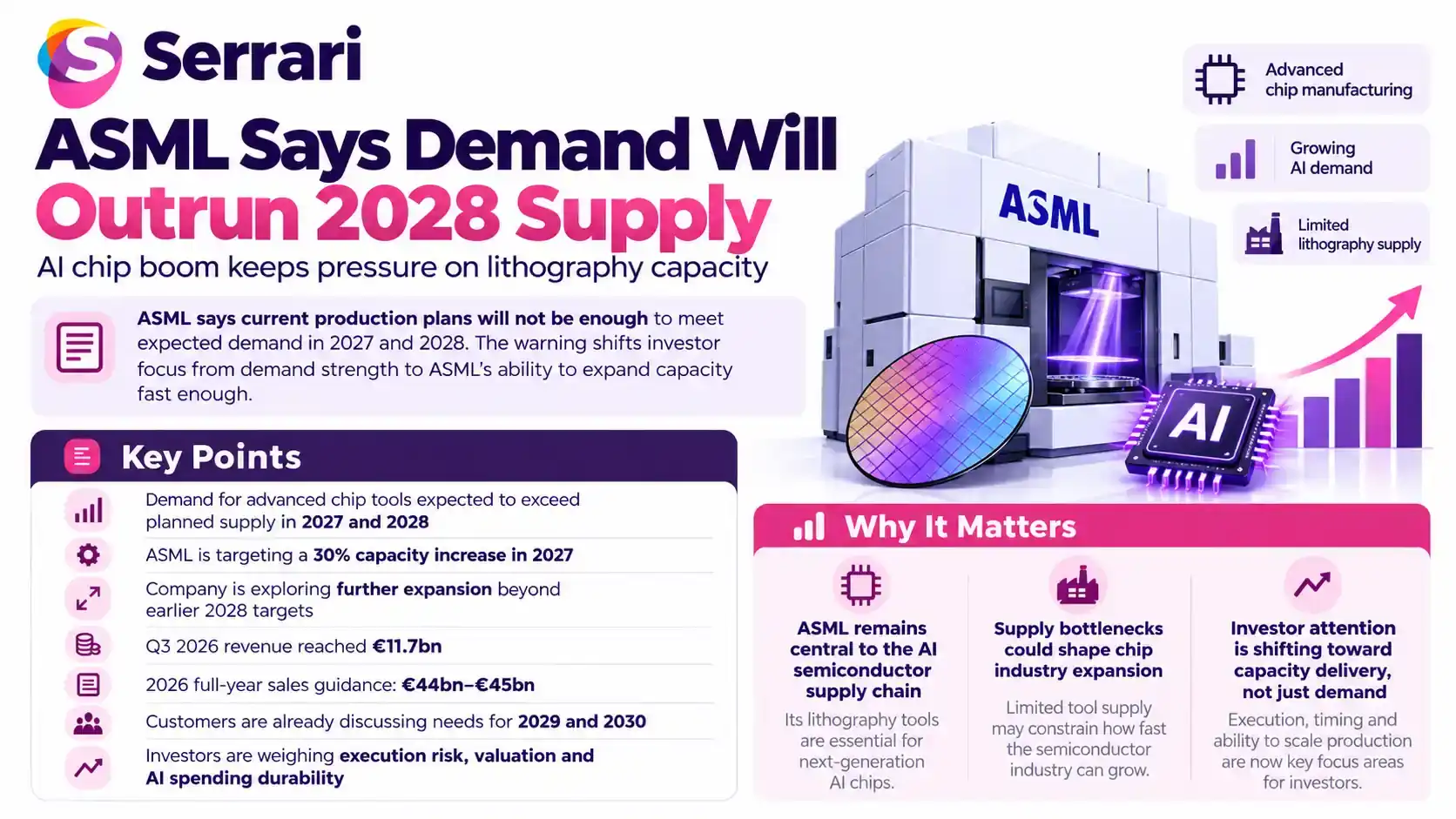
Dutch semiconductor equipment manufacturer ASML expects demand for its most advanced chipmaking systems to exceed currently planned production capacity in both 2027 and 2028. The warning, disclosed with its third-quarter 2026 results, reflects chipmakers’ efforts to expand manufacturing for artificial intelligence (AI) processors and advanced memory.
The outlook shifts attention from whether customers want ASML’s equipment to whether the company can deliver enough machines on time. Investors are also weighing expansion costs, the sustainability of AI spending and a share price that had climbed sharply earlier in 2026.
Key Overview
- Supply constraints: ASML expects its current 2027 and 2028 output plans to fall short of customer demand.
- Expansion plans: Capacity for certain lithography systems is targeted to rise 30% in 2027, with additional increases being investigated for 2028.
- Financial performance: Third-quarter revenue reached €11.7 billion, with €5.0 billion in net income.
- Full-year outlook: ASML forecasts 2026 sales of €44 billion to €45 billion.
- Future demand: Customers have expressed interest in equipment deliveries as far ahead as 2029 and 2030, but those requests are not all accepted orders.
- Investor concerns: Production execution, valuation and the profitability of wider AI infrastructure investment remain key uncertainties.
Why ASML Cannot Yet Meet Projected Demand
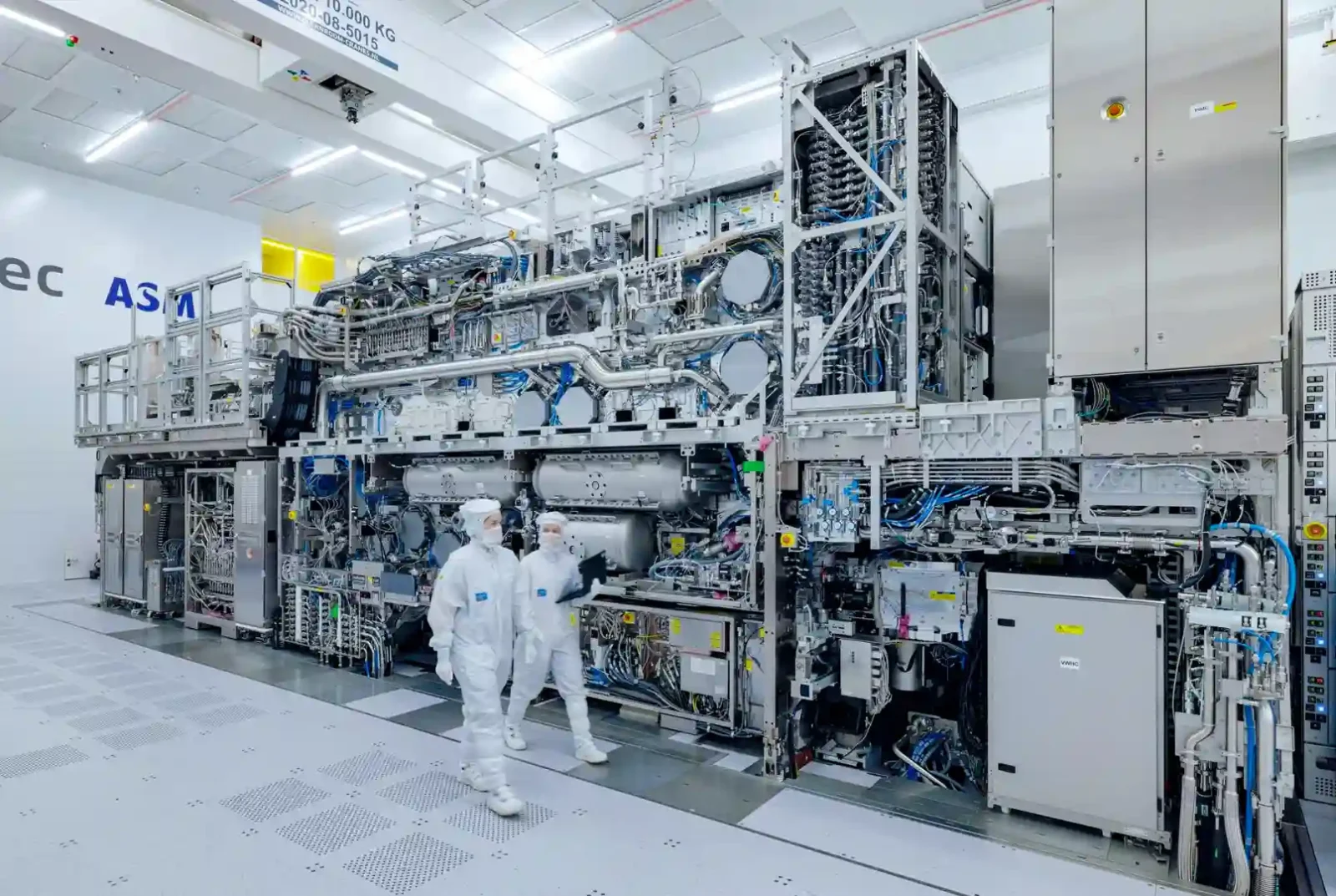
ASML supplies extreme ultraviolet (EUV) lithography systems, which use light to print exceptionally small patterns onto semiconductor wafers. These machines are critical to producing many leading-edge processors, while its deep ultraviolet (DUV) systems also serve a broad range of chipmaking processes.
The company’s updated capacity outlook calls for a 30% increase in capacity for low-numerical-aperture EUV and DUV immersion systems in 2027. Management is investigating ways to exceed a previously discussed further 30% growth target in 2028. These figures describe plans and investigations, not guaranteed deliveries.
To produce more output, ASML is shortening assembly times, improving equipment already installed at customer factories and developing faster models. The company’s manufacturing expansion plans also include additional facilities in Eindhoven, but their first phase is not expected to come online until 2029.
Context is everything. Stay ahead of shifting trends with today’s market updates, and uncover emerging opportunities using the Serrari Group Market Index and Marketplace. Then, take control of your own financial future by exploring our Money & Life Reset Transformation Blueprint ™ to build stronger habits, create better systems, and design a path toward lasting wealth.
Strong Earnings Add Pressure to Deliver
ASML reported record third-quarter revenue of €11.66 billion, up from €9.33 billion in the preceding quarter. Net income reached €4.96 billion, while the gross margin rose to 57.5% from 54.0%.
Revenue from maintenance, services and equipment upgrades also increased to approximately €3.3 billion. For the final quarter of 2026, the company expects sales of €14.2 billion to €15.2 billion and a gross margin near 57%. Its full-year sales guidance stands at €44 billion to €45 billion.
These figures show substantial current earnings strength. However, accelerating factory output may require more spending and complex coordination, leaving a gap between a strong order outlook and the profits eventually realised from it.
Why Investors Are Reassessing ASML’s Valuation
ASML shares had gained nearly 70% during 2026 before renewed market volatility on October 15. In the investor valuation debate, one fund analyst described the company’s forward price-to-earnings ratio as having fallen to about 30, compared with more than 45 in June.
A lower multiple can make a growing business appear less expensive, but it can also reflect doubts about future earnings expectations. Investors are examining whether AI data-centre projects will generate sufficient returns to justify continued heavy capital spending. Higher financing costs, power constraints and broader technology-sector volatility could also slow deployment, even where chip demand remains strong.
Customers Are Planning Further Into the Future
Major chipmakers are planning manufacturing investments several years ahead. TSMC, a key producer of chips for companies including Nvidia and Apple, reaffirmed a 2026 capital expenditure budget of $60 billion to $64 billion on October 15, while acknowledging tight equipment supply.
ASML says customers are discussing potential equipment requirements for 2029 and 2030. The company has not yet committed to accepting those longer-dated requests because it wants to assess total demand and available production capacity before allocating future delivery slots.
For investors, the central question is no longer simply whether AI is creating demand for advanced chips. It is whether ASML can turn that demand into timely equipment shipments and sustainable earnings without taking on excessive execution risk.
Sources: ASML / Reuters / TSMC
Your financial future isn’t something you wait for—it’s something you build.
The real question is: when do you begin?
Move beyond simply staying informed.
Navigate the markets with clarity—track trends through the Serrari Group Market Index, uncover opportunities in the Serrari Marketplace, and build practical knowledge with our Curated Wealth Builder Platform.
Stay connected to what truly matters.
Get daily insights on macro trends and financial movements across Kenya, Africa, and global markets—delivered through the Serrari Newsletter.
Growth opens doors.
Advance your career through professional programs including ACCA, HESI A2, ATI TEAS 7 , HESI EXIT , NCLEX – RN and NCLEX – PN, Financial Literacy!🌟—designed to move you forward with confidence.
See where money is flowing—clearly and in real time.
Track Money Market Funds, Treasury Bills, Treasury Bonds, Green Bonds, and Fixed Deposits, alongside global and African indexes, key economic indicators, and the evolving Crypto and stablecoin landscape—all within Serrari’s Market Index.