




A proposed US accounting update could make it easier for companies to include certain stablecoins in their reported cash equivalents, potentially reducing friction for corporate payments and treasury management. In a recent analysis of the proposal, Stripe-backed blockchain company Tempo argues that clearer treatment could help finance teams adopt digital-dollar payments without sacrificing reported liquidity.
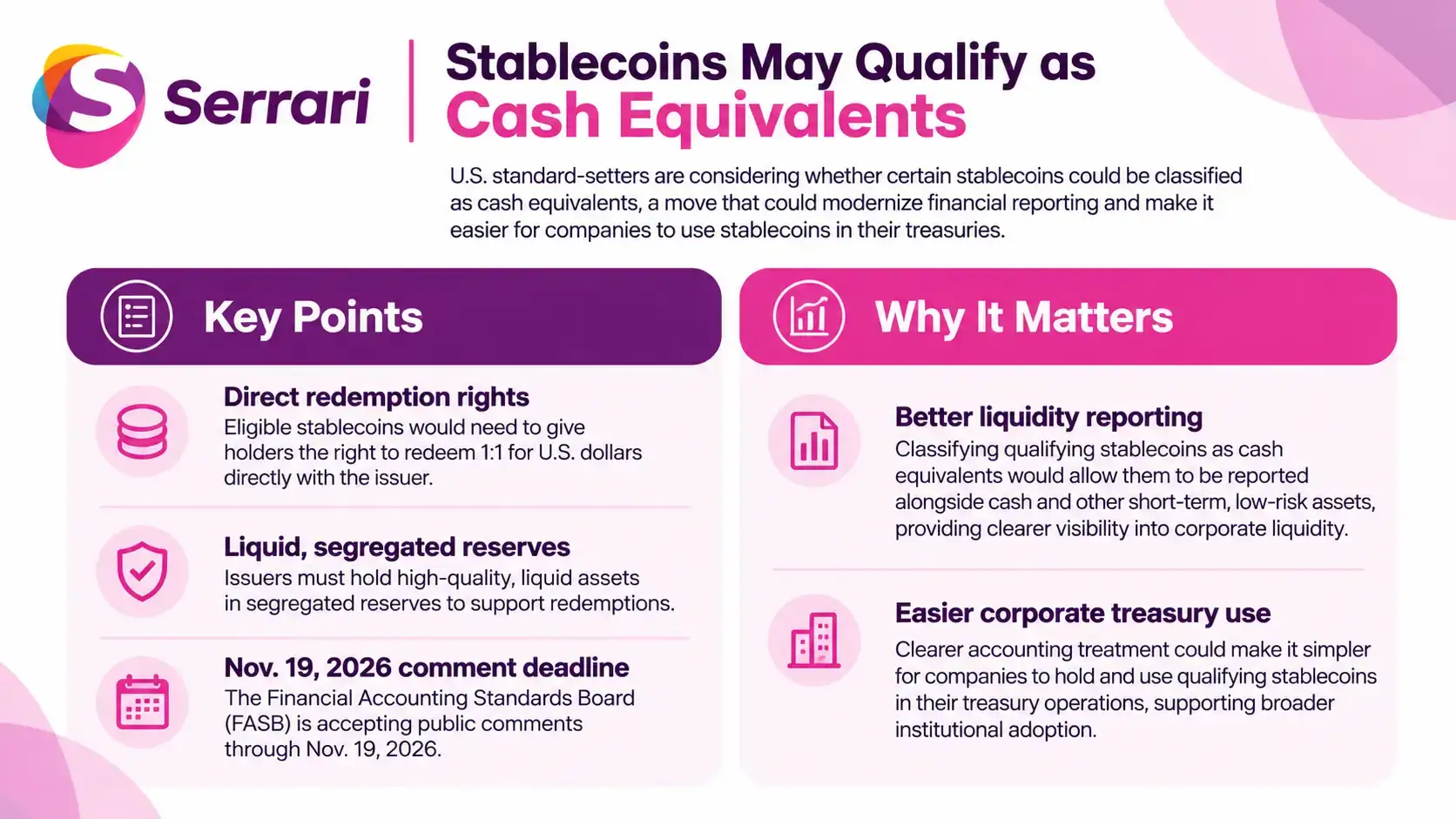
The Financial Accounting Standards Board (FASB) issued its draft accounting guidance on August 18, 2026. It does not redefine cash equivalents or automatically qualify every dollar-pegged token. Instead, it illustrates when existing accounting criteria can be met. Comments are due November 19, 2026, and no final effective date has been set.
Key Overview
- Proposed treatment: Certain stablecoins could qualify as cash equivalents under existing US accounting principles.
- Redemption conditions: Holders need on-demand contractual rights to redeem directly with the issuer for a known cash amount.
- Reserve standards: Issuers must maintain segregated, at least one-to-one backing in short-term, highly liquid assets under the qualifying example.
- Existing precedent: Coinbase already reports certain payment stablecoins as cash equivalents.
- Next milestone: Public comments close on November 19, 2026, before a final decision and implementation date.
Why Cash-Equivalent Status Matters to Companies
Companies use reported cash and cash equivalents to communicate how much liquidity is readily available. A stablecoin used for settlements can be economically convenient but may receive a different balance-sheet classification depending on its legal terms and accounting treatment.
That difference can affect reported liquidity measures and potentially loan covenants tied to specified cash balances. It does not automatically change a lender’s contractual definition of eligible liquidity. More consistent accounting could nevertheless make stablecoins easier to evaluate for supplier payments, cross-border transfers and treasury operations.
Three Tests That Determine Eligibility
The proposed illustrative accounting examples focus on three characteristics: an on-demand contractual cash redemption right, direct redemption with the issuer for a known amount, and segregated reserves covering at least the outstanding token value in short-term, highly liquid assets.
A company purchasing USDC on an exchange would not necessarily qualify merely because it can sell the tokens near $1. Without an enforceable direct redemption arrangement, secondary-market liquidity is insufficient under the proposed example. Similarly, direct redemption rights alone would not qualify a token backed by volatile assets such as gold and cryptocurrencies.
Crucially, classification depends on the holder’s rights and issuer’s reserves, not only the stablecoin’s brand. Qualifying companies could elect cash-equivalent presentation; it would not be compulsory.
Context is everything. Stay ahead of shifting trends with today’s market updates, and uncover emerging opportunities using the Serrari Group Market Index and Marketplace. Then, take control of your own financial future by exploring our Money & Life Reset Transformation Blueprint ™ to build stronger habits, create better systems, and design a path toward lasting wealth.
Coinbase Shows the Treatment Is Already Possible
The proposal addresses inconsistent existing practice rather than creating cash-equivalent accounting from scratch. In its 2025 annual financial statements, Coinbase disclosed that it had changed its accounting policy to classify payment stablecoins, including USDC, EURC and PYUSD, as cash equivalents.
Tempo cites Coinbase’s direct redemption arrangement with Circle as an example of why contractual access matters. Another business holding the same token without equivalent issuer rights could reach a different accounting conclusion.
Wider Disclosure and Regulatory Implications
Beyond stablecoins, the proposal would require companies reporting cash equivalents to disclose their significant components and corresponding amounts annually. The requirement could cover Treasury bills, money market funds and other qualifying instruments even where no digital assets are held.
The accounting debate follows the GENIUS Act signed in July 2025, which established a federal framework for payment stablecoin issuers. The law takes effect on January 18, 2027, or 120 days after federal regulators issue final implementing rules, whichever is earlier. It also restricts cash-equivalent treatment for payment stablecoins issued by non-permitted issuers once applicable.
Meanwhile, stablecoin market data show total market capitalization above $300 billion, although that total includes more than dollar-pegged tokens. Separately, the US administration has reportedly considered overseas stablecoin partnerships to support international dollar use; no confirmed rollout was identified in that report.
What Happens Next?
Before the November 19 comment deadline, corporate finance teams can review issuer agreements, redemption fees and restrictions, reserve disclosures, and the wording of any loan covenants. The final standard may differ from the proposal, and companies will still need to assess applicable laws, internal controls and accounting policies before treating stablecoins as cash equivalents.
Sources: FASB / Tempo / Deloitte / US Securities and Exchange Commission / US Government Publishing Office / DefiLlama / Bloomberg
Your financial future isn’t something you wait for—it’s something you build.
The real question is: when do you begin?
Move beyond simply staying informed.
Navigate the markets with clarity—track trends through the Serrari Group Market Index, uncover opportunities in the Serrari Marketplace, and build practical knowledge with our Curated Wealth Builder Platform.
Stay connected to what truly matters.
Get daily insights on macro trends and financial movements across Kenya, Africa, and global markets—delivered through the Serrari Newsletter.
Growth opens doors.
Advance your career through professional programs including ACCA, HESI A2, ATI TEAS 7 , HESI EXIT , NCLEX – RN and NCLEX – PN, Financial Literacy!🌟—designed to move you forward with confidence.
See where money is flowing—clearly and in real time.
Track Money Market Funds, Treasury Bills, Treasury Bonds, Green Bonds, and Fixed Deposits, alongside global and African indexes, key economic indicators, and the evolving Crypto and stablecoin landscape—all within Serrari’s Market Index.