















Recent moves in the U.S. Treasury yields reflect growing expectations that the Federal Reserve may raise interest rates later in 2026. Markets reacted strongly to the Fed’s more hawkish tone under Chairman Kevin Warsh, pushing short-term yields to their highest levels in more than a year.
Key Overview
- The 2-year Treasury yield recorded its biggest Fed-day jump since 2008.
- Kevin Warsh’s first Fed meeting delivered a hawkish message.
- The Fed kept rates unchanged at 3.5%-3.75%.
- Markets are pricing in higher odds of a rate hike later in 2026.
- The 2-year yield climbed above 4.20%.
- Long-term Treasury yields moved lower.
- The yield curve flattened further.
- Strong economic data supported the Fed’s cautious stance.
- Inflation concerns remain above the Fed’s 2% target.
- Investors are increasingly focused on near-term policy tightening.
2-Year Treasury Yield Jumps on Hawkish Fed Signals
The 2-year Treasury yield climbed sharply following the conclusion of Federal Reserve Chairman Kevin Warsh’s first policy meeting, as investors reacted to a more hawkish outlook on interest rates.
The yield on the two-year note, which closely tracks expectations for Federal Reserve policy, rose for a second consecutive day after recording its largest increase on a Fed meeting day since March 2008.
The move reflects growing market expectations that policymakers could raise borrowing costs later in 2026 instead of cutting rates as many investors had previously anticipated.
Although the Federal Reserve left the benchmark federal funds rate unchanged at 3.5% to 3.75%, comments from officials and updated projections suggested that concerns over persistent inflation continue to dominate policy discussions.
The result was a sharp repricing across short-term debt markets, while longer-term Treasury yields moved lower.
The divergence between short- and long-term rates highlights investors’ increasing focus on the path of monetary policy over the coming months.
U.S. Treasury Yields React to Hawkish Fed Outlook
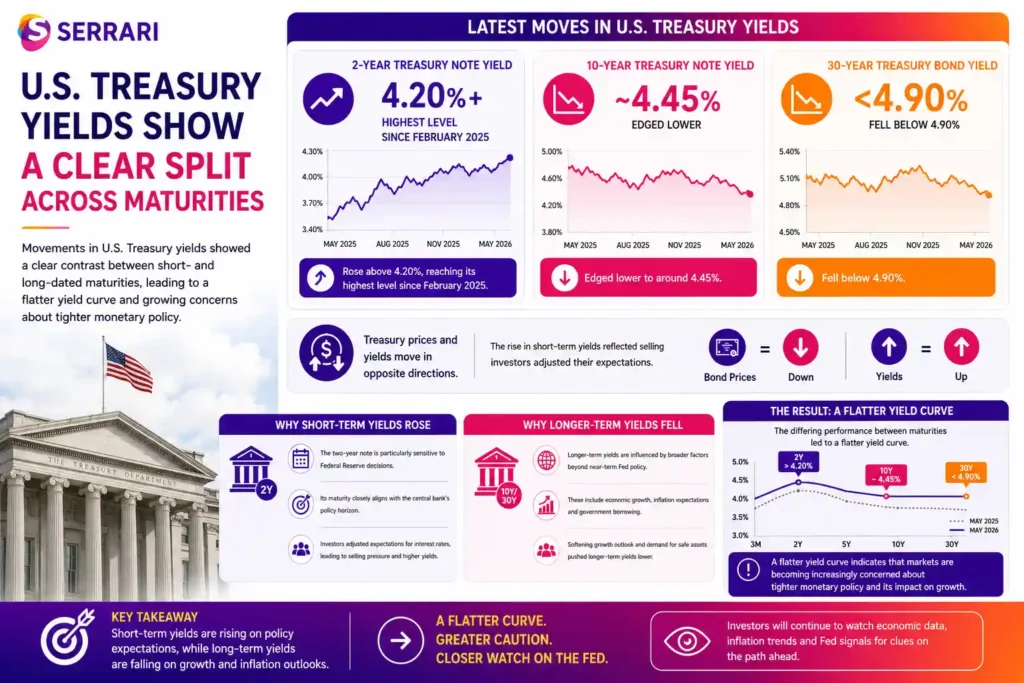
Movements in U.S. Treasury yields showed a clear contrast between short- and long-dated maturities.
The two-year note yield rose above 4.20%, reaching its highest level since February 2025.
Meanwhile, the benchmark 10-year Treasury yield edged lower to around 4.45%, while the 30-year Treasury bond yield fell below 4.90%.
Because Treasury prices and yields move in opposite directions, the rise in short-term yields reflected selling pressure as investors adjusted their expectations.
The two-year note is particularly sensitive to Federal Reserve decisions because its maturity closely aligns with the central bank’s policy horizon.
Longer-term yields, however, are influenced by broader factors such as economic growth, inflation expectations and government borrowing.
The differing performance between maturities led to a flatter yield curve, indicating that markets are becoming increasingly concerned about tighter monetary policy.
Treasury Yield Surge Marks Biggest Fed-Day Move Since 2008
The latest Treasury yield surge represented one of the most significant reactions to a Federal Reserve meeting in nearly two decades.
According to MUFG, the jump of more than 16 basis points in the two-year yield was the largest increase on a Fed decision day since March 2008.
Markets interpreted the latest projections and policy statement as a signal that the central bank is becoming more concerned about inflation risks.
Updated forecasts showed that nine Fed officials now expect interest rates to increase before the end of 2026.
This marks a notable shift from earlier expectations that policymakers would move toward easing monetary conditions.
The yield premium between 30-year and two-year Treasuries also narrowed to near a fourteen-month low, reflecting stronger emphasis on short-term policy tightening.
Such flattening of the curve is often viewed as evidence that markets anticipate higher rates in the near future.
Hawkish Fed Policy Changes Market Expectations
The market reaction was largely driven by perceptions of a more hawkish Fed policy stance.
While the Federal Reserve kept rates unchanged, officials signaled that inflation remains a concern and that additional tightening may be necessary.
The updated dot plot revealed that half of Federal Open Market Committee members expect at least one rate increase before the end of the year.
Only one policymaker projected a rate cut.
According to Tom Graff, chief investment officer at Facet, the latest projections represent a marked shift compared with previous forecasts that favored lower rates.
Chris Rupkey, chief economist at FWDBONDS, argued that the economy currently faces no material downside risks, giving policymakers room to maintain their restrictive stance.
The changing outlook has led investors to reassess expectations for future interest rates.
Interest-rate futures now imply a strong probability that the Fed could raise borrowing costs by October.
Short-Term Interest Rates Rise Alongside Strong Economic Data
Developments in short-term interest rates have been reinforced by resilient economic indicators.
Initial jobless claims rose modestly to 226,000, slightly above expectations but still consistent with a relatively strong labor market.
Meanwhile, the Philadelphia Fed manufacturing index improved significantly in June, rising to 10.3 from negative territory in May.
Consumer spending data also pointed to continued economic resilience.
Core retail sales increased by 0.7% in May after a 0.5% gain in April, indicating that household demand remains relatively healthy.
These figures have supported the Federal Reserve’s decision to maintain current policy settings while keeping the possibility of further tightening on the table.
Strong economic activity reduces the urgency for rate cuts and strengthens the case for maintaining restrictive monetary conditions.
Context is everything. Stay ahead of shifting trends with today’s market updates, and uncover emerging opportunities using the Serrari Group Market Index and Marketplace. Then, take control of your own financial future by exploring our Money & Life Reset Transformation Blueprint ™ to build stronger habits, create better systems, and design a path toward lasting wealth.
Warsh Fed Outlook Signals Inflation Concerns
The emerging Warsh Fed outlook suggests that inflation remains the central challenge facing policymakers.
Although inflation has moderated from previous highs, it continues to remain above the Federal Reserve’s 2% target.
Policymakers are therefore increasingly focused on preventing inflation from becoming entrenched.
Kevin Warsh’s first meeting as chairman emphasized maintaining credibility in the fight against rising prices.
The removal of language that previously hinted at future rate cuts reinforced the perception that the central bank is prepared to act if inflation remains stubborn.
Investors interpreted this as evidence that the Federal Reserve may prioritize price stability over concerns about slowing growth.
As a result, expectations for easier monetary policy have diminished significantly.
Bond Market Reaction Highlights Policy Risks
The broader bond market reaction underscores how sensitive investors remain to changes in Federal Reserve communication.
Short-term yields surged while longer-term rates declined, creating a flatter yield curve and increasing attention on the outlook for interest rates.
The response reflects concerns that borrowing costs could remain elevated for longer than previously expected.
Higher short-term rates influence financing costs throughout the economy, affecting everything from corporate borrowing to consumer lending.
Mortgage rates, auto loans and credit card rates are all influenced by movements in Treasury markets.
As investors digest the implications of a more hawkish Federal Reserve, volatility across fixed-income markets could remain elevated.
Future inflation readings and economic indicators will likely determine whether expectations for additional rate hikes continue to strengthen.
Conclusion
The sharp rise in the 2-year Treasury yield highlights how dramatically market expectations have shifted following Kevin Warsh’s first Federal Reserve meeting. Although the Fed kept rates unchanged, officials signaled increasing concern about inflation and opened the door to possible future rate hikes.
Strong economic data and a hawkish policy outlook have pushed short-term yields to their highest levels since early 2025. As investors continue to monitor inflation and growth, Treasury markets are likely to remain highly sensitive to changes in Federal Reserve guidance.
FAQs
1. Why did the 2-year Treasury yield rise sharply?
The 2-year Treasury yield increased after the Federal Reserve adopted a more hawkish tone and signaled that additional rate hikes could occur later in 2026. Investors adjusted their expectations, leading to one of the biggest Fed-day yield increases since 2008.
2. Why is the 2-year Treasury yield important?
The two-year Treasury note closely reflects expectations for Federal Reserve policy. Changes in its yield often indicate how investors expect interest rates to evolve over the next several years and can influence borrowing costs across the economy.
3. Did the Federal Reserve raise interest rates?
No. The Federal Reserve kept the benchmark federal funds rate unchanged at 3.5% to 3.75%. However, policymakers indicated that inflation risks remain elevated, leading markets to price in the possibility of future rate increases.
4. What does a flatter yield curve mean?
A flatter yield curve occurs when the difference between short-term and long-term Treasury yields narrows. This often signals that investors expect tighter monetary policy in the near term and may anticipate slower economic growth over the longer term.
Sources: Reuters, CNBC, Yahoo Finance, The Wall Street Journal, Equiti
Your financial future isn’t something you wait for—it’s something you build.
The real question is: when do you begin?
Move beyond simply staying informed.
Navigate the markets with clarity—track trends through the Serrari Group Market Index, uncover opportunities in the Serrari Marketplace, and build practical knowledge with our Curated Wealth Builder Platform.
Stay connected to what truly matters.
Get daily insights on macro trends and financial movements across Kenya, Africa, and global markets—delivered through the Serrari Newsletter.
Growth opens doors.
Advance your career through professional programs including ACCA, HESI A2, ATI TEAS 7 , HESI EXIT , NCLEX – RN and NCLEX – PN, Financial Literacy!🌟—designed to move you forward with confidence.
See where money is flowing—clearly and in real time.
Track Money Market Funds, Treasury Bills, Treasury Bonds, Green Bonds, and Fixed Deposits, alongside global and African indexes, key economic indicators, and the evolving Crypto and stablecoin landscape—all within Serrari’s Market Index.