
















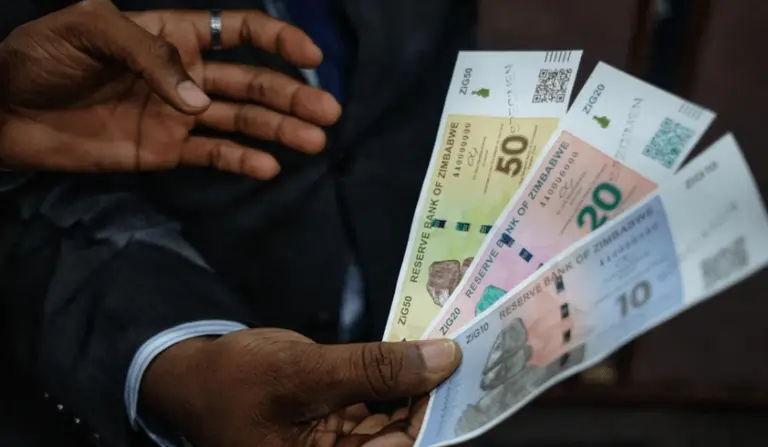
The Reserve Bank of Zimbabwe (RBZ) has opted to maintain its key interest rate at 35%, signaling a commitment to a tight monetary policy even as the country’s newly introduced currency, the Zimbabwe Gold (ZiG), continues to depreciate.
The decision reflects the central bank’s strategy to curb inflation, stabilize the currency, and restore confidence in the monetary system. However, the move has sparked debate, as economic challenges persist, and the local population increasingly prefers U.S. dollars for transactions over ZiG.
Why the RBZ Maintained the 35% Interest Rate
The RBZ’s decision to hold rates steady at 35% is part of a broader strategy to:
- Stabilize the ZiG currency, which has depreciated over 43% since its launch in April 2024.
- Contain inflationary pressures, which have surged in both local and U.S. dollar terms.
- Reinforce market confidence by preventing further capital flight and exchange rate volatility.
- Attract foreign investment by keeping interest rates attractive to lenders.
RBZ Governor John Mushayavanhu defended the move, stating that a high interest rate environment is necessary to control market volatility and prevent further currency erosion.
Currency Depreciation and Inflation Trends
Despite these efforts, ZiG has continued to lose value, dropping from an exchange rate of 13.9 per U.S. dollar in April 2024 to 24.6 per dollar as of February 2025.
- The currency’s weakness is attributed to low adoption rates, with only 30% of Zimbabweans transacting in ZiG, while the majority (70%) prefer using U.S. dollars.
- The lack of confidence stems from Zimbabwe’s history of failed currencies, including the Zimbabwean dollar (which collapsed in 2008 due to hyperinflation), the bond notes, and RTGS dollar.
- Many businesses and individuals fear ZiG will follow the same fate, making them reluctant to fully transition away from the dollarized economy.
Inflation, a persistent challenge for Zimbabwe, has also surged:
- ZiG inflation rose from 3.7% to 10.5% on a month-to-month basis in January.
- U.S. dollar inflation jumped from 2.5% to 14.6% over the same period, indicating that even dollar-based transactions are being affected by price volatility.
- The biggest contributors to inflation include rising food prices, housing costs, and imported goods, which are subject to exchange rate fluctuations.
The Challenge of a Dual-Currency System
Zimbabwe operates under a dual-currency system, where both ZiG and U.S. dollars are legal tender. However, this arrangement creates several economic distortions:
- Wage Pressures:
- Workers paid in ZiG struggle to keep up with rising prices, while those paid in U.S. dollars have greater purchasing power.
- This creates income inequality and fuels demand for more U.S. dollar wages, adding pressure to businesses.
- Retail and Pricing Disparities:
- Many shops and service providers list prices in U.S. dollars and apply a higher exchange rate for ZiG payments, making the local currency less attractive for daily use.
- Some retailers reject ZiG altogether, further undermining its adoption.
- Banking Sector Liquidity Issues:
- Banks face low demand for ZiG-denominated loans, as businesses prefer financing in stable U.S. dollars.
- This affects the efficacy of the central bank’s monetary policies, limiting its ability to stimulate economic growth.
Stock Market and Investor Reactions
The RBZ’s decision to maintain high interest rates has divided opinion among investors and financial analysts.
1. Stock Market Reaction
- The Zimbabwe Stock Exchange (ZSE) saw mixed reactions, with investors wary that high interest rates could stifle economic expansion.
- Investors in interest-sensitive sectors—such as real estate, construction, and manufacturing—have expressed concerns that borrowing costs remain too high to stimulate business growth.
2. Banking Sector Perspective
- Commercial banks and lenders argue that a more accommodative monetary policy (lower interest rates) could encourage lending and economic activity.
- However, the central bank insists that maintaining a tight monetary stance is necessary to prevent further currency instability.
Government Efforts to Support Economic Growth
To counterbalance the negative effects of high interest rates, the Zimbabwean government has introduced several initiatives to support economic activity:
1. Targeted Finance Facility
In late 2024, the RBZ launched the Targeted Finance Facility, a special-purpose fund aimed at:
- Providing capital to key productive sectors such as agriculture, mining, and manufacturing.
- Supporting small and medium-sized enterprises (SMEs) that struggle to access credit due to high borrowing costs.
2. Foreign Currency Reserves and Trade Strategy
On a positive note, Zimbabwe’s foreign currency reserves increased to $548 million in January, providing:
- A buffer against exchange rate fluctuations.
- More liquidity to support trade and essential imports.
3. Import Substitution and Local Industry Promotion
- The government is pushing for greater self-reliance, promoting local industries to reduce dependence on imported goods.
- However, low industrial capacity utilization and power shortages remain major obstacles to domestic production growth.
What Lies Ahead: Will Interest Rates Change in 2025?
As Zimbabwe navigates a complex economic landscape, the big question remains: Will the RBZ cut interest rates later in 2025?
Factors That Could Lead to a Rate Cut
- If inflation declines significantly, the central bank may ease monetary policy to boost economic growth.
- Greater adoption of ZiG and improved confidence in the currency could reduce pressure on the RBZ to maintain high rates.
- A more stable exchange rate environment would provide room for lower borrowing costs.
Challenges That Could Keep Interest Rates High
- Persistent inflationary pressures, especially in food and energy prices, could force the RBZ to maintain or even increase rates.
- Lack of trust in ZiG may keep dollarization levels high, limiting the effectiveness of monetary policy tools.
- Global economic factors, such as a strong U.S. dollar or rising commodity prices, could impact Zimbabwe’s economy.
IMF and External Monetary Policy Influence
The International Monetary Fund (IMF) has urged Zimbabwe to implement structural reforms to:
- Strengthen monetary and fiscal policies.
- Improve currency stability.
- Restore investor confidence in the country’s financial system.
Conclusion: A Fragile Balancing Act for Zimbabwe’s Economy
Zimbabwe’s decision to hold its interest rate at 35% reflects a delicate balancing act between:
- Stabilizing the currency and controlling inflation.
- Supporting economic growth while maintaining investor confidence.
- Addressing structural challenges in a dual-currency environment.
While foreign reserves have increased and the government is pushing for local industry growth, the underlying issues of low confidence in ZiG and high inflation remain persistent risks.
For now, Zimbabwe’s tight monetary stance is aimed at restoring economic credibility. However, if inflation continues to rise and ZiG fails to gain public trust, the central bank may have to reconsider its approach in the coming months.
As the RBZ and government navigate these challenges, all eyes will be on how Zimbabwe manages its currency experiment, whether inflation stabilizes, and whether the interest rate policy shifts in 2025 to promote economic growth and financial stability.
Ready to take your career to the next level? Join our dynamic courses: ACCA, HESI A2, ATI TEAS 7 , HESI EXIT , NCLEX – RN and NCLEX – PN, Financial Literacy!🌟 Dive into a world of opportunities and empower yourself for success. Explore more at Serrari Ed and start your exciting journey today! ✨
photo source: Google
By: Montel Kamau
Serrari Financial Analyst
7th January, 2025