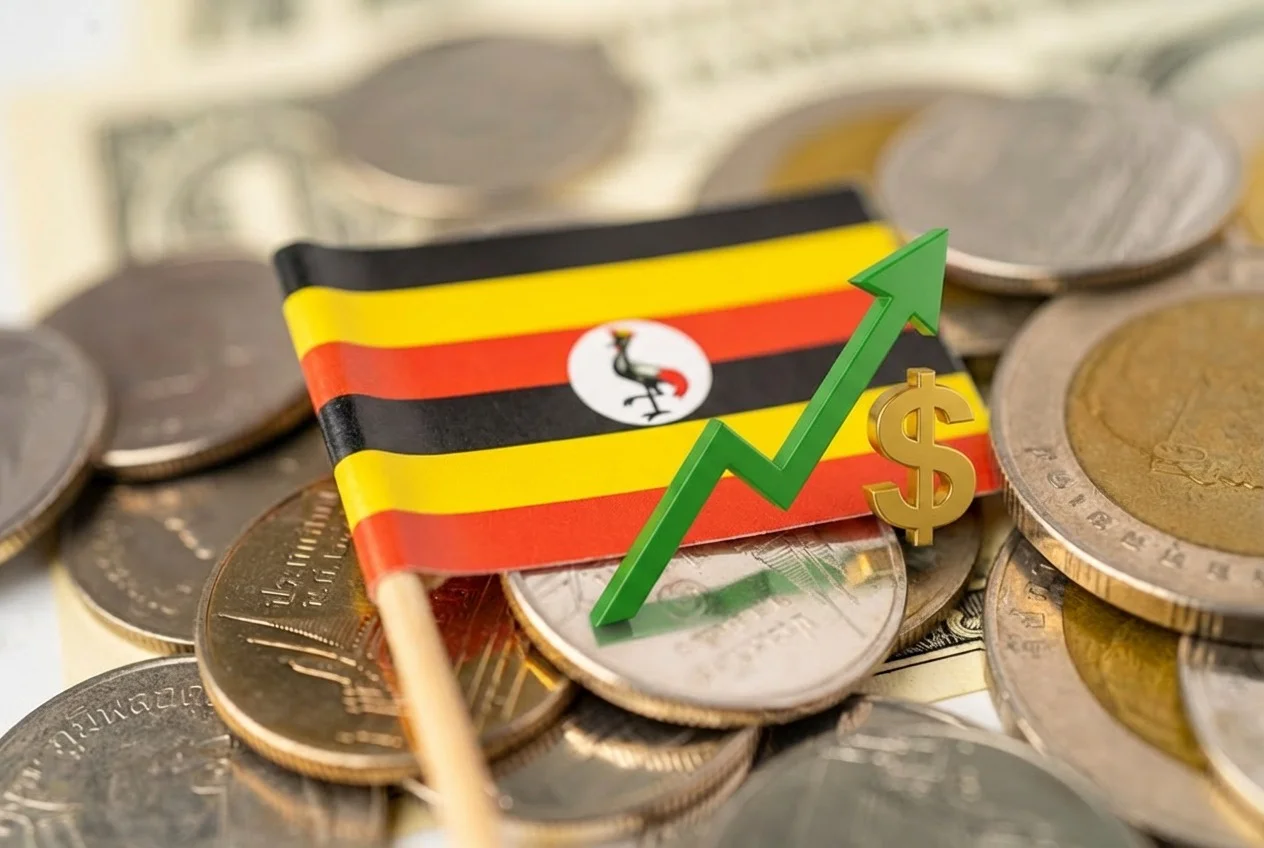
Uganda remains classified as a low-income economy in the World Bank’s country income groupings for the fiscal year running from July 2026 to June 2027, despite the government’s declaration that the country has attained lower-middle-income status.
The apparent contradiction comes from the use of different economic indicators. President Yoweri Museveni has highlighted Uganda’s gross domestic product per capita, while the World Bank classifies economies using gross national income per person calculated through its Atlas method.
Uganda’s failure to cross the World Bank threshold does not mean its economy is stagnant. Growth remains comparatively strong, exports and foreign-exchange reserves have increased, and the expected start of commercial oil production could accelerate expansion. However, rapid population growth, fiscal pressures, informality and the difference between domestic production and income retained by residents continue to affect income per person.
Key Overview
- Uganda remains a low-income economy under the World Bank’s latest classification.
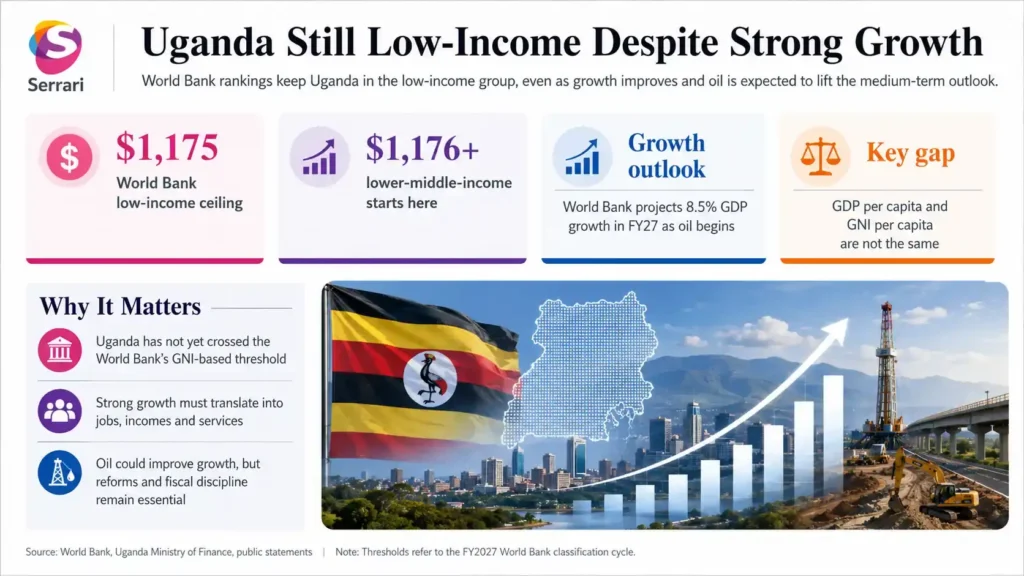
- The low-income ceiling for the 2027 fiscal year is $1,175 in GNI per capita.
- Lower-middle-income status begins at $1,176 and extends to $4,635.
- President Museveni cited GDP per capita of approximately $1,278 when declaring that Uganda had crossed the threshold.
- GDP and GNI per capita are different measures and cannot be used interchangeably.
- The World Bank projects economic growth of 8.5% in FY2027 as oil production begins.
- Strong headline growth must translate into higher household incomes, productive employment and improved public services.
Uganda Remains Below the World Bank Threshold
The World Bank’s latest income classifications place Uganda in the low-income category for the period from July 2026 to June 2027.
Under the updated thresholds, an economy is considered low income when its 2025 GNI per capita, calculated through the Atlas method, is $1,175 or less. Lower-middle-income economies have GNI per capita ranging from $1,176 to $4,635.
The classification is updated every July using the most recent available national income, population and exchange-rate data. The World Bank’s 2026–2027 classification review covered 218 economies and recorded six upward movements, including Togo’s transition from low-income to lower-middle-income status.
Uganda was not among the countries that moved into a higher category. The classification will remain the official World Bank reference until the end of June 2027, although the underlying economic estimates may later be revised.
GDP and GNI Tell Different Economic Stories
President Museveni’s middle-income declaration was based primarily on Uganda’s estimated GDP per capita rather than the measure used by the World Bank.
During his 2026 State of the Nation Address, Museveni said Uganda’s economy had grown to approximately $69.3 billion and that GDP per capita had reached $1,278.
GDP measures the value of goods and services produced within a country, regardless of who ultimately receives the resulting income. GNI adjusts that figure by adding income earned abroad by residents and subtracting income generated domestically but paid to foreign individuals or companies.
This distinction can be significant in an economy receiving large foreign investments. Production associated with foreign-owned businesses increases GDP, but profits repatriated abroad do not form part of the income retained by Ugandan residents.
Population growth also affects the calculation. Even when total national income expands rapidly, per-capita income may increase more slowly when it is divided among a fast-growing population.
The World Bank also converts GNI into US dollars using the Atlas method, which smooths short-term exchange-rate movements rather than relying only on the exchange rate prevailing at the end of the year.
Uganda remains a low-income economy under the World Bank’s latest classification, despite stronger growth, rising exports and a promising oil-led outlook.
Context is everything. Stay ahead of shifting trends with today’s market updates, and uncover emerging opportunities using the Serrari Group Market Index and Marketplace. Then, take control of your own financial future by exploring our Money & Life Reset Transformation Blueprint ™ to build stronger habits, create better systems, and design a path toward lasting wealth.
Economic Growth Remains Strong Despite the Classification
Uganda’s low-income designation should not be interpreted as evidence that the country has made no economic progress.
The World Bank’s 27th Uganda Economic Update reported that real GDP growth averaged 6.6% in the second half of 2025, compared with 6% in 2024. Household consumption, investment, construction, manufacturing and oil-related infrastructure supported the expansion.
The Bank projects that the non-oil economy will grow by approximately 6% in FY2026. Overall growth could accelerate to 8.5% in FY2027 once commercial oil production begins.
Uganda’s government has also reported improving external-sector indicators. According to the 2026/27 Budget Speech, export earnings from goods and services reached $18.04 billion in the 12 months to March 2026, compared with $5.93 billion during the corresponding period four years earlier.
Foreign-exchange reserves increased to $6 billion, while strong exports, investment and remittance inflows helped Uganda record a balance-of-payments surplus of $2.47 billion over the same period.
These developments support the government’s argument that the economy is becoming larger and more diversified. However, they do not by themselves prove that Uganda has crossed the World Bank’s GNI-based income threshold.
Oil Could Accelerate Growth but Brings Fiscal Risks
Commercial oil production could become the most important near-term driver of Uganda’s economy. Oil exports may narrow the current-account deficit, strengthen government revenue and attract investment into logistics, construction and supporting services.
However, the benefits will depend on how the revenue is managed. The World Bank estimates that Uganda’s fiscal deficit widened to about 6.5% of GDP in FY2026, while public debt reached approximately 52.3% of GDP.
Interest payments now consume close to one-third of domestic revenue, limiting the funds available for health, education and other public services. Oil income could ease these pressures, but weak spending controls or excessive borrowing could reduce its long-term impact.
Economic diversification will therefore remain essential. Uganda will need to expand manufacturing, commercial agriculture, tourism, technology and other productive industries rather than depending heavily on petroleum exports.
Growth Must Translate Into Household Prosperity
Crossing an international income threshold would carry considerable political and symbolic importance, but the classification alone would not guarantee improved living standards.
The World Bank estimates that more than half of Ugandans live on less than $3 a day and that approximately nine in ten employed people work in the informal economy. Informal employment often provides limited income security, social protection or access to workplace benefits.
The country must therefore convert economic growth into productive jobs, higher wages and sustainable household enterprises. Education, technical skills, affordable finance, infrastructure and stronger public institutions will be central to that transition.
Uganda’s economy is moving closer to lower-middle-income status, but the World Bank’s latest classification confirms that the internationally recognised threshold has not yet been crossed. Sustained increases in income retained by Ugandans—not GDP growth alone—will determine when the country formally graduates.
Sources: World Bank / State House Uganda / Uganda Ministry of Finance, Planning and Economic Development
Your financial future isn’t something you wait for—it’s something you build.
The real question is: when do you begin?
Move beyond simply staying informed.
Navigate the markets with clarity—track trends through the Serrari Group Market Index, uncover opportunities in the Serrari Marketplace, and build practical knowledge with our Curated Wealth Builder Platform.
Stay connected to what truly matters.
Get daily insights on macro trends and financial movements across Kenya, Africa, and global markets—delivered through the Serrari Newsletter.
Growth opens doors.
Advance your career through professional programs including ACCA, HESI A2, ATI TEAS 7 , HESI EXIT , NCLEX – RN and NCLEX – PN, Financial Literacy!🌟—designed to move you forward with confidence.
See where money is flowing—clearly and in real time.
Track Money Market Funds, Treasury Bills, Treasury Bonds, Green Bonds, and Fixed Deposits, alongside global and African indexes, key economic indicators, and the evolving Crypto and stablecoin landscape—all within Serrari’s Market Index.