





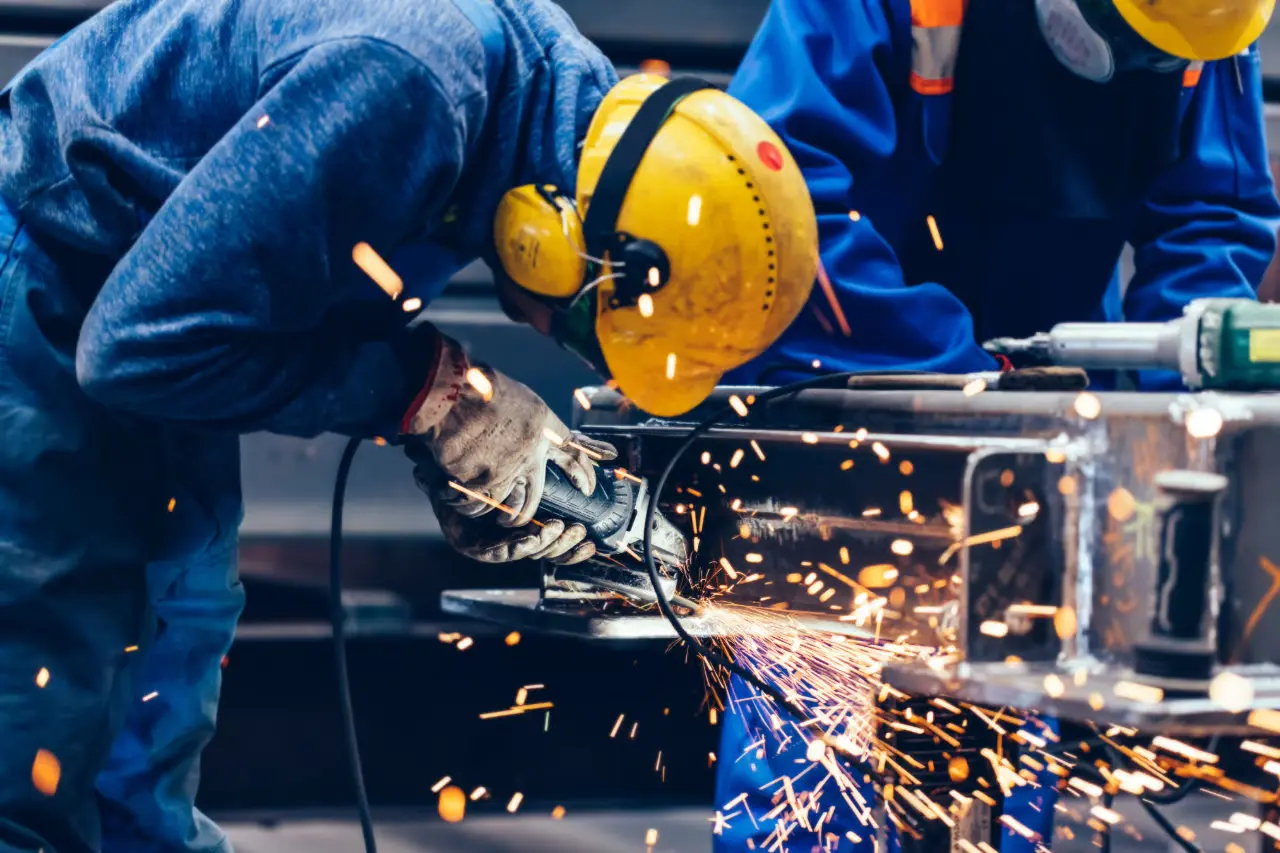
Germany’s industrial economy is undergoing a difficult structural adjustment as automotive manufacturers, machinery producers and other large employers reduce workforces in response to weak demand, high operating costs and intensifying international competition.
The country is not experiencing three consecutive years of economic contraction, as some reports have suggested. After recessions in 2023 and 2024, official figures show that gross domestic product increased by 0.2% in 2025 and expanded by 0.3% in the first quarter of 2026.
Nevertheless, the recovery remains fragile. Industrial employment continues to decline, Volkswagen is considering a much larger restructuring and Germany’s economic uncertainty is reinforcing political divisions across Europe’s largest economy.
Key Overview
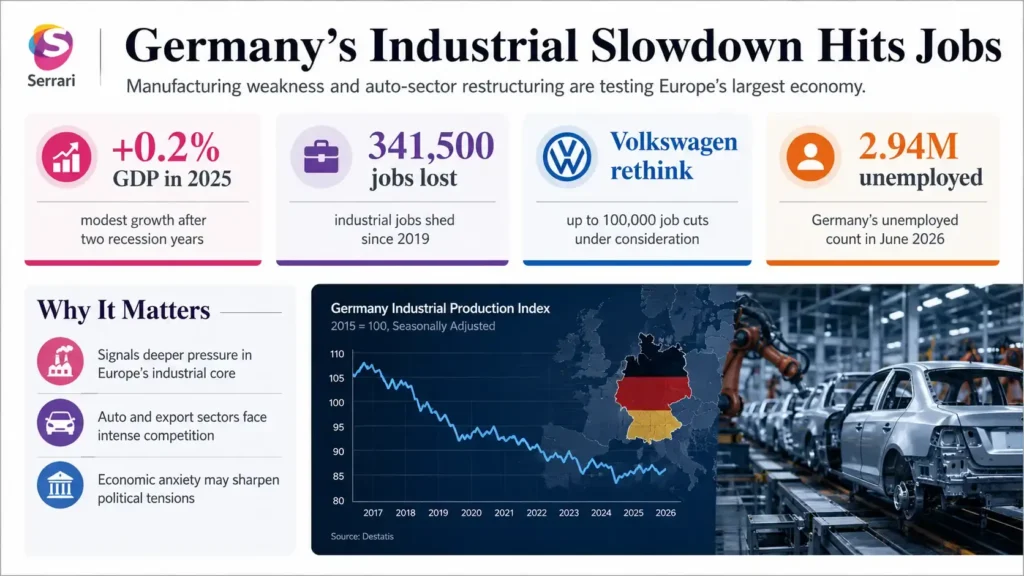
- Germany’s economy grew by 0.2% in 2025 after two consecutive years of recession.
- GDP increased by 0.3% quarter-on-quarter during the first quarter of 2026.
- German industry had lost approximately 341,500 jobs since 2019 by early 2026.
- The automotive sector alone had shed about 125,800 positions over that period.
- Volkswagen is considering as many as 100,000 job reductions and four German plant closures.
- Germany recorded approximately 2.94 million unemployed people in June 2026.
- The AfD received 20.8% of the vote in the February 2025 federal election.
- Foreign workers holding employment-based residence permits may face additional immigration requirements after losing their jobs.
Industrial Employment Continues to Contract
Germany’s economic weakness is most visible in its manufacturing sector. Industrial companies employed approximately 127,300 fewer people at the end of the first quarter of 2026 than a year earlier.
Since 2019, the sector has shed around 341,500 positions, equivalent to slightly more than 6% of its workforce. The automotive industry has been hit hardest, losing approximately 125,800 jobs during the same period, including about 32,000 over the most recent year measured.
The decline reflects several overlapping challenges. German manufacturers face elevated domestic costs, weak investment, subdued demand and growing competition from Asian producers. Export-oriented companies are also navigating changing trade policies and slower demand in markets such as China.
Energy-intensive industries remain under pressure following the loss of substantial Russian pipeline-gas supplies after the invasion of Ukraine. Electricity and gas costs have moderated from their crisis peaks but continue to affect chemicals, metals, glass and other sectors that depend heavily on affordable energy.
Artificial intelligence and automation may accelerate workforce changes in selected administrative, engineering and production functions. However, available data does not support treating AI as the principal cause of Germany’s current industrial job losses. Weak competitiveness, excess capacity and sector-specific restructuring remain more immediate factors.
Volkswagen Considers a Much Deeper Restructuring
Volkswagen has become the most prominent example of Germany’s industrial difficulties.
In December 2024, the company reached an agreement with labour representatives to reduce its German workforce by more than 35,000 positions by 2030 through measures including retirement, natural attrition and voluntary departures.
The agreement also called for German production capacity to be reduced by approximately 734,000 vehicles. It avoided immediate compulsory redundancies and wholesale factory closures.
Volkswagen is now considering a substantially broader overhaul. Proposals under discussion include up to 100,000 job reductions, the potential closure of four German plants and a major reduction in the group’s vehicle portfolio.
The proposals have not been fully approved and should not be presented as confirmed layoffs. Volkswagen’s supervisory structure gives employee representatives and the state of Lower Saxony considerable influence, making negotiations with unions and political stakeholders unavoidable.
The company is responding to high German production costs, underused factories, US tariffs and competition from Chinese manufacturers. Its challenges also reflect the cost of developing electric vehicles, batteries and software while continuing to support a wide range of conventional models.
The Economy Is Weak but Not in Continuous Recession
Germany contracted in both 2023 and 2024, creating the impression of an economy trapped in permanent decline. However, official data shows a modest change in direction.
Price-adjusted GDP increased by 0.2% in 2025, ending two years of recession. Growth continued into 2026, with the economy expanding by 0.3% in the first quarter.
These gains remain too small to resolve Germany’s structural problems. Ageing infrastructure, lengthy planning processes, labour shortages in some skilled occupations and limited digitalisation continue to constrain productivity and investment.
The labour market has also weakened without collapsing. Germany recorded 2.936 million unemployed people in June 2026, while the nationally calculated unemployment rate stood at 6.2%.
Under the internationally comparable methodology, however, unemployment was considerably lower at 3.7% in May. Germany therefore continues to have relatively low unemployment by European standards, even as industrial employment contracts.
Context is everything. Stay ahead of shifting trends with today’s market updates, and uncover emerging opportunities using the Serrari Group Market Index and Marketplace. Then, take control of your own financial future by exploring our Money & Life Reset Transformation Blueprint ™ to build stronger habits, create better systems, and design a path toward lasting wealth.
Foreign Workers Face Added Residency Pressure
Foreign professionals working under employment-linked residence permits can face immigration consequences after losing a qualifying job.
EU Blue Card holders should inform the relevant immigration authority when their employment ends. The authority may limit the validity of the permit, but the exact period allowed for finding another job depends on the individual’s circumstances and the decisions of the local office.
It is therefore inaccurate to assume that every foreign worker automatically receives a fixed three-to-six-month window. Residence rights vary according to the type of permit, time already spent in Germany and eligibility for another status.
International students are generally less exposed because their residence permits are based on continued enrolment rather than a particular part-time job. Graduates of German institutions may receive up to 18 months to seek qualified employment after completing their studies.
Access to unemployment insurance also depends on contribution history. Eligible workers generally receive about 60% of their previous net earnings, rising to 67% when they have qualifying children.
Economic Anxiety Strengthens Political Fault Lines
Germany’s industrial uncertainty is contributing to political dissatisfaction, particularly in regions where manufacturing has historically provided secure and well-paid employment.
The Alternative for Germany received 20.8% of second votes in the February 2025 federal election and became the second-largest parliamentary party, winning 152 seats.
Economic insecurity does not alone explain the party’s growth. Immigration, energy policy, dissatisfaction with established parties and regional differences between eastern and western Germany also influence voter behaviour.
However, prolonged factory restructuring could strengthen parties that portray Germany’s economic transition as evidence of political failure. Foreign workers may become particularly vulnerable when debates about industrial decline are connected to immigration and competition for public resources.
Germany’s Weakness Has Wider European Consequences
Germany accounts for roughly one-quarter of the European Union’s economic output and is deeply integrated with suppliers across Central and Eastern Europe.
When German vehicle and machinery production declines, manufacturers in countries including Poland, Czechia, Slovakia and Hungary can experience lower orders. A weaker German economy can also reduce European investment and limit the bloc’s capacity to finance defence, energy and industrial-policy priorities.
Germany’s central challenge is therefore not simply to preserve every existing industrial job. It must attract new investment, expand energy infrastructure, improve productivity and help workers move into competitive technologies without allowing entire regions to fall behind.
The country has returned to modest growth, but its industrial transformation is only beginning. How successfully Germany manages that shift will influence employment, political stability and Europe’s broader economic position.
Sources: Reuters / German Federal Statistical Office / German Federal Employment Agency / Volkswagen Group / Federal Returning Officer / Make it in Germany
Your financial future isn’t something you wait for—it’s something you build.
The real question is: when do you begin?
Move beyond simply staying informed.
Navigate the markets with clarity—track trends through the Serrari Group Market Index, uncover opportunities in the Serrari Marketplace, and build practical knowledge with our Curated Wealth Builder Platform.
Stay connected to what truly matters.
Get daily insights on macro trends and financial movements across Kenya, Africa, and global markets—delivered through the Serrari Newsletter.
Growth opens doors.
Advance your career through professional programs including ACCA, HESI A2, ATI TEAS 7 , HESI EXIT , NCLEX – RN and NCLEX – PN, Financial Literacy!🌟—designed to move you forward with confidence.
See where money is flowing—clearly and in real time.
Track Money Market Funds, Treasury Bills, Treasury Bonds, Green Bonds, and Fixed Deposits, alongside global and African indexes, key economic indicators, and the evolving Crypto and stablecoin landscape—all within Serrari’s Market Index.
















Comments are closed.