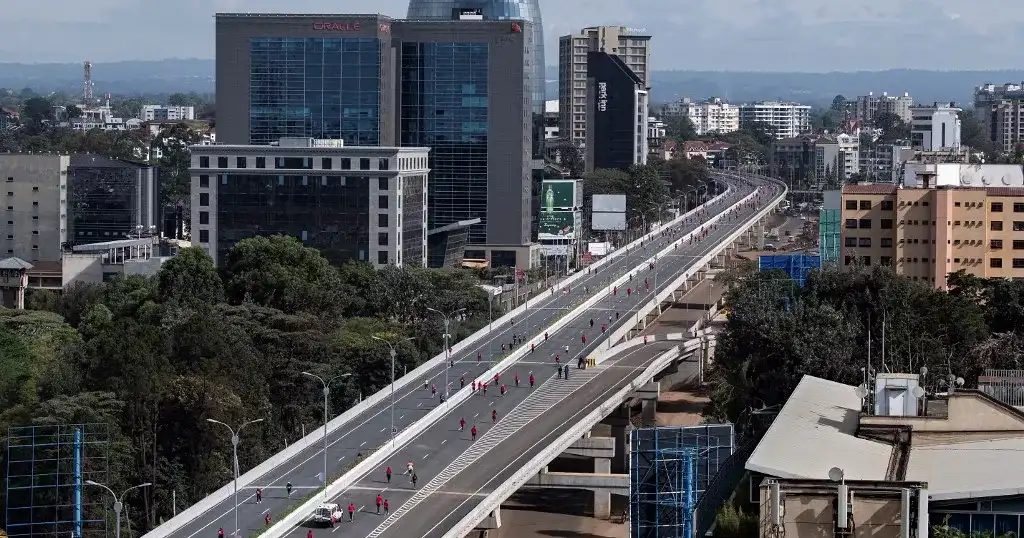
Kenya’s National Infrastructure Fund represents a major change in how the country plans to finance transport, energy, water and other large-scale development projects.
Rather than relying primarily on taxation and sovereign borrowing, the Fund is intended to invest public capital in commercially viable infrastructure enterprises that can generate revenue, attract private investors and eventually repay or recycle the capital committed to them.
The Fund has been seeded with proceeds from the partial sale of government holdings in Kenya Pipeline Company and Safaricom. Its potential is significant, but projections involving investment returns, private-capital mobilisation and annual project financing remain illustrative rather than guaranteed outcomes.
Key Overview
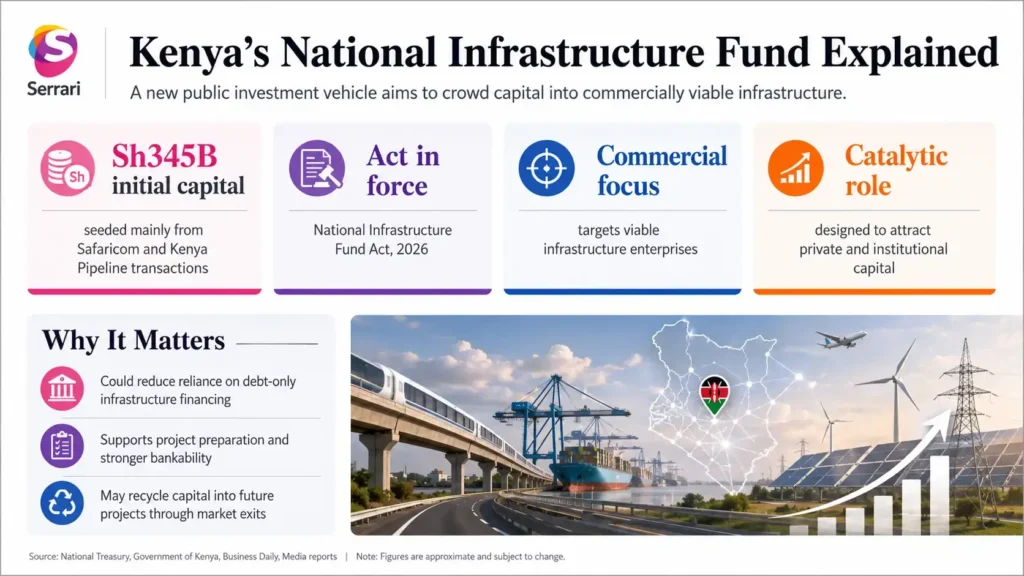
- The National Infrastructure Fund was established under the National Infrastructure Fund Act, 2026.
- Its mandate includes accelerating infrastructure development and mobilising private and non-traditional capital.
- Recent government statements place its initial capital at approximately Sh345 billion.
- Seed funding came mainly from transactions involving Kenya Pipeline Company and Safaricom.
- The Fund must invest according to an Investment Policy approved through the statutory governance process.
- It is designed to support commercially viable projects rather than permanently finance loss-making public assets.
- Strong governance, project selection and transparent reporting will determine whether it succeeds.
A New Model for Financing Infrastructure
The National Infrastructure Fund Act came into force on March 25, 2026, creating a dedicated institution to scale up nationally important infrastructure and attract capital beyond conventional government borrowing.
The Fund may invest in infrastructure companies, project vehicles and other approved instruments. Its mandate also includes supporting project preparation, improving commercial viability and mobilising money from institutional investors, development-finance institutions and other private sources.
This approach responds to the limitations of debt-funded infrastructure. Kenya has substantial requirements in roads, airports, railways, power generation, irrigation and logistics, but its public finances leave limited room for additional borrowing.
A professionally managed investment vehicle could allow the government to commit equity to suitable projects while using that participation to attract pension funds, insurers, sovereign investors and commercial lenders.
However, the Fund does not automatically remove fiscal risk. Projects that fail to generate sufficient revenue could still lose public capital or create pressure for government guarantees and additional financial support.
Privatisation Proceeds Provide the Seed Capital
The Fund’s initial capital was raised from the partial monetisation of two valuable government holdings.
Kenya raised approximately Sh106.3 billion from the Kenya Pipeline Company offering after selling a 65% interest in the petroleum-transport company. The government also agreed to reduce its Safaricom stake by selling 15 percentage points to Vodafone Kenya.
The Safaricom transaction was structured to include both the share-purchase proceeds and an upfront payment linked to future dividends.
Recent government statements indicate that the combined proceeds allocated to the Fund amount to roughly Sh345 billion. This is close to, but not exactly the same as, the Sh347 billion estimate used in some commentary because transaction values and amounts formally transferred may differ.
Using proceeds from successful state investments to create new infrastructure assets could establish a recurring development cycle. The central test is whether the new assets generate returns at least as valuable as the stakes the government has sold.
Private Capital Could Multiply the Fund’s Reach
The Fund’s greatest potential lies in using public equity to attract additional capital.
Infrastructure projects are frequently financed through a combination of sponsor equity and long-term debt. When a credible investor provides early-stage capital, helps prepare the project and addresses regulatory risks, lenders and institutional investors may be more willing to participate.
For example, if the Fund and its partners supplied 30% of a project’s cost as equity, debt investors could potentially finance the remaining 70%. This would allow each shilling of equity to support a substantially larger investment.
The original article estimates that annual Fund income and matched private equity could support Sh240 billion to Sh300 billion of infrastructure each year. That calculation assumes a 12% annual cash return, partial reinvestment of earnings, equal private-sector participation and a 70% debt-financing ratio.
Those assumptions demonstrate the model’s possible scale, but they are not official forecasts. Returns will vary by asset, while some projects may require longer development periods before producing cash.
Context is everything. Stay ahead of shifting trends with today’s market updates, and uncover emerging opportunities using the Serrari Group Market Index and Marketplace. Then, take control of your own financial future by exploring our Money & Life Reset Transformation Blueprint ™ to build stronger habits, create better systems, and design a path toward lasting wealth.
Commercial Viability Changes Project Selection
The Act’s emphasis on commercially viable infrastructure could reshape how projects are designed.
Instead of beginning with construction plans, project preparation would need to establish customer demand, realistic pricing, operating costs and reliable revenue. Airports would require passenger and freight forecasts, energy projects would need credible purchasers, and transport investments would require evidence of sustainable traffic volumes.
The Fund could also coordinate approvals, policy reforms and supporting public investment in ways that an individual private developer may struggle to achieve.
This could improve bankability and reduce execution risk. Nevertheless, commercial discipline must not be weakened by political pressure to fund projects without adequate demand or realistic repayment capacity.
The Investment Policy will therefore be central to defining eligible sectors, return expectations, risk limits, environmental standards and procedures for preventing conflicts of interest.
Capital Recycling Could Support Future Projects
The Fund is also expected to recycle investments instead of holding every asset indefinitely.
Once an infrastructure enterprise is operational and financially stable, the Fund could sell part of its interest to strategic investors or through instruments such as public listings, infrastructure real-estate investment trusts and asset-backed securities.
Successful exits would release money for new projects while creating investment opportunities for pension schemes, insurers and retail investors through Kenya’s capital markets.
This model would be especially valuable if it repeatedly converts early-stage projects into mature, investable enterprises. Poorly timed sales or weak valuations, however, could reduce public returns.
Governance Will Determine the Fund’s Success
The Fund’s Governing Council is required to prepare an Investment Policy for Cabinet approval. Its governance framework will need to protect investment decisions from political interference while ensuring accountability for public money.
Clear financial reporting, independent audits, competitive procurement and public disclosure of major investments will be essential. The Fund must also explain how projects are valued, what risks the government retains and how expected financial returns compare with social and economic benefits.
Kenya’s National Infrastructure Fund could become a powerful platform for turning limited public equity into much larger infrastructure investment.
Its lasting impact will not depend only on how much money it begins with, but on whether it selects viable projects, attracts credible investors, generates returns and preserves public wealth across successive investment cycles.
Sources: Kenya Law / Reuters / Parliament of Kenya / Institute of Economic Affairs Kenya
Your financial future isn’t something you wait for—it’s something you build.
The real question is: when do you begin?
Move beyond simply staying informed.
Navigate the markets with clarity—track trends through the Serrari Group Market Index, uncover opportunities in the Serrari Marketplace, and build practical knowledge with our Curated Wealth Builder Platform.
Stay connected to what truly matters.
Get daily insights on macro trends and financial movements across Kenya, Africa, and global markets—delivered through the Serrari Newsletter.
Growth opens doors.
Advance your career through professional programs including ACCA, HESI A2, ATI TEAS 7 , HESI EXIT , NCLEX – RN and NCLEX – PN, Financial Literacy!🌟—designed to move you forward with confidence.
See where money is flowing—clearly and in real time.
Track Money Market Funds, Treasury Bills, Treasury Bonds, Green Bonds, and Fixed Deposits, alongside global and African indexes, key economic indicators, and the evolving Crypto and stablecoin landscape—all within Serrari’s Market Index.