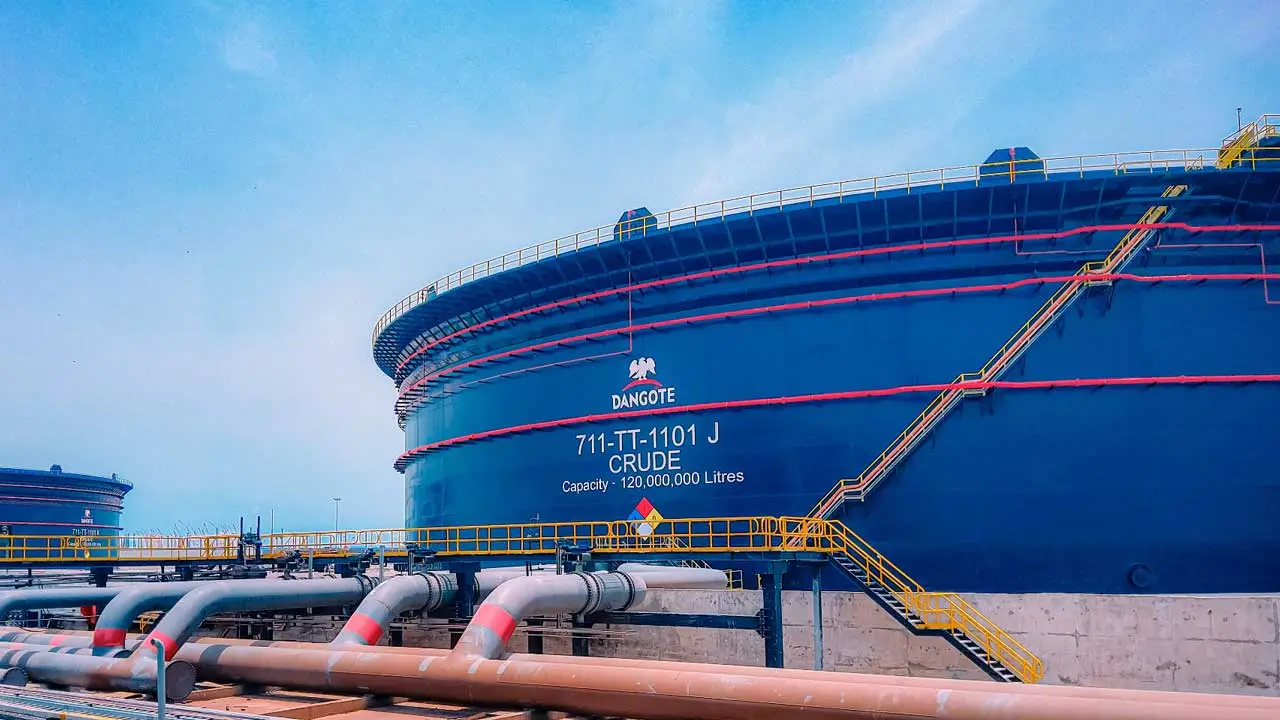
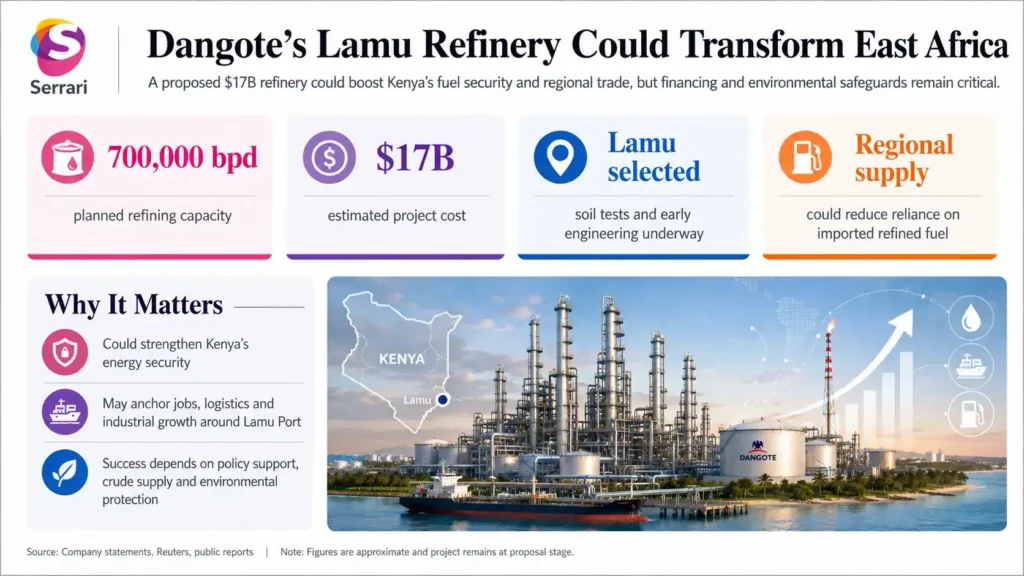
Dangote Industries’ proposed oil refinery in Lamu could significantly reshape Kenya’s energy supply, industrial development and regional trade position. The planned facility would process as much as 700,000 barrels of crude oil per day, making it East Africa’s largest refinery if completed.
The project is reportedly expected to cost about $17 billion, equivalent to roughly Sh2.2 trillion, although Dangote Industries has not publicly confirmed a final investment figure. The company says site selection has been completed, soil testing is under way and preliminary engineering work has started.
The development could reduce East Africa’s dependence on imported refined fuel and strengthen Lamu Port’s role within the wider Lamu Port-South Sudan-Ethiopia Transport corridor. However, the project remains at an early stage and will require financing, regulatory approvals, crude-supply agreements, environmental safeguards and regional fuel buyers before construction can proceed at full scale.
Key Overview
- The proposed refinery would have capacity of approximately 700,000 barrels per day.
- Published estimates place the potential investment at about $17 billion, or Sh2.2 trillion.
- Dangote Industries has confirmed Lamu as its preferred Kenyan location.
- Soil testing, design and preliminary engineering work have begun.
- Financing could combine internal cash, bonds and proceeds from a planned initial public offering.
- Construction could take between three and five years, depending on approvals and financing.
- Kenya currently depends heavily on imported refined petroleum products.
- Environmental protection, crude availability and supportive trade policies will be crucial to the project’s viability.
Lamu Selected for Dangote’s East African Expansion
Dangote Industries has selected Lamu for a proposed 700,000-barrel-per-day refinery intended to serve Kenya and neighbouring East African markets.
Edwin Devakumar, the group’s vice-president for oil and gas, said the site had been selected, soil investigations were in progress and design and engineering work had commenced. He described Kenya as the preferred location after the group also evaluated Tanzania’s port city of Tanga.
The company cited infrastructure, logistics and access to regional markets as important considerations. Lamu offers direct access to the Indian Ocean and forms the coastal anchor of a planned transport network connecting Kenya with Ethiopia and South Sudan.
A separate report estimated the development at approximately $17 billion. However, Dangote Industries has not disclosed a definitive project cost and has instead indicated that the investment could be comparable to its refinery near Lagos, which eventually cost more than $20 billion.
The distinction is important because the Lamu development remains a proposal rather than a fully financed construction project. Final costs could change substantially following engineering studies, environmental assessments and negotiations over land, infrastructure and government support.
Refinery Could Reduce Kenya’s Fuel Import Exposure
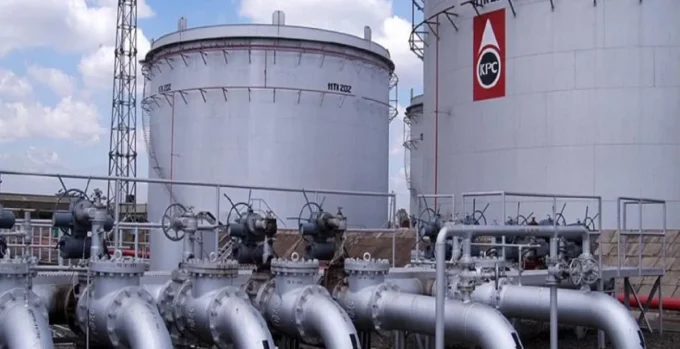
Kenya has not operated a commercial crude-oil refinery since processing activities at the Mombasa refinery ceased in 2013. The country consequently relies on imported petrol, diesel, kerosene and aviation fuel to meet domestic demand.
A national petroleum policy published in 2025 stated that Kenya was importing approximately 490,000 tonnes of petroleum products each month, equivalent to an annual volume of about 5.9 million tonnes.
A refinery in Lamu could replace a portion of those imports with regionally processed fuel. It could also supply markets including Uganda, Rwanda, South Sudan, Ethiopia and the Democratic Republic of Congo, depending on transport infrastructure, pricing and supply agreements.
Local refining would not completely shield Kenya from global energy shocks because the facility would still require a reliable supply of imported or regional crude oil. Nevertheless, it could reduce freight costs, shorten supply chains and give East African buyers an alternative to importing finished products from the Middle East, Asia and Europe.
The project could also stimulate demand for storage terminals, pipelines, roads, port services, engineering firms and maintenance contractors. Claims about the precise number of jobs it will create should, however, be treated cautiously until detailed construction and operating plans are published.
Lamu Port Could Gain a Stronger Regional Role
The proposed refinery aligns with Kenya’s ambition to develop Lamu into a regional logistics and industrial centre.
The wider LAPSSET corridor is designed to connect Lamu Port with inland markets through roads, railways, pipelines and associated economic zones. A large refinery could provide the port with a major anchor tenant while generating additional cargo volumes for crude imports and refined-product exports.
Trade Cabinet Secretary Lee Kinyanjui has described the investment as evidence of growing commercial interest in Lamu. Kenya is also seeking deeper trade and infrastructure cooperation with Ethiopia, Somalia, Djibouti, Sudan and Eritrea.
However, several components of the corridor remain incomplete, meaning the refinery’s regional impact would depend on reliable transport connections. Without sufficient pipelines, roads, rail systems and storage facilities, moving large volumes of fuel to landlocked markets could become expensive.
The refinery would therefore need to be developed alongside supporting infrastructure rather than treated as an isolated industrial project.
Context is everything. Stay ahead of shifting trends with today’s market updates, and uncover emerging opportunities using the Serrari Group Market Index and Marketplace. Then, take control of your own financial future by exploring our Money & Life Reset Transformation Blueprint ™ to build stronger habits, create better systems, and design a path toward lasting wealth.
Financing and Policy Support Remain Major Tests
Dangote Industries plans to fund the development using a combination of internally generated cash, bonds and IPO proceeds.
That approach reflects the financing model used for the group’s Nigerian refinery, but the scale of the Lamu proposal means external investors and lenders are likely to demand firm evidence of commercial viability.
Key requirements will include long-term crude-supply contracts, agreements with fuel distributors, predictable taxation, foreign-exchange access and clarity on whether imported refined products will compete with locally produced fuel under the same regulatory conditions.
The experience of the Lagos refinery also highlights the danger of cost escalation. Its initial estimate rose significantly because of site changes, engineering challenges, currency depreciation, pandemic-related disruption and global inflation.
Kenya will therefore need to balance investor incentives with consumer protection and competition. Policies designed to support the refinery should not create an inefficient monopoly or expose taxpayers to excessive financial risk.
Environmental and Heritage Risks Require Scrutiny
Lamu contains sensitive marine ecosystems, fishing communities and cultural assets, including the UNESCO-listed Lamu Old Town.
Previous large energy proposals in the county have faced opposition over potential effects on mangroves, fisheries, air quality, tourism and local livelihoods. A refinery of the proposed scale would require extensive environmental and social-impact assessments before construction.
Safeguards would need to address oil spills, industrial emissions, wastewater disposal, marine traffic and the cumulative impact of associated pipelines and storage terminals.
Consultation with local residents will also be essential. Economic benefits may not be broadly shared unless communities receive access to employment, training, business opportunities and compensation where land or livelihoods are affected.
Outlook
The proposed Lamu refinery could become one of Kenya’s largest-ever private industrial investments and fundamentally alter East Africa’s fuel market.
Its scale, location and developer give it greater credibility than many refinery proposals previously discussed in the region. However, site studies and preliminary engineering do not guarantee completion.
The project’s success will depend on whether Dangote Industries can secure financing, crude supplies, buyers, regulatory certainty and public confidence while protecting Lamu’s environmental and cultural heritage. Until those conditions are met, the refinery should be viewed as a potentially transformative but still developing investment proposal.
Sources: Reuters / Forbes Africa / Kenya Ministry of Energy and Petroleum / Programme for Infrastructure Development in Africa / The Star
Your financial future isn’t something you wait for—it’s something you build.
The real question is: when do you begin?
Move beyond simply staying informed.
Navigate the markets with clarity—track trends through the Serrari Group Market Index, uncover opportunities in the Serrari Marketplace, and build practical knowledge with our Curated Wealth Builder Platform.
Stay connected to what truly matters.
Get daily insights on macro trends and financial movements across Kenya, Africa, and global markets—delivered through the Serrari Newsletter.
Growth opens doors.
Advance your career through professional programs including ACCA, HESI A2, ATI TEAS 7 , HESI EXIT , NCLEX – RN and NCLEX – PN, Financial Literacy!🌟—designed to move you forward with confidence.
See where money is flowing—clearly and in real time.
Track Money Market Funds, Treasury Bills, Treasury Bonds, Green Bonds, and Fixed Deposits, alongside global and African indexes, key economic indicators, and the evolving Crypto and stablecoin landscape—all within Serrari’s Market Index.