
Latest Uganda Treasury bills data show that Uganda maintained the highest 91-day Treasury bill rate among major East African Community economies during the first quarter of 2026. Despite a slight decline from the previous quarter, Uganda’s yields remained well above those of Kenya, Rwanda, Burundi and Tanzania.
Key Overview
- Uganda recorded a 91-day Treasury bill rate of 9.9% in Q1 2026.
- The yield declined from 10.7% in Q4 2025.
- Burundi posted the second-highest rate at 8.4%.
- Rwanda followed with a rate of 8.3%.
- Kenya recorded a 91-day Treasury bill rate of 7.5%.
- Tanzania had the lowest yield at 4.2%.
- Rwanda was the only country to register higher rates compared to Q4 2025.
- Uganda and Tanzania had a yield gap of 5.7 percentage points.
- Private sector credit expanded by 14%.
- Net foreign assets increased by 26%.
Uganda Treasury Bill Rates Remain Region’s Highest
The latest Uganda treasury bill rates data show that the country continued to offer the highest returns on 91-day Treasury bills among major East African Community economies during the first quarter of 2026.
According to the latest EAC monetary statistics, Uganda’s benchmark 91-day Treasury bill yield stood at 9.9%, maintaining the country’s position as the highest-yielding short-term government securities market in the region.
Although the rate was lower than the 10.7% recorded during the fourth quarter of 2025, Uganda still provided more attractive returns than neighboring countries.
The figures highlight the differences in monetary conditions and government borrowing costs across East Africa, with investors continuing to monitor yields as indicators of inflation expectations, liquidity conditions and monetary policy.
Despite the slight decline in yields, Uganda remains one of the most attractive destinations for fixed-income investors seeking relatively high short-term returns.
Context is everything. Stay ahead of shifting trends with today’s market updates, and uncover emerging opportunities using the Serrari Group Market Index and Marketplace. Then, take control of your own financial future by exploring our Money & Life Reset Transformation Blueprint ™ to build stronger habits, create better systems, and design a path toward lasting wealth.
Uganda Treasury Bills Continue to Offer Attractive Returns
Recent Uganda Treasury bills statistics indicate that yields remain elevated despite easing from the previous quarter.
The 91-day Treasury bill rate of 9.9% demonstrates the government’s continued reliance on domestic debt markets while providing investors with competitive returns.
Short-term Treasury bills are widely used by governments to finance short-term funding needs and manage liquidity. They are also considered low-risk investment instruments because they are backed by sovereign governments.
Uganda’s relatively high yields make these securities particularly attractive to investors seeking income opportunities.
Although yields have moderated since the end of 2025, the current levels remain significantly above those observed in several neighboring countries.
This reflects differences in economic conditions, monetary policy settings and investor demand across the region.
East Africa Treasury Bill Rates Show Wide Differences
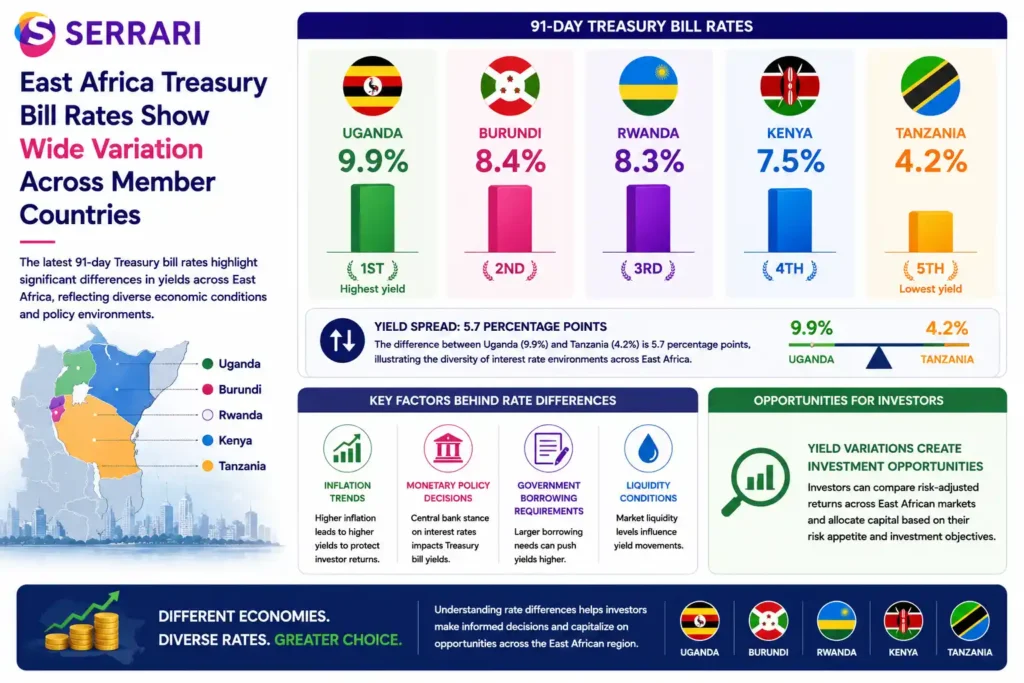
The latest East Africa treasury bill rates reveal considerable variation among member countries.
Uganda maintained the highest yield at 9.9%, followed by Burundi with a rate of 8.4%.
Rwanda ranked third with a 91-day Treasury bill rate of 8.3%, while Kenya recorded a yield of 7.5%.
Tanzania posted the lowest rate among the five countries at 4.2%.
The difference between Uganda and Tanzania amounted to 5.7 percentage points, illustrating the diversity of interest rate environments across East Africa.
Such differences are influenced by factors including inflation trends, monetary policy decisions, government borrowing requirements and overall liquidity conditions.
For investors, these yield variations create opportunities to compare risk-adjusted returns across regional markets.
Uganda T-Bill Yields Decline From Late 2025
Although Uganda T-bill yields remained the highest in the region, they declined from the levels recorded in late 2025.
The 91-day rate fell from 10.7% in the fourth quarter of 2025 to 9.9% during the first quarter of 2026.
A similar trend was observed in several neighboring countries.
Burundi, Kenya and Tanzania also experienced lower Treasury bill rates compared with the previous quarter.
Rwanda stood out as the only country where yields increased.
Its rate rose from 7.6% in the fourth quarter of 2025 to 8.3% in the first quarter of 2026.
These movements suggest that monetary conditions across East Africa are evolving differently depending on domestic economic developments.
The changing yield environment also reflects varying inflation expectations and central bank policy responses.
Government Securities Uganda Remain Important Investment Tools
The latest performance of government securities Uganda highlights their importance within the country’s financial system.
Treasury bills provide the government with access to short-term funding while offering investors a secure avenue for preserving capital and earning returns.
Institutional investors, banks and individuals frequently allocate funds to these securities because of their relatively low risk profile.
High yields can also help attract domestic savings and strengthen participation in local debt markets.
For governments, Treasury bills represent an essential component of debt management strategies.
The continued attractiveness of Ugandan government securities demonstrates confidence in the country’s financial markets and their ability to support funding requirements.
Strong demand for such instruments often contributes to overall market stability.
Short-Term Interest Rates Reflect Economic Conditions
Movements in short-term interest rates often provide insight into broader economic conditions.
Treasury bill yields are influenced by inflation expectations, central bank policy decisions and liquidity levels within the financial system.
Higher yields can indicate tighter monetary conditions or increased borrowing requirements, while lower rates may reflect easing inflation pressures and improved liquidity.
Uganda’s decline in Treasury bill rates compared with the previous quarter suggests that borrowing costs have moderated somewhat.
Nevertheless, yields remain elevated relative to regional peers.
These trends are closely watched by investors because they influence returns on fixed-income investments and broader financial market conditions.
Changes in short-term rates can also affect lending costs and investment decisions throughout the economy.
East African Bond Markets Continue Expanding
Developments across East African bond markets continue to demonstrate growing financial integration within the region.
Government securities remain important instruments for financing public expenditure and supporting capital market development.
The latest statistics also showed broader economic improvements.
Private sector credit expanded by 14%, indicating continued lending activity and economic momentum.
Meanwhile, net foreign assets grew by 26%, reflecting stronger external positions within regional economies.
These indicators suggest that East African financial systems remain resilient despite changing global conditions.
As regional markets deepen and investor participation expands, government securities are likely to play an increasingly important role in supporting economic growth and financial stability.
Continued development of bond markets could also improve access to capital and strengthen monetary policy transmission mechanisms.
Conclusion
Uganda treasury bill rates remained the highest among major East African Community economies during the first quarter of 2026. Although yields eased from late 2025 levels, Uganda’s 9.9% rate continued to outpace neighboring countries, underscoring its position as one of the region’s most attractive fixed-income markets.
Differences in yields across East Africa reflect varying monetary conditions and economic trends. With private sector credit and net foreign assets also recording strong growth, regional financial markets continue to demonstrate resilience and expanding opportunities for investors.
FAQs
1. What was Uganda’s 91-day Treasury bill rate in Q1 2026?
Uganda recorded a 91-day Treasury bill rate of 9.9% during the first quarter of 2026. Although this represented a decline from the 10.7% recorded in the previous quarter, it remained the highest yield among major East African Community economies.
2. Which East African country had the lowest Treasury bill rate?
Tanzania recorded the lowest 91-day Treasury bill rate at 4.2% during the first quarter of 2026. This created a yield gap of 5.7 percentage points compared with Uganda, which had the highest rate in the region.
3. Which country experienced rising Treasury bill yields?
Rwanda was the only country among the five major East African economies to register an increase in Treasury bill yields. Its 91-day rate rose from 7.6% in the fourth quarter of 2025 to 8.3% in the first quarter of 2026.
4. Why are Treasury bill rates important?
Treasury bill rates provide insight into government borrowing costs, monetary policy conditions and investor sentiment. They also influence returns for fixed-income investors and serve as indicators of broader economic and financial market developments.
Your financial future isn’t something you wait for—it’s something you build.
The real question is: when do you begin?
Move beyond simply staying informed.
Navigate the markets with clarity—track trends through the Serrari Group Market Index, uncover opportunities in the Serrari Marketplace, and build practical knowledge with our Curated Wealth Builder Platform.
Stay connected to what truly matters.
Get daily insights on macro trends and financial movements across Kenya, Africa, and global markets—delivered through the Serrari Newsletter.
Growth opens doors.
Advance your career through professional programs including ACCA, HESI A2, ATI TEAS 7 , HESI EXIT , NCLEX – RN and NCLEX – PN, Financial Literacy!🌟—designed to move you forward with confidence.
See where money is flowing—clearly and in real time.
Track Money Market Funds, Treasury Bills, Treasury Bonds, Green Bonds, and Fixed Deposits, alongside global and African indexes, key economic indicators, and the evolving Crypto and stablecoin landscape—all within Serrari’s Market Index.