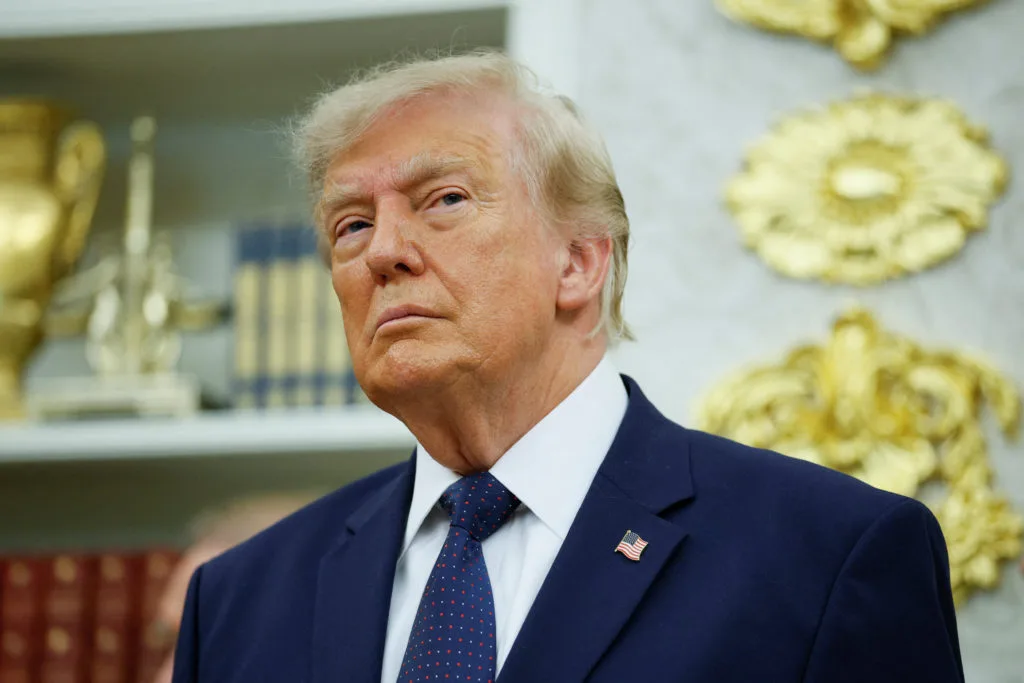
US President Donald Trump has abandoned a proposal to charge a 20% fee on cargo moving through the Strait of Hormuz, replacing the idea with plans to pursue trade and investment agreements with Gulf states.
The reversal came only a day after Trump proposed the charge as Washington reinstated a blockade on Iranian ports amid renewed military confrontation with Tehran. The proposal had drawn criticism from the UN shipping agency, which said there was no legal basis for mandatory fees on vessels exercising rights of transit passage through international straits. (Reuters)
The policy change removes one immediate source of uncertainty for shipping companies, but the broader risk to the Strait remains elevated. Vessel traffic has slowed sharply, oil prices remain sensitive to military developments, and renewed US-Iran hostilities continue to threaten one of the world’s most important energy corridors. (Reuters)
Key Overview
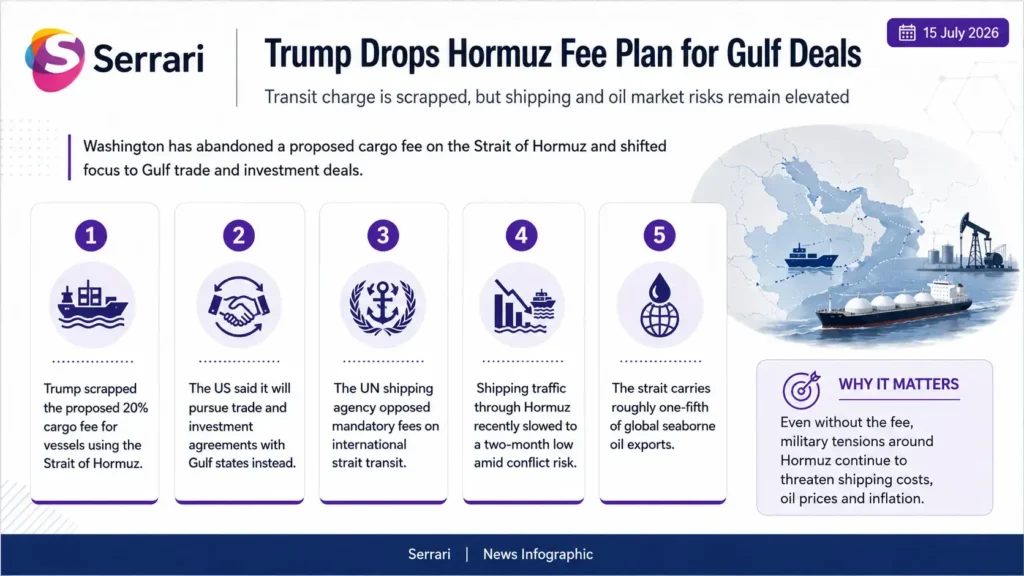
- Trump dropped his proposed 20% charge on cargo passing through the Strait of Hormuz.
- The US president said the fee would be replaced by trade and investment deals with Gulf states.
- The International Maritime Organization opposed mandatory transit fees for international straits.
- Tanker traffic through Hormuz recently fell to its lowest level in two months.
- Renewed US-Iran military action continues to threaten shipping and energy markets.
Trump Reverses Course on the Proposed Hormuz Charge
Trump said on July 14 that he would no longer pursue the 20% cargo fee he had proposed for vessels using the Strait of Hormuz.
Instead, he said the United States would pursue trade and investment agreements with Gulf countries following what he described as productive discussions with regional leaders. No detailed structure for those agreements was immediately announced. (Reuters)
The decision represented a rapid shift from the position Trump announced a day earlier, when he said the US would seek a 20% reimbursement on cargo moving through the waterway while reinstating a naval blockade on Iran. (Reuters)
The fee proposal had raised significant legal and diplomatic questions. The UN shipping agency opposed such charges, maintaining that states do not have a legal basis to impose mandatory tolls on ships exercising transit passage through international straits. (Reuters)
By dropping the fee, Washington removed a controversial proposal that could have added another layer of cost and uncertainty to global trade at a time when shipowners are already confronting heightened security risks.
Military Escalation Keeps Shipping Under Pressure
The reversal does not resolve the wider crisis surrounding the Strait.
The US has resumed military operations against Iranian targets, while Iran has continued retaliatory attacks against regional targets and commercial shipping. Trump has also reinstated the blockade of Iranian ports, raising concerns that the confrontation could continue to disrupt maritime traffic. (Reuters)
The Strait of Hormuz is strategically critical because it carries roughly a fifth of global oil flows. Any sustained disruption can quickly affect freight costs, insurance premiums, refinery supply and global inflation expectations. (Reuters)
Recent shipping data showed tanker traffic through the Strait falling to its lowest level in two months as renewed strikes and attacks on vessels increased safety concerns.
The situation is also difficult to measure precisely because some vessels have reportedly switched off public tracking systems, making real-time traffic counts less reliable. (Reuters)
Context is everything. Stay ahead of shifting trends with today’s market updates, and uncover emerging opportunities using the Serrari Group Market Index and Marketplace. Then, take control of your own financial future by exploring our Money & Life Reset Transformation Blueprint ™ to build stronger habits, create better systems, and design a path toward lasting wealth.
Oil Markets Remain Highly Sensitive to Hormuz Risk
Energy markets have reacted sharply to the renewed conflict.
Oil prices surged after Washington announced the renewed blockade and Trump initially proposed the transit charge. Although prices later moderated after he abandoned the fee, the market continues to carry a significant geopolitical risk premium. (Reuters)
The importance of Hormuz means even partial disruption can have global consequences. Producers including Saudi Arabia, Iraq, Kuwait, the United Arab Emirates and Qatar rely heavily on regional export routes, while Asian economies remain major buyers of Gulf crude and liquefied natural gas.
The latest crisis is also occurring after earlier disruptions had already reduced normal shipping activity. Even during periods of improved access, vessel movements remained below pre-war levels, illustrating how long it can take for shipping confidence and logistics networks to normalise. (Reuters)
Higher oil and transport costs can eventually feed into consumer prices by increasing the cost of fuel, manufacturing and freight. That has made the Strait an important issue not only for energy markets but also for central banks and governments monitoring renewed inflation pressures.
Gulf Investment Replaces a Controversial Revenue Plan
Trump’s decision to replace the proposed fee with Gulf trade and investment agreements shifts the focus from charging shipping traffic to negotiating broader economic commitments.
The Gulf states already have deep commercial relationships with the United States and have announced major investment ambitions across technology, infrastructure, energy and manufacturing. The latest announcement suggests Washington may seek to use those relationships as part of a wider strategy linking regional security cooperation with economic investment.
However, the substance and value of any new agreements will depend on negotiations that have not yet been publicly detailed.
For shipping companies, the immediate benefit is that the proposed 20% US charge has been withdrawn. For global markets, however, the more important question remains whether the Strait can return to stable and predictable commercial operation.
Until the military confrontation eases, Hormuz is likely to remain a major source of uncertainty for oil prices, shipping costs and the wider global economy.
Sources: Reuters / Associated Press / The Wall Street Journal
Your financial future isn’t something you wait for—it’s something you build.
The real question is: when do you begin?
Move beyond simply staying informed.
Navigate the markets with clarity—track trends through the Serrari Group Market Index, uncover opportunities in the Serrari Marketplace, and build practical knowledge with our Curated Wealth Builder Platform.
Stay connected to what truly matters.
Get daily insights on macro trends and financial movements across Kenya, Africa, and global markets—delivered through the Serrari Newsletter.
Growth opens doors.
Advance your career through professional programs including ACCA, HESI A2, ATI TEAS 7 , HESI EXIT , NCLEX – RN and NCLEX – PN, Financial Literacy!🌟—designed to move you forward with confidence.
See where money is flowing—clearly and in real time.
Track Money Market Funds, Treasury Bills, Treasury Bonds, Green Bonds, and Fixed Deposits, alongside global and African indexes, key economic indicators, and the evolving Crypto and stablecoin landscape—all within Serrari’s Market Index.