In Nairobi, Super Petrol will continue retailing at KSh214.03 per litre, Diesel at KSh222.86, and Kerosene at KSh191.38. The government has also extended the reduced 8% Value Added Tax rate on petroleum products for three more months and committed KSh945 million from the Petroleum Development Levy to help maintain current pump prices. (Reuters)
Key Overview
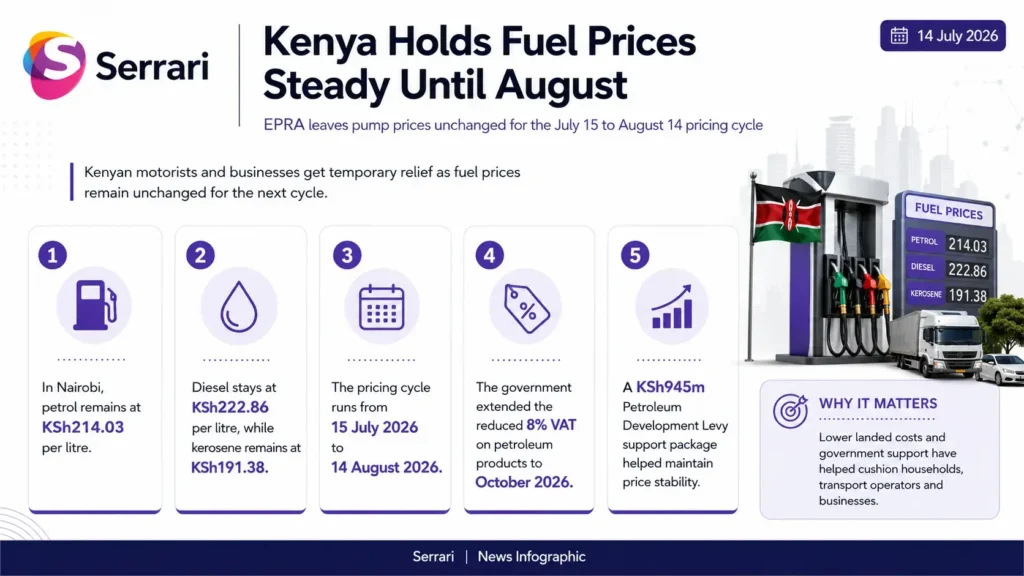
- Nairobi fuel prices remain at KSh214.03 for Super Petrol, KSh222.86 for Diesel and KSh191.38 for Kerosene.
- The prices will remain in force from July 15 to August 14, 2026.
- The government has extended the reduced 8% VAT rate on petroleum products until October 14, 2026.
- KSh945 million from the Petroleum Development Levy will be used to support price stability.
- June landed costs were reported at $886.92 per cubic metre for petrol, $984.37 for diesel and $1,028.17 for kerosene. (People Daily)
EPRA Keeps Pump Prices Unchanged
Kenya’s Energy and Petroleum Regulatory Authority has maintained the maximum retail prices that applied during the previous pricing cycle.
Motorists in Nairobi will therefore continue paying KSh214.03 per litre for Super Petrol, KSh222.86 for Diesel, and KSh191.38 for Kerosene until the next monthly review. The current prices followed reductions in the previous cycle, when petrol fell by KSh0.22 per litre and diesel by KSh10.00 per litre. (EPRA)
The unchanged prices offer short-term predictability to motorists, public transport operators and businesses whose operating costs are heavily influenced by fuel.
Prices will still vary by location because of transport and distribution costs. Under the new schedule, motorists in Mombasa will pay KSh210.87 for Super Petrol, KSh219.58 for Diesel and KSh188.09 for Kerosene.
In Nakuru, the respective prices are KSh212.92, KSh222.27 and KSh190.81, while Kisumu and Eldoret motorists will continue paying KSh213.69 for petrol, KSh223.09 for diesel and KSh191.63 for kerosene.
Government Support Helps Hold Prices Down
The decision to keep prices unchanged is supported by two major government interventions.
First, the government has extended the reduced 8% VAT rate on petroleum products for another three months, taking the measure to October 14, 2026. The reduced tax rate was introduced after a sharp rise in international energy costs and has been extended to cushion households and businesses from further volatility. (Reuters)
Second, the government will deploy a KSh945 million fuel subsidy from the Petroleum Development Levy during the July-August pricing cycle.
Energy and Petroleum Cabinet Secretary Opiyo Wandayi said the intervention was intended to sustain current pump prices while global oil markets remain unsettled. (People Daily)
The measures underline the extent to which Kenya’s current pump prices are being influenced not only by international import costs but also by tax and price-stabilisation policy.
Context is everything. Stay ahead of shifting trends with today’s market updates, and uncover emerging opportunities using the Serrari Group Market Index and Marketplace. Then, take control of your own financial future by exploring our Money & Life Reset Transformation Blueprint ™ to build stronger habits, create better systems, and design a path toward lasting wealth.
Lower June Landed Costs Provide Additional Relief
The latest pricing cycle also benefited from a decline in the landed cost of imported petroleum products.
The average landed cost of Super Petrol was reported at $886.92 per cubic metre in June 2026. Diesel averaged $984.37 per cubic metre, while Kerosene stood at $1,028.17 per cubic metre. (Tuko.co.ke – Kenya news.)
The moderation in import costs provided some relief after sharp increases earlier in 2026. However, Kenya remains exposed to international petroleum prices because the country imports its refined fuel requirements.
That means any renewed increase in international oil prices, freight expenses or insurance costs could eventually filter through to domestic pump prices.
Middle East Risks Remain a Threat to Future Prices
Although prices are unchanged for the current cycle, the outlook remains uncertain.
Kenya imports most of its petroleum products through supply arrangements linked to the Middle East, making the country vulnerable to disruptions in global shipping and energy markets. The government has said that all scheduled cargoes have continued arriving and that fuel supplies remain adequate despite renewed regional tensions. (Reuters)
The government-to-government import arrangement has also helped provide greater certainty over freight and premium costs, according to the Energy Ministry.
However, continued geopolitical instability could push global benchmark prices higher in future pricing cycles. Any sustained increase would put additional pressure on the government to decide whether to continue using tax relief and Petroleum Development Levy funds to cushion consumers.
Stable Prices Offer Temporary Relief to the Economy
Holding fuel prices steady provides immediate relief to sectors where transport and energy costs form a significant part of operating expenses.
Public transport operators, manufacturers, logistics companies, farmers and households all face indirect exposure to fuel prices. Sharp increases can raise transport costs and feed into the prices of food and other goods.
For now, consumers have another month of price stability. The next major test will come in the August review, when new international petroleum costs, exchange-rate movements and the evolving situation in global energy markets will again determine how much support may be required to prevent further increases.
The current prices remain effective from July 15 to August 14, 2026.
Sources: Energy and Petroleum Regulatory Authority / Reuters / People Daily / Tuko
Your financial future isn’t something you wait for—it’s something you build.
The real question is: when do you begin?
Move beyond simply staying informed.
Navigate the markets with clarity—track trends through the Serrari Group Market Index, uncover opportunities in the Serrari Marketplace, and build practical knowledge with our Curated Wealth Builder Platform.
Stay connected to what truly matters.
Get daily insights on macro trends and financial movements across Kenya, Africa, and global markets—delivered through the Serrari Newsletter.
Growth opens doors.
Advance your career through professional programs including ACCA, HESI A2, ATI TEAS 7 , HESI EXIT , NCLEX – RN and NCLEX – PN, Financial Literacy!🌟—designed to move you forward with confidence.
See where money is flowing—clearly and in real time.
Track Money Market Funds, Treasury Bills, Treasury Bonds, Green Bonds, and Fixed Deposits, alongside global and African indexes, key economic indicators, and the evolving Crypto and stablecoin landscape—all within Serrari’s Market Index.