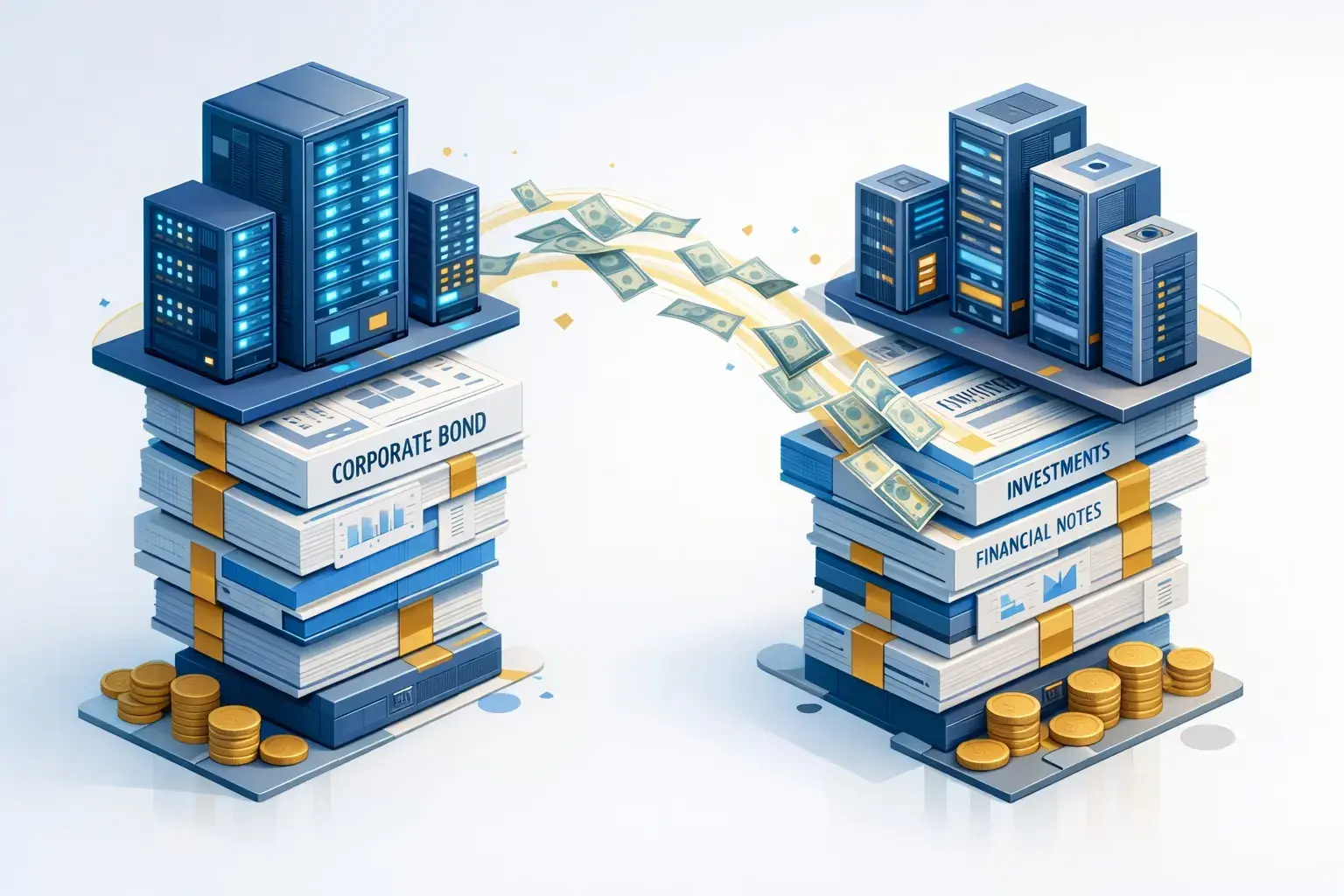
Corporate bond spreads show the extra yield investors receive for lending to companies instead of the US government. In July 2026, US investment-grade corporate bonds offer a total yield above 5%, but the ICE BofA US Corporate Index option-adjusted spread is only 0.78 percentage point. That means much of the yield is coming from the Treasury-rate backdrop rather than unusually generous credit compensation. At the same time, AI corporate debt is growing quickly as hyperscalers borrow to fund data centres, chips, power and cloud infrastructure. For investors, the key issue is whether the income is enough to compensate for duration, credit and technology-sector concentration risk.
Key Overview
- The ICE BofA US Corporate Index effective yield reached 5.35% on 13 July 2026.
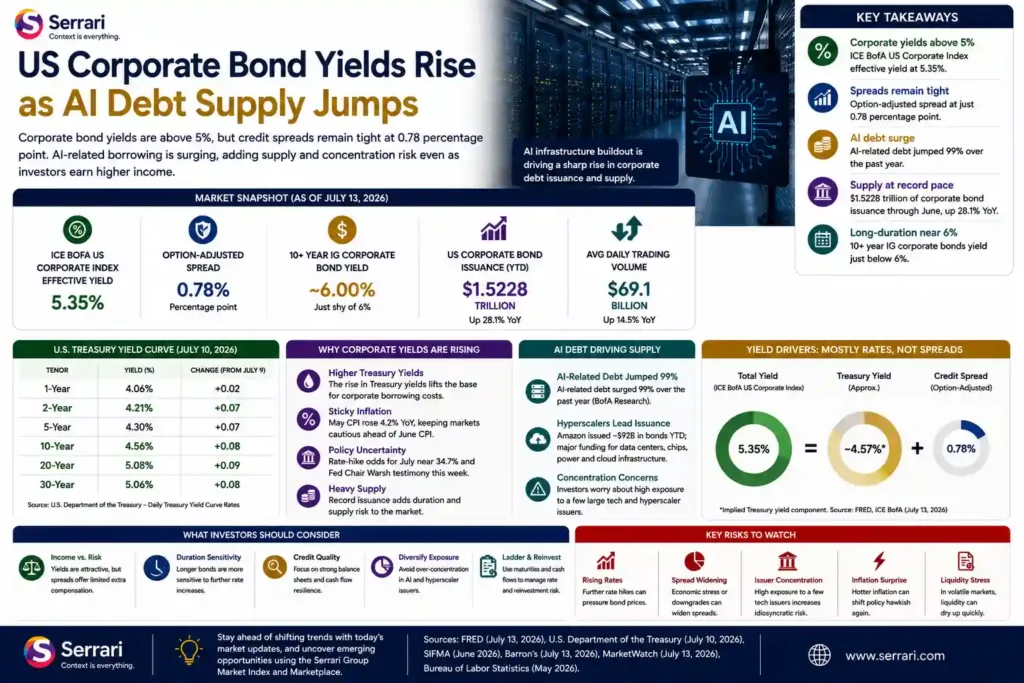
- The same index’s option-adjusted spread was 0.78 percentage point.
- Long-duration investment-grade bonds are yielding just below 6%, according to WSJ’s summary of ICE BofA index data.
- SIFMA reported US corporate-bond issuance of $1.5228 trillion through June, up 28.1% year on year.
- Average daily corporate-bond trading volume reached $69.1 billion, up 14.5% year on year.
- MarketWatch, citing Bank of America research, reported that AI-related debt jumped 99% over the past year.
US Corporate Bond Yields Rise as AI Debt Supply Jumps
Corporate Yields Move Above 5%
The US investment-grade credit market is offering income levels that look attractive compared with much of the post-2008 low-rate era. FRED data show the ICE BofA US Corporate Index effective yield at 5.35% on 13 July 2026 under the FRED corporate index yield table. (FRED)
That headline yield matters for income investors. A 5%-plus investment-grade yield can appeal to investors building bond ladders, pension portfolios, insurance portfolios or diversified income allocations. But the total yield needs to be separated into two pieces: the underlying Treasury yield and the corporate spread.
Spreads Remain Narrow
The extra credit compensation is much thinner than the headline yield suggests. FRED data show the ICE BofA US Corporate Index option-adjusted spread at 0.78 percentage point on 13 July under the FRED corporate spread table. (FRED)
That means investors are not receiving a large premium for taking company-specific risk. The spread compensates for default risk, downgrade risk, liquidity risk and corporate-specific uncertainty. A high all-in yield with a tight spread can still leave investors exposed if Treasury yields rise further or if credit spreads widen from low levels.
Long-Duration Bonds Near 6%
Long-duration bonds add another layer. WSJ reported that investment-grade bonds with maturities of at least 10 years were yielding just shy of 6%, according to ICE BofA index data via FactSet. The same report noted that the weighted average life of that long-bond index was more than 20 years under the WSJ long-duration corporate yield report. (The Wall Street Journal)
That income can look compelling, but long-duration bonds are highly sensitive to rate changes. If Treasury yields rise, long corporate-bond prices can fall even if the issuer’s credit quality remains strong.
Issuance Is Running Hot
Supply is also rising quickly. SIFMA reported US corporate-bond issuance of $1.5228 trillion through June 2026, up 28.1% year on year. It also reported average daily trading volume of $69.1 billion, up 14.5%, and total corporate debt outstanding of $11.7 trillion as of the first quarter under the SIFMA corporate bond statistics. (SIFMA)
Heavy issuance is not automatically negative. Companies may borrow to fund investment, refinance maturities or lock in funding. But when supply rises quickly, investors must ask whether spreads are wide enough to absorb the new paper.
AI Debt Becomes a Supply Force
AI corporate debt is now a major part of the supply story. MarketWatch, citing Bank of America research, reported that AI-related debt had jumped 99% over the past year and that hyperscalers were the largest contributors to the increase in US investment-grade supply through 10 July under the MarketWatch AI debt supply report. (MarketWatch)
This is not only an equity-market story. Data centres, chips, cloud capacity and power infrastructure require large upfront funding. Bond markets are becoming one of the key channels through which technology companies finance that buildout.
Context is everything. Stay ahead of shifting trends with today’s market updates, and uncover emerging opportunities using the Serrari Group Market Index and Marketplace. Then, take control of your own financial future by exploring our Money & Life Reset Transformation Blueprint ™ to build stronger habits, create better systems, and design a path toward lasting wealth.
Concentration Risk Is the New Question
The key risk is concentration. MarketWatch reported that Amazon’s debt issuance stood at about $92 billion so far this year across currencies, and that a surprise issuance widened 30-year hyperscaler bond spreads by 6 to 15 basis points. Columbia Threadneedle’s Tom Murphy told MarketWatch that institutional investors are increasingly concerned about issuer concentration limits under the MarketWatch hyperscaler concentration report. (MarketWatch)
That matters for index investors. If technology company debt becomes a larger share of investment-grade benchmarks, passive portfolios may become more exposed to the same AI infrastructure cycle than investors realise.
Not Necessarily Financial Distress
Heavy AI borrowing does not automatically mean technology issuers are financially stressed. J.P. Morgan Asset Management argues that using the bond market to fund long-term AI capital expenditure can be rational because it locks in long-dated funding, preserves cash and can be cheaper than equity for strong issuers under the J.P. Morgan AI debt analysis. (J.P. Morgan)
That is the balanced view. The issue is less that every AI borrower is weak, and more that the bond market is absorbing a larger, more concentrated technology financing cycle.
What Investors Should Compare
Investors should compare corporate-bond yields with Treasuries of similar maturity, not only with cash or deposits. A 5.35% corporate index yield may look attractive, but if the spread is only 0.78 percentage point, the investor must decide whether that spread is enough for corporate risk.
They should also compare maturity. Short and intermediate bonds may offer less duration risk, while long corporate bonds offer more income but can fall more sharply if yields rise. For bond income investing, the maturity decision is as important as the issuer decision.
What to Watch Next
The first number to watch is the corporate spread. If spreads widen while Treasury yields stay high, corporate-bond prices can face a double hit. The second is issuance volume, especially from large technology companies and AI infrastructure borrowers.
The third is rating stability. Investment-grade status reduces credit risk, but it does not eliminate downgrade risk. The fourth is benchmark concentration. Investors using index funds should understand how much exposure they have to technology company debt.
Conclusion
US Corporate Bond Yields are higher, but the extra credit compensation remains limited. The ICE BofA US Corporate Index yield of 5.35% offers meaningful income, yet the 0.78-point spread shows that much of that income comes from Treasury rates rather than wide corporate-risk compensation.
At the same time, AI-related borrowing is changing the supply mix. For investors, the question is not whether corporate bonds are attractive in isolation. It is whether the yield, spread and maturity provide enough compensation for duration risk, credit risk and growing exposure to the AI infrastructure cycle.
FAQs
1. Why are US Corporate Bond Yields rising?
US Corporate Bond Yields are rising because Treasury yields have moved higher and corporate-bond supply has increased. The ICE BofA US Corporate Index effective yield reached 5.35% on 13 July. However, the credit spread remained narrow at 0.78 percentage point, meaning much of the rise reflects the broader interest-rate backdrop rather than a large increase in credit compensation.
2. What is a corporate bond spread?
A corporate bond spread is the extra yield a company pays above a comparable Treasury yield. It compensates investors for risks such as default, downgrade, liquidity and issuer-specific uncertainty. In July 2026, the ICE BofA US Corporate Index spread was 0.78 percentage point, which is relatively narrow compared with the all-in yield above 5%.
3. Why does AI corporate debt matter?
AI corporate debt matters because large technology companies are borrowing heavily to finance data centres, chips, cloud capacity and power infrastructure. This adds supply to the investment-grade corporate-bond market and can increase concentration risk if portfolios hold several issuers exposed to the same AI infrastructure cycle.
4. Are higher corporate yields good for investors?
Higher corporate yields can be good for investors putting new money to work because they provide more income. But they are not uniformly positive. Existing bond holders can face price losses when yields rise, and tight credit spreads may mean investors are not being paid much extra for taking corporate risk.
5. What should corporate bond investors watch next?
Corporate bond investors should watch credit spreads, Treasury yields, new issuance, technology-sector concentration, rating changes and trading liquidity. They should also compare corporate bonds with Treasuries, money market funds and deposits to decide whether the extra yield justifies the added risk.
Sources: FRED, SIFMA, WSJ, MarketWatch, J.P Morgan, Reuter, FINRA TRACE
Your financial future isn’t something you wait for—it’s something you build.
The real question is: when do you begin?
Move beyond simply staying informed.
Navigate the markets with clarity—track trends through the Serrari Group Market Index, uncover opportunities in the Serrari Marketplace, and build practical knowledge with our Curated Wealth Builder Platform.
Stay connected to what truly matters.
Get daily insights on macro trends and financial movements across Kenya, Africa, and global markets—delivered through the Serrari Newsletter.
Growth opens doors.
Advance your career through professional programs including ACCA, HESI A2, ATI TEAS 7 , HESI EXIT , NCLEX – RN and NCLEX – PN, Financial Literacy!🌟—designed to move you forward with confidence.
See where money is flowing—clearly and in real time.
Track Money Market Funds, Treasury Bills, Treasury Bonds, Green Bonds, and Fixed Deposits, alongside global and African indexes, key economic indicators, and the evolving Crypto and stablecoin landscape—all within Serrari’s Market Index.