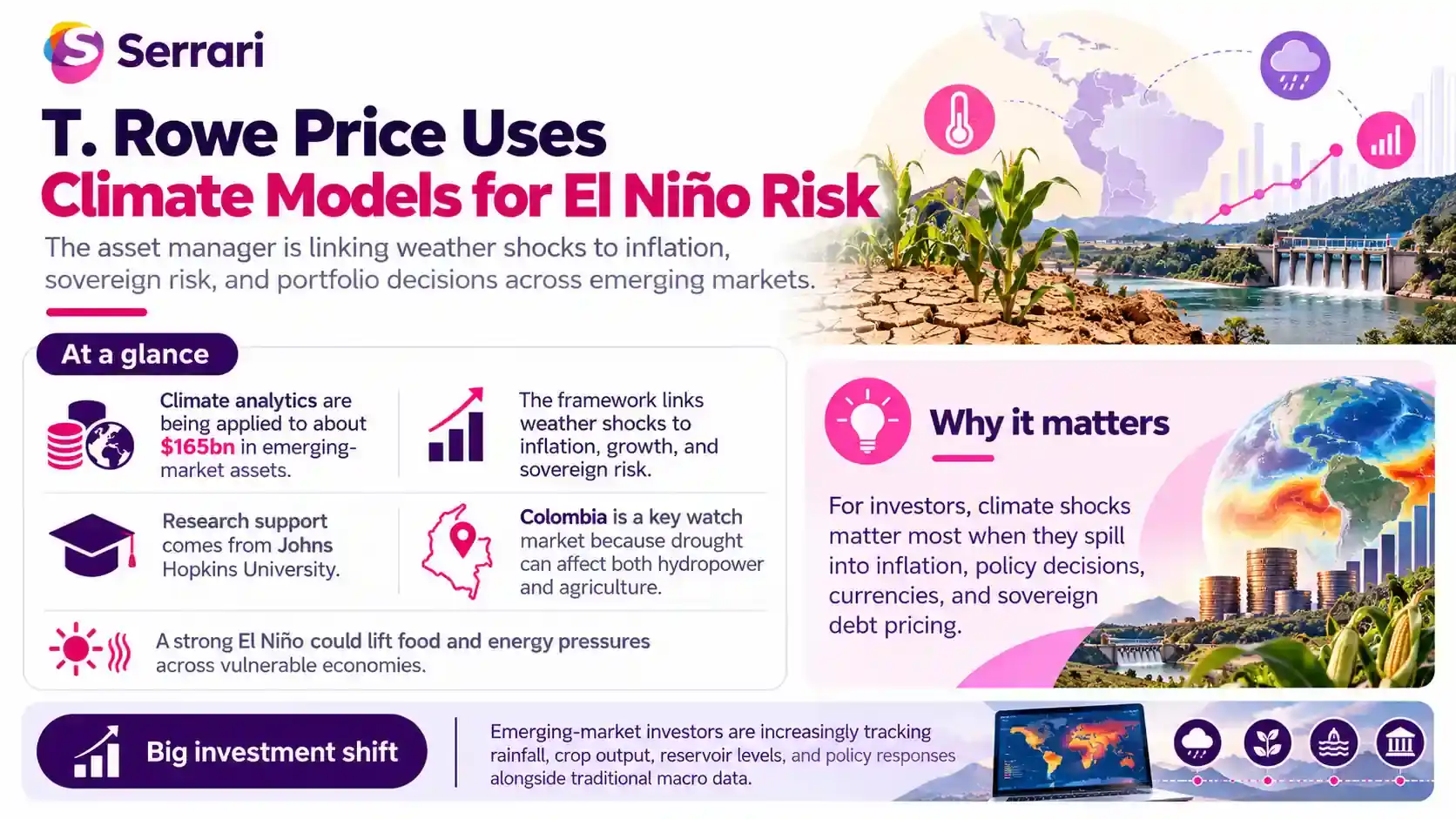
T. Rowe Price is sharpening how it manages climate-related risk across roughly $165 billion in emerging-market debt and equities, using specialised weather and economic models as a strengthening El Niño threatens agriculture, electricity systems, inflation and sovereign finances.
The asset manager has been working with researchers at Johns Hopkins University to connect weather patterns with economic outcomes such as food inflation, hydropower shortages, fiscal pressure and currency weakness.
Rather than treating El Niño as a purely environmental event, the firm is incorporating it directly into country-level investment decisions across sovereign bonds, local interest rates, currencies and equities.
Key Overview
- T. Rowe Price is applying climate analytics to approximately $165 billion in emerging-market assets.
- The firm has collaborated with Johns Hopkins University on models linking El Niño to sovereign and economic risks.
- The analysis examines weather, agriculture, hydrology and their transmission into inflation, growth and public finances.
- Colombia is a key example because drought can simultaneously affect food output and hydroelectric power generation.
- A strong El Niño could raise global food prices by disrupting rice, palm oil and other agricultural production.
- Investors are increasingly assessing how governments and central banks may respond to climate-driven inflation and fiscal pressure.
- Climate exposure alone does not determine investment risk; financial buffers and policy responses can significantly change outcomes.
Climate Risk Moves Into Portfolio Construction
T. Rowe Price has moved beyond relying solely on conventional economic indicators when analysing emerging markets.
Its sovereign investment teams are now using a dedicated El Niño risk framework that traces how unusual rainfall, drought and heat can affect agriculture, electricity generation, inflation, trade and government finances.
The approach is designed to identify where physical climate shocks are most likely to become financially significant.
A country may experience extreme weather without suffering severe market consequences if it has sufficient food reserves, flexible electricity generation, healthy foreign-exchange reserves and fiscal space. In more vulnerable economies, however, the same shock can increase inflation, weaken growth, pressure currencies and raise sovereign borrowing risks.
This distinction is increasingly important as the 2026 El Niño strengthens.
Johns Hopkins Models Add More Granular Analysis
T. Rowe Price began deepening its climate research through a collaboration with Johns Hopkins University after the previous El Niño cycle.
Researchers have been studying the connection between climate shocks and sovereign debt, examining more than 100 countries and conducting deeper analysis on selected emerging markets.
The work combines meteorological, hydrological and agricultural data with economic indicators such as growth, inflation and debt sustainability.
One objective is to understand the entire transmission chain.
A drought may initially reduce crop yields. Lower agricultural production can then push food prices higher, affecting inflation. Central banks may respond by keeping interest rates elevated, while governments may increase subsidies or food imports. Those measures can then influence fiscal deficits, foreign-exchange reserves and eventually sovereign bond pricing.
For investors, that sequence is more useful than simply knowing that a country is exposed to El Niño.
Context is everything. Stay ahead of shifting trends with today’s market updates, and uncover emerging opportunities using the Serrari Group Market Index and Marketplace. Then, take control of your own financial future by exploring our Money & Life Reset Transformation Blueprint ™ to build stronger habits, create better systems, and design a path toward lasting wealth.
Colombia Shows How Climate Can Reach Markets
Colombia illustrates why T. Rowe Price is paying close attention to these transmission channels.
The country relies heavily on hydroelectric generation, meaning prolonged drought can reduce reservoir levels and increase dependence on more expensive thermal power.
At the same time, weaker rainfall can damage agricultural output.
This creates the possibility of simultaneous food and electricity inflation. Colombia’s central bank has already identified potential El Niño effects as an inflation risk, alongside higher food prices and utility tariffs.
For bond investors, the concern extends beyond weather itself. Higher inflation could influence the timing of interest-rate cuts, while electricity subsidies or emergency spending could place additional pressure on public finances.
T. Rowe Price’s framework therefore evaluates whether drought conditions could materially alter inflation, monetary policy, the currency or sovereign credit fundamentals.
Food Prices Could Become a Global Pressure Point
The potential consequences extend far beyond Latin America.
A powerful El Niño can alter rainfall across major agricultural regions, affecting crops ranging from maize and beans to rice and palm oil.
In Southeast Asia, reduced rainfall poses particular risks because the region is a major producer and exporter of staple foods and agricultural commodities.
A stronger El Niño could therefore create significant pressure on global food supplies, particularly if drought affects several major exporting countries simultaneously.
Higher food prices can be especially damaging in emerging economies where food represents a large share of household spending and inflation baskets.
The consequences can include weaker disposable incomes, renewed inflation, delayed monetary easing and greater pressure on government subsidy programmes.
Investors Focus on Policy Response, Not Weather Alone
T. Rowe Price’s approach also reflects a broader change in how asset managers analyse climate events.
The investment impact of El Niño depends not only on how severe the weather becomes but also on how governments, central banks and infrastructure systems respond.
Countries with diversified power systems, larger fiscal buffers and strong external reserves may absorb disruptions relatively well. Others may face deteriorating trade balances, higher borrowing costs and weaker currencies.
That means investors are increasingly examining reservoir levels, crop conditions, food imports, energy systems and policy credibility alongside conventional economic data.
T. Rowe Price’s climate modelling shows how environmental risks are becoming embedded directly into financial analysis. For emerging-market investors, understanding El Niño is increasingly less about predicting the weather and more about determining where that weather could eventually affect inflation, interest rates, currencies, corporate earnings and sovereign debt.
Sources: T. Rowe Price / Johns Hopkins University / Banco de la República / Associated Press / Business Times / Reuters
Your financial future isn’t something you wait for—it’s something you build.
The real question is: when do you begin?
Move beyond simply staying informed.
Navigate the markets with clarity—track trends through the Serrari Group Market Index, uncover opportunities in the Serrari Marketplace, and build practical knowledge with our Curated Wealth Builder Platform.
Stay connected to what truly matters.
Get daily insights on macro trends and financial movements across Kenya, Africa, and global markets—delivered through the Serrari Newsletter.
Growth opens doors.
Advance your career through professional programs including ACCA, HESI A2, ATI TEAS 7 , HESI EXIT , NCLEX – RN and NCLEX – PN, Financial Literacy!🌟—designed to move you forward with confidence.
See where money is flowing—clearly and in real time.
Track Money Market Funds, Treasury Bills, Treasury Bonds, Green Bonds, and Fixed Deposits, alongside global and African indexes, key economic indicators, and the evolving Crypto and stablecoin landscape—all within Serrari’s Market Index.