
















Standard Bank Group has mobilised R3.45 billion for climate-smart agriculture over the past year, supporting farmers as they adapt to climate change, improve productivity, and strengthen resilience. The financing supports sustainable farming practices, renewable energy, efficient irrigation, and precision agriculture technologies that help reduce climate risks while improving long-term profitability and food security.
Key Overview
- Standard Bank mobilised R3.45 billion for climate-smart agriculture.
- Financing supports sustainable farming and climate resilience.
- Investments include irrigation, renewable energy, and regenerative agriculture.
- Farmers are adopting precision agriculture and data-driven technologies.
- The funding supports food security and rural economic growth.
- Climate-smart practices improve efficiency and profitability.
- The bank aims to expand access to sustainable finance.
- The initiative aligns with South Africa’s climate commitments.
Financing Resilient Farming Amid Climate Challenges
Standard Bank Group has mobilised R3.45 billion in financing for climate-smart agriculture over the past year, reinforcing its commitment to sustainable food production, climate resilience, and inclusive economic growth across South Africa.
The financing supports farmers and agricultural businesses that are adopting climate-smart practices to improve productivity, reduce environmental impacts, and strengthen resilience against increasingly severe climate risks.
As weather patterns become more unpredictable and farming costs continue to rise, financial institutions are playing an increasingly important role in helping producers adapt to changing conditions while maintaining food production and economic stability.
Agriculture Faces Growing Climate Risks
The agricultural sector remains one of the industries most exposed to climate change.
Farmers across South Africa continue to face growing challenges, including:
- Erratic rainfall patterns.
- Prolonged droughts.
- Water shortages.
- Rising temperatures.
- Increasing input costs.
- Greater weather-related risks.
These pressures are forcing producers to adopt new technologies and farming methods that improve resilience while maintaining profitability.
Climate change has also increased uncertainty for farmers, making access to suitable financing essential for long-term sustainability.
Financing Climate-Smart Solutions
Standard Bank’s funding supports several climate-smart agricultural interventions.
These include:
- Water-efficient irrigation systems.
- Renewable energy installations.
- Regenerative farming practices.
- Precision agriculture technologies.
- Solar-powered equipment.
- Data-driven crop management systems.
These investments help farmers reduce operational costs, improve efficiency, and strengthen resilience against climate shocks.
The bank says the adoption of such technologies is helping producers optimize resources while increasing agricultural productivity.
Farmers Embrace Sustainable Practices
According to Louis Van Ravesteyn, Standard Bank Group Head of Agriculture, farmers are already responding to the realities of climate change.
However, scaling these solutions requires access to appropriate financing.
He noted that agriculture is shifting toward more resilient and efficient production models that combine sustainability with productivity.
Many producers are increasingly recognising that sustainable farming practices can also improve profitability and long-term business performance.
Technology Drives Agricultural Efficiency
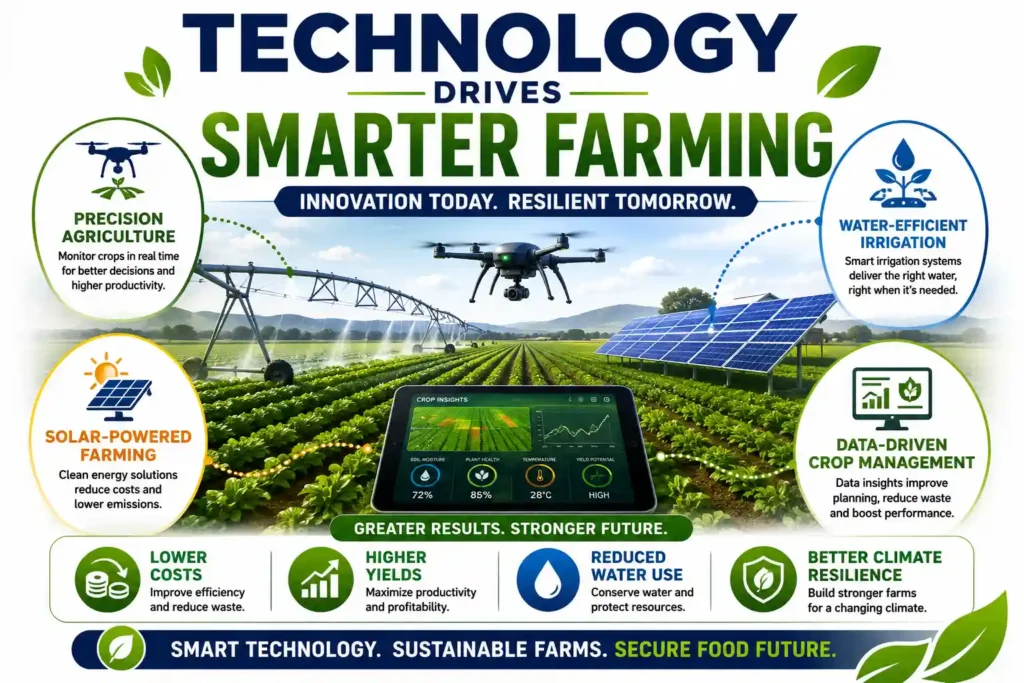
Technological innovation is becoming increasingly important within modern farming operations.
Precision agriculture tools allow farmers to:
- Monitor crop performance.
- Improve fertilizer use.
- Reduce water consumption.
- Increase yields.
- Lower production costs.
Solar-powered irrigation systems and renewable energy solutions are also helping reduce energy costs while lowering emissions.
Data-driven farming techniques provide producers with valuable insights that support better decision-making and risk management.
These technologies enable farmers to maximise productivity while adapting to climate-related challenges.
Context is everything. Stay ahead of shifting trends with today’s market updates, and uncover emerging opportunities using the Serrari Group Market Index and Marketplace. Then, take control of your own financial future by exploring our Money & Life Reset Transformation Blueprint ™ to build stronger habits, create better systems, and design a path toward lasting wealth.
Supporting Rural Economies
Climate-smart agriculture plays a critical role in supporting rural communities and local economies.
Agriculture remains a major source of:
- Employment.
- Income generation.
- Food production.
- Economic activity.
By improving resilience and productivity, sustainable farming practices help strengthen rural livelihoods and support long-term economic development.
The bank’s financing strategy also focuses on improving access to funding for emerging and mid-sized farmers who often face barriers to traditional lending.
Sustainable Finance Strategy
The agricultural financing forms part of Standard Bank’s broader sustainable finance strategy.
The bank prioritises investments that generate measurable environmental and social benefits alongside financial returns.
Climate-smart agriculture has become a major focus because of its ability to:
- Reduce greenhouse gas emissions.
- Protect natural resources.
- Support biodiversity.
- Improve food security.
- Strengthen rural economies.
The approach aligns with both global sustainability objectives and South Africa’s climate commitments.
Building a Just Transition
Boitumelo Sethlatswe, Standard Bank Head of Sustainability, said sustainable finance is about delivering real economic outcomes.
She noted that directing capital toward climate-smart agriculture supports producers, communities, and ecosystems while helping build a more resilient agricultural sector.
According to Sethlatswe, this approach forms an important component of a just transition by ensuring that climate action also protects livelihoods and enable inclusive growth.
The bank believes that strengthening resilience throughout agricultural value chains is essential for long-term sustainability.
Improving Food Security
Climate-smart agriculture contributes directly to food security by helping producers adapt to changing conditions.
Resilient farming systems can:
- Maintain stable production.
- Reduce climate risks.
- Protect natural resources.
- Improve yields.
- Increase efficiency.
As climate pressures intensify, the ability of farmers to adapt will increasingly determine the stability of South Africa’s food systems.
Investment in sustainable agriculture therefore represents both an environmental and economic priority.
Outlook
Standard Bank’s R3.45 billion commitment highlights the growing role of sustainable finance in supporting agricultural resilience. As climate risks continue to affect food production, access to tailored financing solutions will become increasingly important for farmers seeking to invest in new technologies and sustainable practices.
Climate-smart agriculture is expected to play a critical role in improving food security, supporting rural economies, and helping South Africa meet its climate goals. Continued investment in innovation, renewable energy, and sustainable farming practices may help create a more resilient agricultural sector capable of adapting to future climate challenges.
FAQs
1. How much financing did Standard Bank provide?
Standard Bank mobilised R3.45 billion for climate-smart agriculture over the past year.
2. What projects does the financing support?
The funding supports irrigation systems, renewable energy, regenerative farming, and precision agriculture technologies.
3. Why is climate-smart agriculture important?
It helps farmers adapt to climate change, improve productivity, reduce risks, and strengthen food security.
4. How does the financing benefit farmers?
The funding helps farmers invest in sustainable technologies, improve efficiency, reduce costs, and increase long-term resilience.
Sources: Engineering News, Business Report, Bizcommunity, StartUp Magazine South Africa
Your financial future isn’t something you wait for—it’s something you build.
The real question is: when do you begin?
Move beyond simply staying informed.
Navigate the markets with clarity—track trends through the Serrari Group Market Index, uncover opportunities in the Serrari Marketplace, and build practical knowledge with our Curated Wealth Builder Platform.
Stay connected to what truly matters.
Get daily insights on macro trends and financial movements across Kenya, Africa, and global markets—delivered through the Serrari Newsletter.
Growth opens doors.
Advance your career through professional programs including ACCA, HESI A2, ATI TEAS 7 , HESI EXIT , NCLEX – RN and NCLEX – PN, Financial Literacy!🌟—designed to move you forward with confidence.
See where money is flowing—clearly and in real time.
Track Money Market Funds, Treasury Bills, Treasury Bonds, Green Bonds, and Fixed Deposits, alongside global and African indexes, key economic indicators, and the evolving Crypto and stablecoin landscape—all within Serrari’s Market Index.