Kenya real estate investment opportunities are attracting increasing interest from Nigerian investors as cross-border property investment gains momentum across Africa. A new investment tour aims to connect investors with Kenya’s growing real estate market and emerging wealth creation opportunities.
Key Overview
- Dewale Consulting launched a Kenya real estate investment tour.
- The six-day programme targets Nigerian investors.
- The tour will run from July 20 to July 25, 2026.
- Participants will visit property developments and attend workshops.
- Kenya is increasingly attracting cross-border investors.
- Residential rental yields are projected between 9% and 12%.
- Some off-plan projects could deliver returns of 25% to 30%.
- The initiative supports intra-African investment growth.
- AfCFTA is encouraging greater economic integration.
- Investors are seeking diversification beyond domestic markets.
Kenya Real Estate Investment Gains Interest from Nigerians
Interest in Kenya real estate investment opportunities is growing among Nigerian investors as cross-border investment activity gains momentum across Africa. The trend reflects a broader shift in how investors are approaching wealth creation, with many seeking exposure to multiple African markets rather than concentrating investments within their home countries.
This growing appetite for regional diversification has prompted Dewale Consulting Ltd (DCL) to launch a dedicated investment programme focused on Kenya’s property sector. The initiative is designed to provide Nigerian investors with firsthand exposure to one of East Africa’s most active real estate markets.
As Africa continues to deepen economic integration through initiatives such as the African Continental Free Trade Area (AfCFTA), cross-border investment opportunities are becoming increasingly attractive to both individual and institutional investors.
Kenya Real Estate Investment Tour Targets Nigerian Investors
The newly launched Kenya real estate investment tour will run from July 20 to July 25, 2026, under the theme “Real Estate Investment Safari: Experience Kenya on the Ground.”
The six-day programme aims to provide participants with direct exposure to property opportunities across Kenya through site visits, educational workshops, and engagements with industry professionals.
According to Dewale Consulting, investors will have the opportunity to inspect property developments, interact with legal and financial experts, and gain a deeper understanding of Kenya’s real estate ecosystem.
The programme reflects growing demand from investors seeking practical, on-the-ground insights before making investment decisions in foreign markets.
Rather than relying solely on market reports and online research, participants will be able to evaluate opportunities directly and engage with key stakeholders operating within the sector.
Context is everything. Stay ahead of shifting trends with today’s market updates, and uncover emerging opportunities using the Serrari Group Market Index and Marketplace. Then, take control of your own financial future by exploring our Money & Life Reset Transformation Blueprint ™ to build stronger habits, create better systems, and design a path toward lasting wealth.
Kenyan Property Investment Attracts Regional Capital
Growing interest in Kenyan property investment reflects the country’s position as one of East Africa’s leading economic hubs.
Kenya continues to attract investors because of its relatively diversified economy, expanding urban population, growing middle class, and improving infrastructure network.
Nairobi remains a major commercial center for multinational corporations, financial institutions, technology firms, and regional businesses. This economic activity supports demand for residential, commercial, and mixed-use developments.
In addition, ongoing urbanization continues to drive housing demand in major cities and emerging satellite towns.
Investors are increasingly viewing Kenya as a market capable of delivering both rental income and long-term capital appreciation.
The country’s relatively mature property sector and established legal framework also contribute to investor confidence compared with some other regional markets.
Nigerian Investors in Kenya Seek Diversification
The increasing presence of Nigerian investors in Kenya highlights a growing trend toward pan-African portfolio diversification.
Many investors are looking beyond domestic opportunities as they seek ways to manage risk and access new growth markets.
According to Dewale Consulting, diversification across African markets can help investors reduce concentration risk while expanding access to opportunities in sectors with different economic drivers.
For Nigerian investors in particular, cross-border investments may provide an additional hedge against currency fluctuations and domestic market volatility.
By allocating capital across multiple jurisdictions, investors can potentially improve portfolio resilience while benefiting from growth opportunities in different regions.
The trend also reflects a broader shift toward viewing Africa as a connected investment landscape rather than a collection of isolated national markets.
Cross-Border Real Estate Investment Continues Expanding
The rise of cross-border real estate investment is being supported by increasing economic cooperation across the continent.
The African Continental Free Trade Area has strengthened conversations around regional integration, trade expansion, and capital mobility.
While property markets remain governed by local regulations, investors are becoming more comfortable exploring opportunities beyond their home countries.
Advancements in digital technology, financial services, and information access have also made it easier for investors to evaluate and manage international property investments.
Cross-border investment activity is no longer limited to multinational corporations and large institutions. Increasingly, individual investors and smaller investment groups are participating in regional property markets.
This trend is expected to continue as African economies become more interconnected and investment barriers gradually decline.
East Africa Property Market Offers Growth Potential
The broader East Africa property market continues to attract attention from investors seeking exposure to long-term economic growth.
East Africa remains one of the fastest-growing regions on the continent, supported by population growth, urbanization, infrastructure development, and expanding consumer markets.
Kenya plays a central role within the region due to its strategic location and well-developed business environment.
Property demand continues to be supported by housing needs, commercial expansion, logistics development, and growing investment activity.
Developers are increasingly targeting emerging residential corridors and mixed-use developments designed to accommodate changing demographic and economic trends.
These factors contribute to the region’s appeal among investors looking for both income-generating assets and capital growth opportunities.
Property Investment Kenya Returns Attract Investors
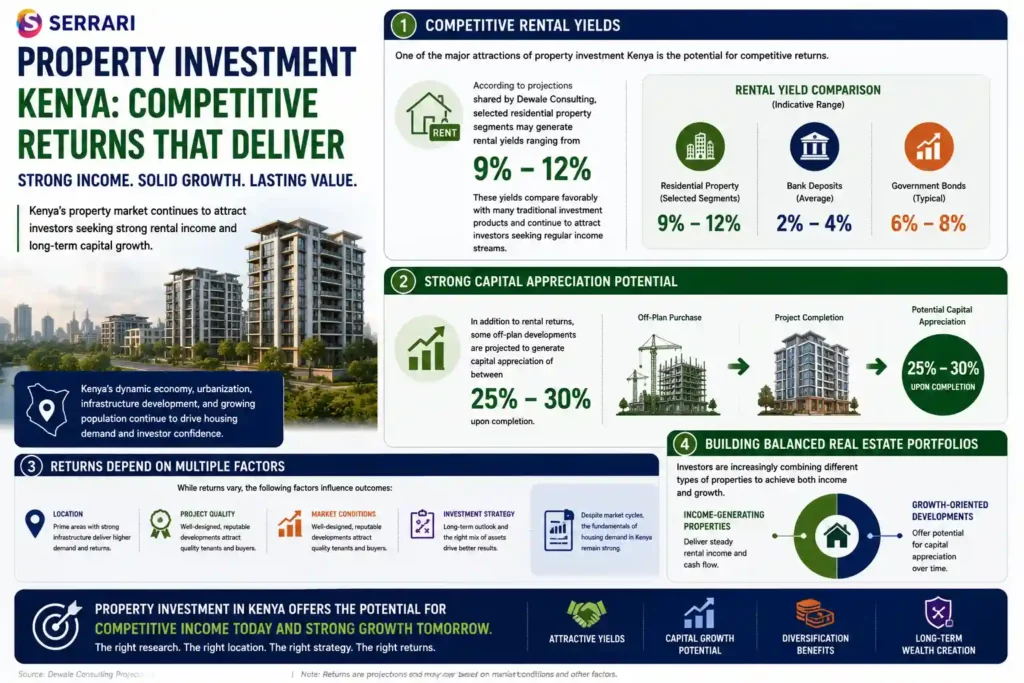
One of the major attractions of property investment Kenya is the potential for competitive returns.
According to projections shared by Dewale Consulting, selected residential property segments may generate rental yields ranging from 9% to 12%.
These yields compare favorably with many traditional investment products and continue to attract investors seeking regular income streams.
In addition to rental returns, some off-plan developments are projected to generate capital appreciation of between 25% and 30% upon completion.
While returns vary depending on location, project quality, market conditions, and investment strategy, the figures highlight why interest in Kenya’s property market remains strong.
Investors are increasingly combining income-generating properties with growth-oriented developments to create balanced real estate portfolios.
African Real Estate Opportunities Support Economic Integration
Growing interest in African real estate opportunities extends beyond property ownership.
Cross-border investment can contribute to broader economic development by encouraging capital flows, business collaboration, knowledge transfer, and regional cooperation.
Industry experts note that stronger investment links between African countries can help unlock economic potential and accelerate development.
Potential benefits include increased trade activity, improved business networks, technology exchange, and stronger regional value chains.
As investors move capital across borders, they also contribute to the development of more integrated and dynamic markets.
The Kenya investment tour reflects this broader movement toward greater economic participation and cooperation across the continent.
Conclusion
The growing interest in Kenya real estate investment highlights the increasing appeal of cross-border property opportunities within Africa. As investors seek diversification, stronger returns, and exposure to new growth markets, Kenya continues to position itself as a leading destination for regional real estate investment.
Initiatives such as the Dewale Consulting investment tour provide investors with valuable opportunities to explore the market directly while supporting broader efforts to strengthen economic integration across the continent. With urbanization, infrastructure development, and regional cooperation continuing to advance, Kenya’s property market remains an important destination for African investors seeking long-term growth.
FAQs
1. Why are Nigerian investors interested in Kenya real estate investment?
Nigerian investors are increasingly exploring Kenya’s property market because it offers diversification opportunities, attractive rental yields, and exposure to one of East Africa’s largest economies. Many investors also view regional investments as a way to spread risk across multiple markets.
2. What returns are being projected for Kenyan property investments?
According to projections highlighted by Dewale Consulting, selected residential properties could generate rental yields of between 9% and 12%. Some off-plan developments may also deliver capital appreciation ranging from 25% to 30% upon completion, although actual returns depend on market conditions and project performance.
3. What is the purpose of the Kenya real estate investment tour?
The investment tour is designed to provide investors with direct exposure to Kenya’s property market. Participants will visit developments, attend educational workshops, and engage with legal and financial experts to better understand investment opportunities and market dynamics.
4. How does cross-border real estate investment benefit African economies?
Cross-border investment can increase capital flows, support business partnerships, encourage knowledge sharing, and strengthen economic integration. It also helps create stronger regional markets while expanding investment opportunities for individuals and institutions across the continent.
Sources: The Guardian, BizGrowth Africa, Business Day
Your financial future isn’t something you wait for—it’s something you build.
The real question is: when do you begin?
Move beyond simply staying informed.
Navigate the markets with clarity—track trends through the Serrari Group Market Index, uncover opportunities in the Serrari Marketplace, and build practical knowledge with our Curated Wealth Builder Platform.
Stay connected to what truly matters.
Get daily insights on macro trends and financial movements across Kenya, Africa, and global markets—delivered through the Serrari Newsletter.
Growth opens doors.
Advance your career through professional programs including ACCA, HESI A2, ATI TEAS 7 , HESI EXIT , NCLEX – RN and NCLEX – PN, Financial Literacy!🌟—designed to move you forward with confidence.
See where money is flowing—clearly and in real time.
Track Money Market Funds, Treasury Bills, Treasury Bonds, Green Bonds, and Fixed Deposits, alongside global and African indexes, key economic indicators, and the evolving Crypto and stablecoin landscape—all within Serrari’s Market Index.