The San Francisco housing market is experiencing one of its strongest surges in years as the AI boom drives intense competition for San Francisco homes. Rising hiring, anticipated tech IPOs, and limited housing inventory have pushed home prices sharply higher, with dozens of properties selling for more than $1 million above their asking prices.
Key Overview
- The AI boom fuels housing demand.
- Million-dollar bidding wars increase.
- Home prices continue climbing.
- Inventory remains historically low.
- Luxury homes attract fierce competition.
- Tech hiring boosts buyer activity.
- IPO expectations support demand.
- Seller’s market strengthens further.
San Francisco Housing Market Sees Million-Dollar Bidding Wars Amid AI Boom
The San Francisco housing market is witnessing an extraordinary surge in demand as the city’s expanding artificial intelligence sector fuels one of the strongest periods of residential property appreciation in recent years. Buyers are paying unprecedented premiums for San Francisco homes, with more than 140 properties selling for at least $1 million above their asking prices during the first half of 2026.
The dramatic increase reflects growing competition among technology executives, investors, and employees seeking homes before a new wave of AI-driven wealth creation reshapes the city’s already expensive real estate market.
AI Boom Drives Demand for San Francisco Homes
The city’s rapidly expanding artificial intelligence industry has become the primary catalyst behind the latest housing surge.
According to real estate brokerage Compass, the number of homes selling for more than $1 million above their asking price has increased dramatically compared with previous years. During the first six months of 2026, more than 140 homes reached that milestone, including 44 transactions recorded in June alone.
By comparison, only eight homes sold for more than $1 million above asking price between January and July 2025, while just six recorded similar premiums during the first half of 2024.
The sharp rise highlights how quickly buyer competition has intensified across San Francisco’s premium residential market.
Context is everything. Stay ahead of shifting trends with today’s market updates, and uncover emerging opportunities using the Serrari Group Market Index and Marketplace. Then, take control of your own financial future by exploring our Money & Life Reset Transformation Blueprint ™ to build stronger habits, create better systems, and design a path toward lasting wealth.
Tech Hiring and IPO Expectations Fuel Competition
Economists attribute the surge largely to the ongoing AI boom, which continues attracting highly paid technology professionals into San Francisco.
Compass Chief Economist Mike Simonsen described the recent activity as “absolutely bananas,” pointing to continued AI hiring, inward migration, and investor positioning ahead of several anticipated technology initial public offerings.
Companies including OpenAI and Anthropic, both headquartered in San Francisco, have reportedly filed to go public at valuations approaching US$1 trillion. Those listings could create thousands of newly wealthy employees and investors, further increasing demand for luxury housing across the city.
The prospect of significant liquidity events has encouraged many buyers to secure property before additional capital enters the local market.
Home Prices Continue Rising
The strength of the San Francisco housing market is also reflected in rapidly rising property values.
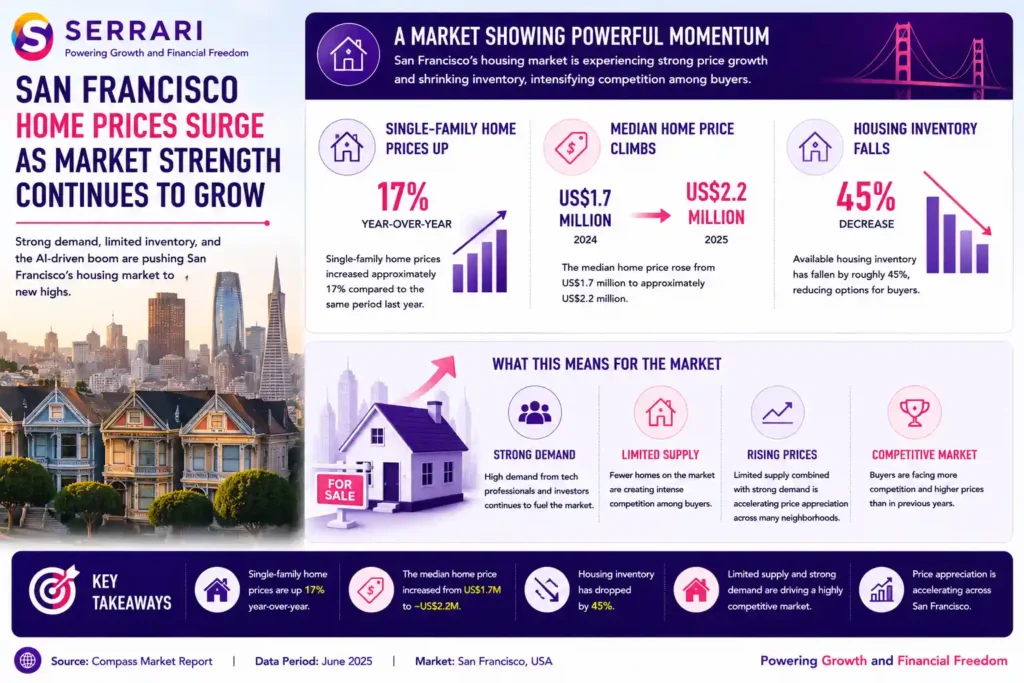
Compass reported that single-family home prices increased approximately 17% year-over-year, while the median price climbed from US$1.7 million to approximately US$2.2 million.
Meanwhile, available housing inventory has fallen by roughly 45%, creating an increasingly competitive environment for buyers.
Limited supply combined with strong demand has significantly accelerated price appreciation across many residential neighborhoods.
Inventory Shortage Intensifies Bidding Wars
One of the biggest drivers behind the recent bidding wars is the shrinking number of available properties.
Homes are now spending an average of just 18 days on the market, representing the fastest selling pace in five years.
As inventory continues to tighten, buyers are increasingly willing to offer substantial premiums above asking prices to secure desirable properties before competing offers emerge.
The shortage of listings has strengthened sellers’ negotiating positions and intensified competition among affluent buyers.
Luxury Housing Market Leads the Rally
The strongest gains have occurred within the city’s luxury housing market, where affluent buyers are competing aggressively for high-end properties.
Several months during 2026 have recorded dozens of homes selling for at least US$1 million above their listing prices.
April and May each saw more than 30 such transactions, while March recorded 20 sales exceeding that premium. Together, these transactions generated tens of millions of dollars in additional sales value beyond asking prices.
By contrast, many months between early 2024 and early 2026 recorded either no million-dollar overbids or fewer than ten such transactions, illustrating how rapidly the market has changed.
Certain Neighborhoods See Strongest Property Demand
The most intense buyer competition has been concentrated within some of San Francisco’s most desirable residential neighborhoods.
Many of the highest overbids occurred within the 94114 ZIP code, which includes communities such as The Castro, Noe Valley, and Dolores Heights.
These neighborhoods continue attracting buyers because of their proximity to technology employers, strong community amenities, attractive housing stock, and convenient access to the broader Bay Area.
Demand in these established residential districts continues to outpace available supply.
Seller’s Market Remains Firm
Housing analysts continue describing San Francisco as a clear seller’s market.
Although overall median listing prices have declined modestly due to a greater number of smaller homes entering the market, economists note that premium properties continue attracting exceptional demand.
Buyers are competing over a relatively limited supply of quality listings, allowing sellers to receive multiple offers and achieve significant price premiums.
The combination of technology sector expansion, strong employment, limited housing construction, and anticipated AI wealth creation suggests demand could remain elevated over the coming months.
Conclusion
The San Francisco housing market has entered a new phase driven by the rapid expansion of artificial intelligence companies and technology investment. As the AI boom creates new high-income buyers and expectations for major IPOs continue building, competition for San Francisco homes has intensified dramatically.
With inventory remaining scarce, home prices continuing to rise, and million-dollar bidding wars becoming increasingly common, the city’s residential real estate market is demonstrating how technological innovation can rapidly reshape local property demand.
FAQs
1. Why is the San Francisco housing market rising so quickly?
The San Francisco housing market is being driven primarily by the rapid expansion of the artificial intelligence industry. Increased hiring, migration of technology professionals, and expectations surrounding major AI company IPOs have significantly boosted buyer demand. At the same time, housing inventory has fallen sharply, creating intense competition that continues pushing home prices higher.
2. Why are buyers paying more than the asking price for San Francisco homes?
Many buyers are offering well above asking prices because the supply of available homes remains limited while demand continues to increase. Highly paid technology employees and investors are competing for desirable properties, particularly in sought-after neighborhoods, resulting in bidding wars where homes frequently sell for hundreds of thousands or even millions of dollars above their listed prices.
3. Which areas of San Francisco are seeing the strongest housing demand?
Some of the strongest demand has been concentrated in neighborhoods within the 94114 ZIP code, including The Castro, Noe Valley, and Dolores Heights. These areas offer attractive residential communities, proximity to major technology employers, and limited housing supply, making them particularly competitive among buyers seeking premium properties.
4. How has the AI boom affected the luxury housing market?
The AI boom has significantly strengthened San Francisco’s luxury housing market by creating a growing pool of high-income buyers and investors. Anticipated public listings of major AI companies have increased confidence among buyers, leading to more aggressive offers, faster home sales, and record-breaking premiums above asking prices across the city’s high-end residential market.
Sources: The Guardian, Fox Business, AoL
Your financial future isn’t something you wait for—it’s something you build.
The real question is: when do you begin?
Move beyond simply staying informed.
Navigate the markets with clarity—track trends through the Serrari Group Market Index, uncover opportunities in the Serrari Marketplace, and build practical knowledge with our Curated Wealth Builder Platform.
Stay connected to what truly matters.
Get daily insights on macro trends and financial movements across Kenya, Africa, and global markets—delivered through the Serrari Newsletter.
Growth opens doors.
Advance your career through professional programs including ACCA, HESI A2, ATI TEAS 7 , HESI EXIT , NCLEX – RN and NCLEX – PN, Financial Literacy!🌟—designed to move you forward with confidence.
See where money is flowing—clearly and in real time.
Track Money Market Funds, Treasury Bills, Treasury Bonds, Green Bonds, and Fixed Deposits, alongside global and African indexes, key economic indicators, and the evolving Crypto and stablecoin landscape—all within Serrari’s Market Index.