















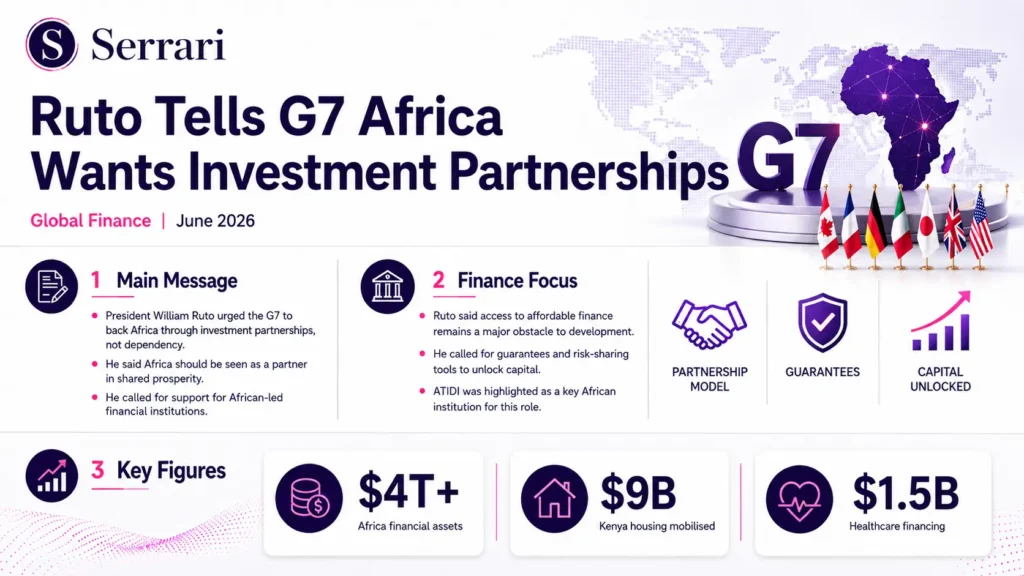
President William Ruto used Kenya’s invitation to the G7 Summit in Évian-les-Bains, France, to press for a new development model built on investment partnerships rather than dependency. Speaking during the G7+ working session on fostering new partnerships and rebuilding international solidarity, Ruto argued that Africa should be treated as a strategic economic partner with capital, institutions and solutions of its own.
His message aligned with broader G7 discussions on debt, development finance and private investment. The summit brought together G7 members and invited countries including Kenya, India, Brazil and South Korea, with leaders discussing how to address debt vulnerabilities and reduce reliance on traditional aid models.
Key Overview
- Ruto urged G7 countries to support African-led financial institutions through guarantees and risk-sharing tools.
- He argued that Africa’s risks have been overstated while its investment opportunities have been undervalued.
- The President said Africa holds more than $4 trillion in financial assets across banks, pension funds, insurers and reserves.
- Ruto highlighted ATIDI as one institution that can deploy guarantees to unlock capital for development.
- The remarks come as G7 leaders place greater emphasis on private investment, debt reform and international financial architecture.
Africa Wants Partnership, Not Dependency
Ruto’s central message was that Africa is no longer asking to be viewed primarily through the lens of aid. Instead, he said the continent wants partnerships based on sovereign equality, mutual benefit and shared prosperity. According to local reporting on his address, the President said Africa has too often been defined by need while its future has been shaped in rooms where African countries had little influence.
That argument reflects a wider shift in African diplomacy. Since the 2023 Africa Climate Summit in Nairobi, African leaders have increasingly framed the continent as a provider of global solutions, particularly in clean energy, climate adaptation and green industrialisation. The Nairobi Declaration described Africa as having both the potential and ambition to become a vital player in global climate solutions.
Ruto extended that argument to finance. He said Africa should not be treated as a burden, but as an opportunity for global prosperity. His appeal was directed at a G7 audience already debating development finance reforms, including how to mobilise more private capital as public aid budgets face pressure.
Context is everything. Stay ahead of shifting trends with today’s market updates, and uncover emerging opportunities using the Serrari Group Market Index and Marketplace. Then, take control of your own financial future by exploring our Money & Life Reset Transformation Blueprint ™ to build stronger habits, create better systems, and design a path toward lasting wealth.
Guarantees at the Centre of Africa’s Financing Push
A major part of Ruto’s proposal focused on guarantees and risk-sharing instruments. He argued that a guarantee is not just money, but confidence that can unlock much larger pools of capital. This is important because many African economies face higher borrowing costs than peers with similar fundamentals, partly because of perceived risk, limited credit enhancement tools and underdeveloped long-term financing channels.
Ruto singled out the African Trade & Investment Development Insurance as one platform that could help deploy such support. ATIDI says it helps facilitate inward investment into Africa by providing insurance against trade and investment risks. Its role has also attracted wider attention after the African Development Bank approved a $125 million investment to expand ATIDI’s risk insurance capacity.
That backing fits into a broader African push to use guarantees, insurance and blended finance to mobilise domestic and international capital. Reuters reported that the AfDB’s investment in ATIDI is part of a wider effort to tap Africa’s estimated $4 trillion in institutional capital and address the continent’s development financing gap.
Kenya’s Domestic Financing Example
Ruto also used Kenya’s own programmes to support his argument that development must begin with domestic mobilisation. He pointed to Kenya’s affordable housing and universal healthcare financing efforts as examples of how governments can begin funding transformation from within before seeking external support.
The broader message was that Africa has capital, but lacks enough financial architecture to convert savings and reserves into long-term productive investment. Pension funds, insurance pools, bank deposits and central bank reserves can play a stronger role in infrastructure, housing, healthcare, manufacturing and climate projects if supported by credible risk frameworks.
This is where G7 support could be catalytic. Rather than replacing African capital, guarantees from advanced economies could reduce risk, improve creditworthiness and attract more institutional investors into projects that may otherwise remain unfunded.
A Wider Debate on Global Financial Reform
Ruto’s remarks came as G7 leaders acknowledged the pressure that debt burdens are placing on developing and middle-income countries. The G7 statement supported reforms and greater private investment, noting that traditional development policies have had limited impact in reducing dependency on external assistance.
For Africa, the challenge is whether global financial reform will move beyond statements into practical instruments. Ruto’s proposal gives G7 countries a clear test: support African-led institutions, de-risk investment and treat the continent as a partner in building future growth.
If acted on, the approach could shift Africa’s development debate from aid flows to capital mobilisation, from dependency to ownership, and from externally designed programmes to African-led investment platforms.
Sources used: People Daily / Reuters / ATIDI / African Development Bank / African Union / Council of the European Union / France Diplomacy
Your financial future isn’t something you wait for—it’s something you build.
The real question is: when do you begin?
Move beyond simply staying informed.
Navigate the markets with clarity—track trends through the Serrari Group Market Index, uncover opportunities in the Serrari Marketplace, and build practical knowledge with our Curated Wealth Builder Platform.
Stay connected to what truly matters.
Get daily insights on macro trends and financial movements across Kenya, Africa, and global markets—delivered through the Serrari Newsletter.
Growth opens doors.
Advance your career through professional programs including ACCA, HESI A2, ATI TEAS 7 , HESI EXIT , NCLEX – RN and NCLEX – PN, Financial Literacy!🌟—designed to move you forward with confidence.
See where money is flowing—clearly and in real time.
Track Money Market Funds, Treasury Bills, Treasury Bonds, Green Bonds, and Fixed Deposits, alongside global and African indexes, key economic indicators, and the evolving Crypto and stablecoin landscape—all within Serrari’s Market Index.