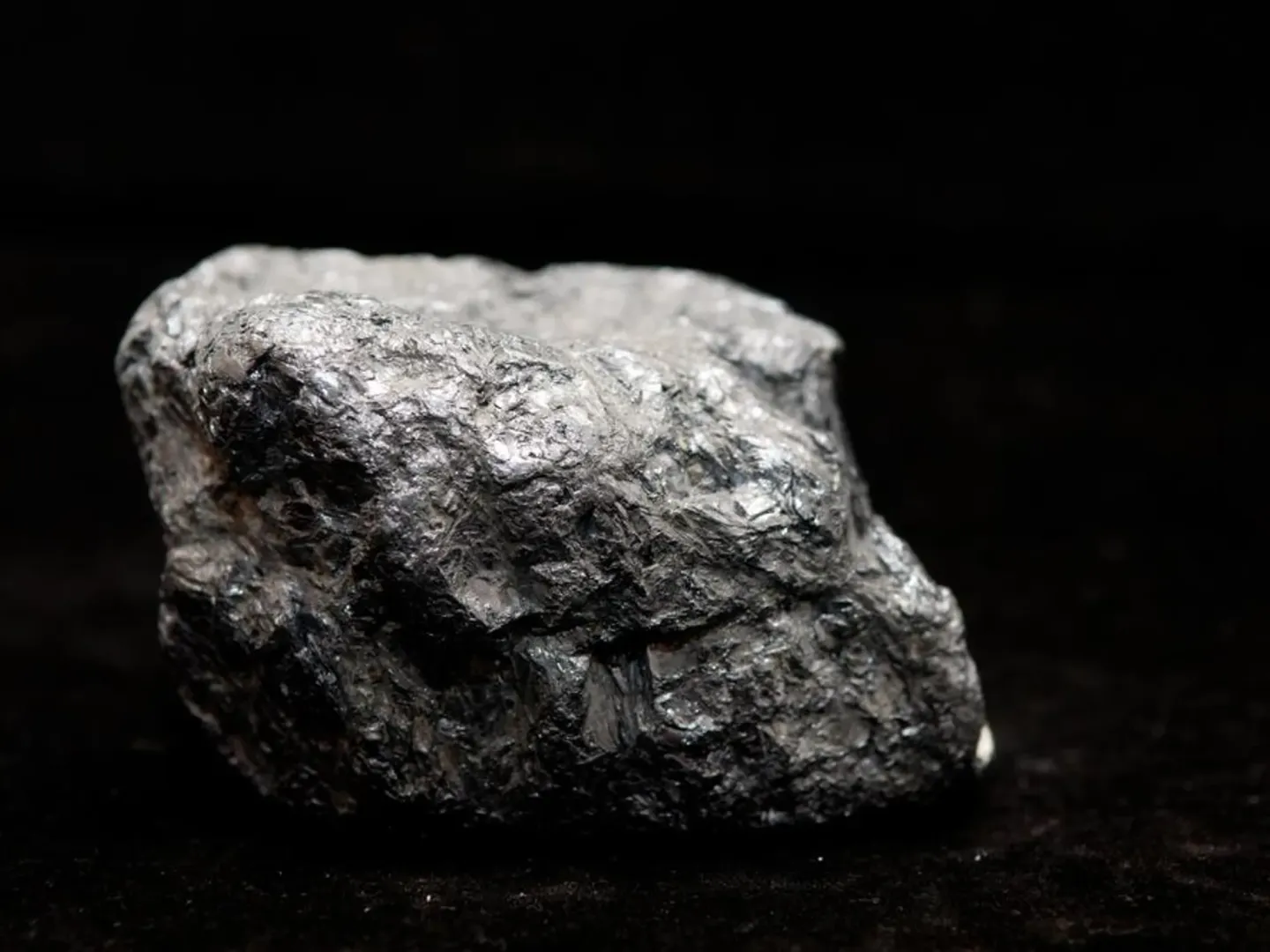
The global rare earth elements market is entering another period of rapid expansion as demand from electric vehicles, renewable energy, electronics, aerospace and defence collides with growing concerns over the concentration of global supply.
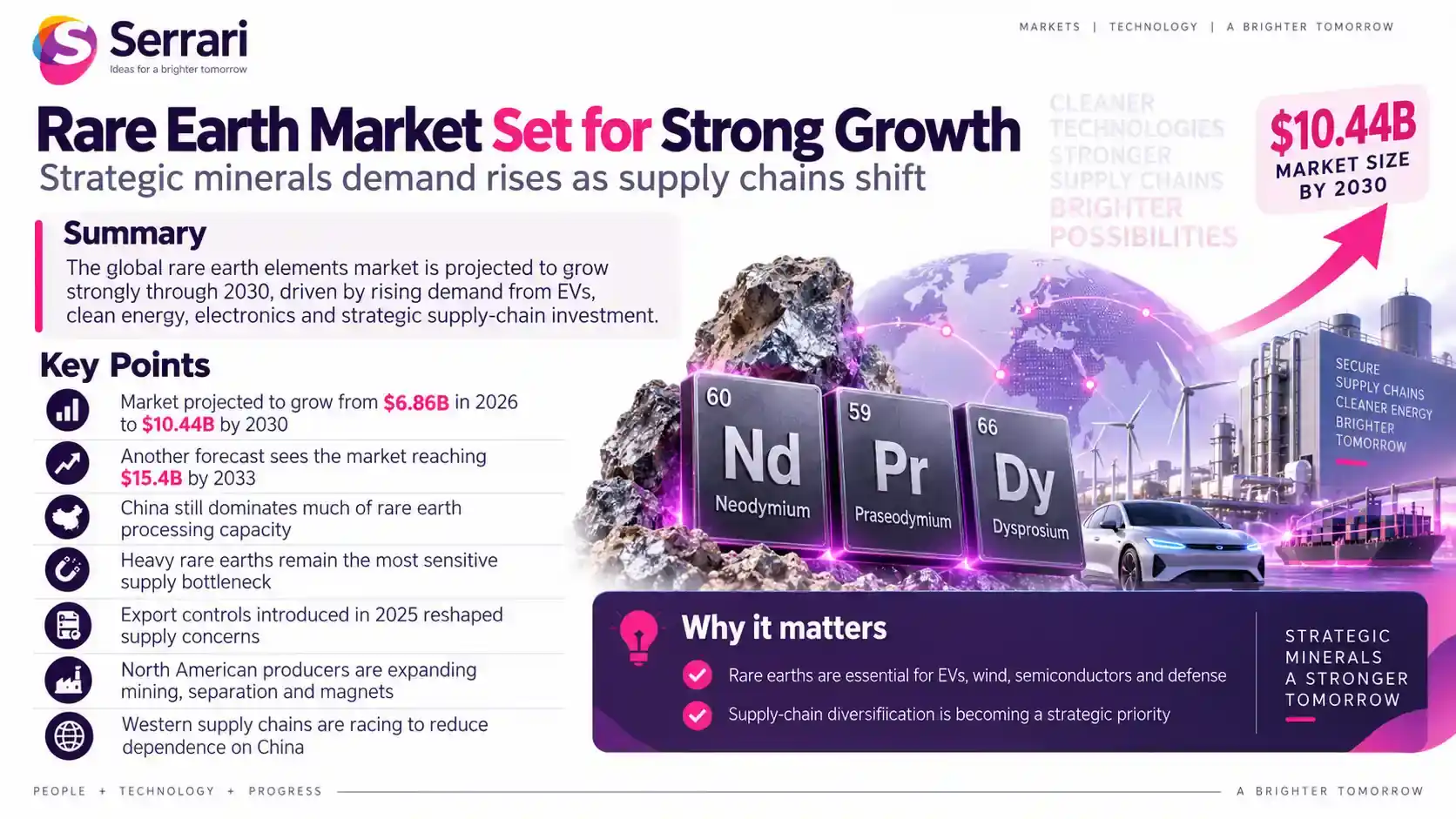
A 2026 market forecast estimates the sector will expand from $6.86 billion in 2026 to $10.44 billion by 2030, representing compound annual growth of 11.1%. A separate longer-term industry projection places the market at $7.8 billion in 2026 and expects it to reach $15.4 billion by 2033.
Behind the headline growth figures lies a more complicated strategic challenge: much of the world’s rare earth processing remains concentrated in China, while heavy rare earth elements used in advanced magnets remain particularly difficult to source elsewhere.
Key Overview
- The rare earth elements market is projected to grow from $6.86 billion in 2026 to $10.44 billion by 2030.
- A separate forecast projects a $15.4 billion market by 2033.
- China continues to dominate global rare earth processing and refining capacity.
- Export controls introduced in April 2025 continue to cover several strategically important medium and heavy rare earth elements.
- Some broader controls announced later in 2025 remain suspended until November 10, 2026.
- North American companies are accelerating investment in mining, separation, processing and magnet manufacturing.
- Heavy rare earths such as dysprosium and terbium remain among the most strategically sensitive parts of the supply chain.
China’s Export Controls Reshape the Supply Chain
Rare earths are a group of elements used across permanent magnets, electric motors, wind turbines, semiconductors, electronics and advanced defence systems. Their strategic importance has risen sharply as demand for electrification and high-performance computing expands.
China’s position is particularly important because it controls a large majority of global rare earth refining and processing. In April 2025, Beijing introduced export controls on seven medium and heavy rare earth categories including samarium, gadolinium, terbium, dysprosium, lutetium, scandium and yttrium.
The controls require exporters to obtain licences rather than imposing a complete export ban, but they demonstrated how heavily global manufacturers depend on Chinese material.
Additional rare-earth-related measures introduced in October 2025 were subsequently suspended. That temporary suspension runs until November 10, 2026, putting rare earth supply chains back in focus as the deadline approaches.
Recent trade tensions have also highlighted the vulnerability. China still accounts for up to roughly 70% of global rare earth mining and more than 85% of refining and production, leaving manufacturers outside China exposed when export licensing or geopolitical tensions disrupt normal flows.
Context is everything. Stay ahead of shifting trends with today’s market updates, and uncover emerging opportunities using the Serrari Group Market Index and Marketplace. Then, take control of your own financial future by exploring our Money & Life Reset Transformation Blueprint ™ to build stronger habits, create better systems, and design a path toward lasting wealth.
Western Investment Accelerates
The supply risk is driving investment throughout North America.
In Texas, Tactical Resources is advancing the Peak Project at the Sierra Blanca Quarry. The company’s latest project work focuses on already-mined, pre-crushed material containing rare earth elements.
Initial scoping tests returned total rare earth plus yttrium extraction results ranging widely by test method, reaching as high as 96.1% under heated hydrochloric-acid conditions. However, the project remains early-stage: no mineral resource or reserve has yet been estimated, and the test results do not establish commercial-scale recovery.
Elsewhere, USA Rare Earth has begun construction of a $1.2 billion magnet manufacturing facility in South Carolina. The investment is designed to expand domestic production of rare earth metals and permanent magnets used in aerospace, defence, semiconductors and energy applications.
The company also completed its combination with Serra Verde Group in September, adding an operating Brazilian source of heavy rare earth material to its wider mine-to-magnet strategy.
Established Producers Are Scaling Capacity
Larger producers are expanding as well.
MP Materials reported 840 metric tons of NdPr production in the second quarter of 2026, up 41% year-on-year, while sales reached 1,006 metric tons. Its quarterly results showed revenue of $108.5 million, alongside continued expansion into magnets and separated heavy rare earth products.
Another developing U.S. project, Elk Creek in Nebraska, has outlined plans to produce eight critical-mineral products. Its updated feasibility study estimates a pre-tax net present value of $4.1 billion over a projected 40-year mine life, although those figures remain projections dependent on construction, financing, commodity prices and successful operations.
Heavy Rare Earths Become the Strategic Battleground
The fastest-growing opportunity may therefore not simply be producing more rare earth material, but building complete supply chains capable of separating, refining and converting specific elements into usable products.
Dysprosium and terbium are particularly important because small amounts can improve the temperature resistance and performance of permanent magnets used in electric vehicles, defence equipment and other demanding applications.
For Western economies, reducing dependence on China will require coordinated investment across mining, separation, refining, metals and magnet manufacturing. New mines alone cannot solve the bottleneck if downstream processing remains concentrated elsewhere.
The rare earth market’s projected expansion toward $10.44 billion by 2030 reflects growing commercial demand, but geopolitics is increasingly shaping where future capacity will be built. As governments and companies race to establish alternative supply chains, rare earths are becoming not only an industrial commodity but a strategic component of economic and national-security policy.
Sources: The Business Research Company / Persistence Market Research / Ministry of Commerce of China / State Council Information Office of China / Reuters / Tactical Resources / USA Rare Earth / MP Materials / NioCorp
Your financial future isn’t something you wait for—it’s something you build.
The real question is: when do you begin?
Move beyond simply staying informed.
Navigate the markets with clarity—track trends through the Serrari Group Market Index, uncover opportunities in the Serrari Marketplace, and build practical knowledge with our Curated Wealth Builder Platform.
Stay connected to what truly matters.
Get daily insights on macro trends and financial movements across Kenya, Africa, and global markets—delivered through the Serrari Newsletter.
Growth opens doors.
Advance your career through professional programs including ACCA, HESI A2, ATI TEAS 7 , HESI EXIT , NCLEX – RN and NCLEX – PN, Financial Literacy!🌟—designed to move you forward with confidence.
See where money is flowing—clearly and in real time.
Track Money Market Funds, Treasury Bills, Treasury Bonds, Green Bonds, and Fixed Deposits, alongside global and African indexes, key economic indicators, and the evolving Crypto and stablecoin landscape—all within Serrari’s Market Index.