














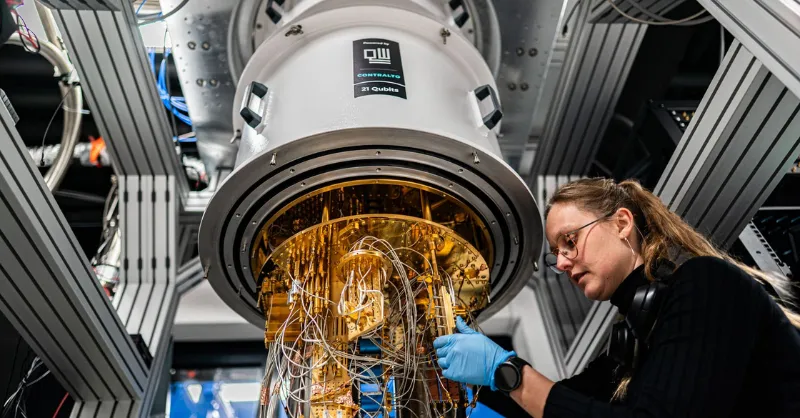
Dutch quantum processor company QuantWare has secured $178 million (€152 million) in Series B funding, marking the largest private round ever raised by a dedicated quantum processor company. The oversubscribed round was backed by Intel Capital, In-Q-Tel (IQT), and ETF Partners, alongside existing investors. The capital will fund KiloFab, a dedicated fabrication facility in Delft designed to increase QuantWare’s production capacity twentyfold, while advancing its VIO-40K architecture — a 3D modular design capable of supporting 10,000-qubit superconducting processors by 2028.
Markets move fast; don’t get left behind. We’ve paired the Serrari Group Market Index with a curated Marketplace and a comprehensive Wealth Builder Platform to ensure you have the data—and the skills—to act on it.
Key Takeaways
- Funding: $178M (€152M) Series B — the largest private round by a dedicated quantum processor company globally.
- Key Investors: Intel Capital, In-Q-Tel (IQT), ETF Partners, FORWARD.one, Invest-NL Deep Tech Fund, InnovationQuarter Capital, Ground State Ventures, and Graduate Ventures.
- Technology: VIO-40K, a 3D modular quantum processor architecture rated for 10,000 qubits — roughly 100x larger than current leading designs.
- Manufacturing: KiloFab, a dedicated fabrication facility in Delft that will increase production capacity by 20x.
- Business Model: Open-architecture quantum processor supplier — often compared to TSMC — serving 50+ customers across 20 countries.
- Previous Funding: Series A totalling $27 million, closed in mid-2025.
A Record Raise for Quantum Hardware
QuantWare, the Delft-based quantum processor company, has closed a $178 million Series B round that places it at the centre of a global push to industrialise quantum computing hardware. The financing, which the company said was heavily oversubscribed, drew strategic backing from Intel Capital, the venture arm of the US chipmaker, as well as from In-Q-Tel (IQT), the investment firm with ties to the US intelligence community, and climate-focused fund ETF Partners. Existing investors including FORWARD.one, Invest-NL Deep Tech Fund, InnovationQuarter Capital, Ground State Ventures, and Graduate Ventures also participated.
The round represents not just a vote of confidence in QuantWare’s technology, but also a broader signal that quantum computing hardware investment is shifting from speculative research bets into strategic industrial plays. As The Next Web reported, the participation of Intel Capital and IQT marks a threshold moment — these are not quantum-thesis venture funds, but institutions with deep ties to conventional semiconductor and national security ecosystems.
“The promise of quantum computing, capable of solving humanity’s intractable challenges, can only happen once it can be manufactured and deployed at scale. That is exactly what we are building,” said Matt Rijlaarsdam, CEO and co-founder of QuantWare.
The Scaling Bottleneck: Why 100 Qubits Has Been the Ceiling
For roughly a decade, the quantum computing sector has struggled with a hardware scaling problem. Most superconducting quantum processors in production remain in the range of around 100 qubits, or quantum bits — the fundamental units of quantum information. While companies like IBM, Google, and Rigetti have made incremental progress in pushing qubit counts higher, the gains have been constrained by the physical limitations of existing chip architectures.
The challenge lies primarily in routing, packaging, and manufacturability. Traditional 2D chip designs route signal lines laterally across the surface of a single processor. As qubit counts increase, the wiring complexity grows exponentially, consuming surface area and introducing crosstalk that degrades performance. This engineering bottleneck — rather than any fundamental physics limitation — has been the primary brake on scaling.
QuantWare’s answer is VIO, a three-dimensional modular architecture that routes connections vertically rather than laterally. Chiplet modules are stacked and connected through high-fidelity chip-to-chip links, with signal lines running between layers instead of across them. The company announced VIO-40K in late April 2026, an architecture rated for processors with up to 10,000 qubits — approximately 100 times the current commercial state of the art.
“In superconducting quantum computing, scale is increasingly constrained by routing, packaging, and manufacturability — not just qubit design,” said Kike Miralles, investment director at Intel Capital. “QuantWare recognised that early and built VIO to address it.”
While the 10,000-qubit target remains aspirational and has not yet been demonstrated at full scale, the architectural approach reflects a growing consensus within the industry that the next phase of quantum advancement will be defined by manufacturing and engineering discipline rather than laboratory breakthroughs alone.
KiloFab: From Lab to Industrial Fabrication
A central component of QuantWare’s plans is KiloFab, a dedicated fabrication facility that the company describes as the world’s largest dedicated quantum open-architecture fab. Located in Delft, the facility is designed to increase QuantWare’s production capacity by a factor of 20, enabling it to meet what the company says is rapidly accelerating global demand.
The shift toward dedicated, industrial-scale fabrication marks a significant departure from the way quantum hardware has traditionally been produced. Many quantum hardware companies still rely on shared university cleanrooms or general-purpose semiconductor foundries, which impose limitations on throughput, customisation, and quality control. KiloFab, by contrast, is purpose-built for quantum processor manufacturing.
As Quantum Computing Report noted, the move toward dedicated industrial-scale fabrication represents a tangible transition toward what the industry increasingly refers to as “hyperscale” quantum manufacturing. The facility will allow QuantWare to offer processors on a more standardised, commercially repeatable basis to its growing customer base, which currently spans more than 50 organisations across 20 countries.
Context is everything. While you follow today’s updates, use the Serrari Group Market Index and Marketplace to spot emerging shifts. Need to sharpen your edge? Our Wealth Builder Platform turns these insights into a professional-grade strategy.
The “TSMC of Quantum”: An Open Architecture Model
QuantWare’s business model distinguishes it from many of its competitors. Rather than building full-stack quantum computers — the approach taken by companies like IBM, Google, and Finland’s IQM — QuantWare positions itself as a specialised hardware supplier. The company has been compared to TSMC, the Taiwanese semiconductor foundry that manufactures chips designed by other companies but does not sell its own consumer products.
Through what QuantWare calls its “quantum open architecture” model, the company offers its VIO technology to other organisations that design their own qubit chips or build their own quantum computing systems. The platform is designed as an open standard that can incorporate third-party qubit chiplets and designs, enabling a wide range of players across the quantum ecosystem to benefit from QuantWare’s scaling technology without being locked into a single vendor’s full-stack solution.
“Our mission is to get the entire industry to scale using VIO,” Rijlaarsdam has said. “We offer it to players that make their own qubit designs, and even to players that make their own qubit chips.”
This supply-chain-oriented positioning aligns with a growing recognition that the quantum computing industry will likely follow the semiconductor industry’s evolution toward horizontal specialisation. Just as the semiconductor sector eventually split into fabless chip designers and dedicated foundries, the quantum sector may increasingly separate qubit design from processor fabrication and system integration.
“The company is poised to play a key role in shaping the global quantum supply chain,” said J.D. Englehart, senior investment director at In-Q-Tel.
Intel Capital’s Measured But Expanding Quantum Bet
Intel Capital’s participation in QuantWare’s Series B is part of a wider pattern of strategic engagement with quantum technologies. The venture arm of Intel has, over the past two years, built a portfolio that spans several layers of the quantum stack. Its investments include Quantum Machines, which raised $170 million in a Series C round in February 2025 for its quantum control systems, and more recently Q-Factor, an Israeli neutral-atom startup that emerged from stealth in April 2026 with $24 million in seed funding.
Intel itself has pursued in-house research into cryogenic control systems and silicon spin-qubit architectures, though its approach has been less headline-driven than some competitors. The QuantWare investment fits a strategy of backing companies that could become foundational suppliers in a horizontally integrated quantum supply chain — an approach that mirrors Intel’s own historical role in the classical computing ecosystem.
QuantWare also confirmed that it is partnering with Nvidia, though the graphics chip giant did not participate in this funding round. The company said it remains open to collaboration across the broader classical semiconductor industry.
Roots in QuTech and the Delft Ecosystem
QuantWare was founded in 2021 by Matthijs Rijlaarsdam and Alessandro Bruno as a spin-out from QuTech, the quantum computing research institute affiliated with Delft University of Technology. Bruno, the company’s CTO, had previously led fabrication of quantum chips at the institute, where researchers were building some of the largest quantum processors in the world — on the order of 50 qubits — more than a decade ago.
That early experience exposed the team to the scaling bottlenecks that have since constrained the broader industry. Working at the intersection of qubit physics and chip engineering, the founders identified modular architecture as the path to overcoming the 2D routing limitations that cap processor size.
“There’s a tremendous ecosystem in Delft, specifically around QuTech,” Rijlaarsdam has said. “I don’t think we could have built this anywhere else, because the expertise was there.”
The Delft quantum cluster is also home to other emerging companies. EU-Startups reported that Delft-based startups Groove Quantum and OrangeQS have also raised funding in 2026, pointing to a concentration of activity around quantum chip manufacturing, validation, and infrastructure in the region.
Europe’s Quantum Ambitions: Closing the Gap
QuantWare’s record round arrives against the backdrop of an intensifying European push to build sovereign quantum computing capabilities. The EU’s Quantum Technologies Flagship, launched in 2018 with a budget of at least €1 billion, has funded dozens of projects across quantum computing, communication, sensing, and simulation. The programme’s next phase under Horizon Europe carries a budget exceeding €400 million.
In parallel, the European Commission published its Quantum Europe Strategy in July 2025, followed by a planned Quantum Act expected to be proposed in mid-2026. The strategy aims to establish a design facility and six quantum chip pilot lines backed by up to €50 million in public funding, alongside efforts to build a European Quantum Internet pilot facility.
Yet despite strong academic foundations, Europe has historically struggled to translate research leadership into commercial-scale hardware. According to a Bird & Bird analysis, Europe attracts only around 5% of global private quantum funding, compared to over 50% for the United States. The funding gap is particularly acute at later stages of development, where European startups often must look abroad for growth capital.
This tension has played out visibly in recent months. IQM Quantum Computers, a Finnish superconducting quantum hardware company, has raised over $600 million in total and is pursuing a listing on the New York Stock Exchange via a SPAC merger expected to close in June 2026 — with BlackRock among its recent backers. Pasqal, the French neutral-atom quantum computing company, announced plans to go public via a $2 billion SPAC deal on Nasdaq in early 2026. France has also committed €500 million through its PROQCIMA programme to develop a fault-tolerant quantum computer demonstrator.
That both IQM and Pasqal have turned to US public markets for growth capital has underscored the limitations of late-stage European financing — a gap that EU officials have tried to address through vehicles like the proposed €3 billion ScaleUp Europe fund.
Rijlaarsdam frames QuantWare’s round as evidence that this dynamic is shifting. “I think with this round, we’ve shown that if you’re building a company that is making excellent progress, that has the right technology, the right team and the right customers, then you can also attract global capital,” he said.
The decision to build KiloFab in the Netherlands is deliberate and carries strategic significance for European backers. Invest-NL Deep Tech Fund and InnovationQuarter Capital, the investment arm of the South Holland regional development agency, both participated in the round and share the vision of anchoring an industrial-scale quantum hardware company on European soil.
A Sector at an Inflection Point
The broader quantum computing investment landscape has undergone a significant transformation. Global equity funding for quantum startups exceeded $3.77 billion through the first three quarters of 2025 alone, representing a 128% year-over-year surge. Corporate strategic investors — including Nvidia, which in September 2025 backed Quantinuum, PsiQuantum, and QuEra Computing in rapid succession — have entered the space in force, shifting the funding profile from venture capital-dominated rounds to broader institutional participation.
This maturation is reflected in the scale and composition of recent rounds. QuantWare’s $178 million sits alongside IQM’s $320 million Series B in September 2025, Quantum Machines’ $170 million Series C, and Alice & Bob’s €100 million Series B — collectively signalling that hardware-focused quantum companies have crossed a threshold from speculative research plays into commercially investable platforms.
Yet commercial applications remain limited, and the timeline for achieving practical quantum advantage continues to be debated. The industry’s roadmaps for fault-tolerant quantum computing — systems capable of reliably outperforming classical computers on economically useful problems — still stretch into the 2030s. The current generation of “noisy intermediate-scale quantum” (NISQ) devices can perform certain calculations, but none has yet delivered a commercially meaningful advantage over classical alternatives.
QuantWare’s bet is that the transition from research to utility will hinge not on a single scientific breakthrough but on the ability to manufacture complex quantum systems reliably and at scale. It is a thesis rooted in manufacturing discipline rather than physics heroics — and one that resonates with investors who have watched the semiconductor industry evolve along similar lines.
“Building a global compute hardware company requires immense ambition,” said Robin van Boxsel of FORWARD.one. “With their VIO technology, they hold the key to leading the high-growth quantum industry.”
Whether that ambition translates into commercial reality will depend on execution. But with $178 million in fresh capital, a dedicated fabrication facility under construction, and strategic backers who understand supply chain economics, QuantWare has positioned itself as one of the most consequential bets in the race to industrialise quantum computing.
Your financial future isn’t something you wait for—it’s something you build.
The real question is: when do you begin?
Move beyond simply staying informed.
Navigate the markets with clarity—track trends through the Serrari Group Market Index, uncover opportunities in the Serrari Marketplace, and build practical knowledge with our Curated Wealth Builder Platform.
Stay connected to what truly matters.
Get daily insights on macro trends and financial movements across Kenya, Africa, and global markets—delivered through the Serrari Newsletter.
Growth opens doors.
Advance your career through professional programs including ACCA, HESI A2, ATI TEAS 7 , HESI EXIT , NCLEX – RN and NCLEX – PN, Financial Literacy!🌟—designed to move you forward with confidence.
See where money is flowing—clearly and in real time.
Track Money Market Funds, Treasury Bills, Treasury Bonds, Green Bonds, and Fixed Deposits, alongside global and African indexes, key economic indicators, and the evolving Crypto and stablecoin landscape—all within Serrari’s Market Index.