Global markets turned sharply risk-off on July 8 after U.S. President Donald Trump said the interim accord with Iran was “over”, reviving fears of a wider Gulf conflict and fresh disruption to energy supplies.
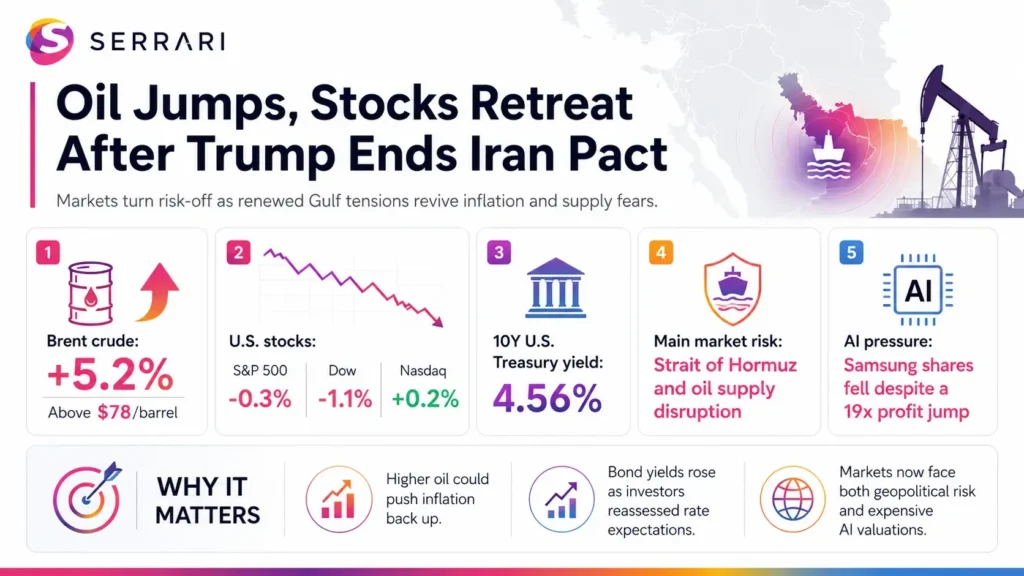
Brent crude jumped more than 5% and settled above $78 a barrel, while stocks and government bonds weakened as investors reassessed inflation, interest-rate and geopolitical risks. The selloff spread across Europe and the United States, although some technology shares later recovered.
Key Overview
- Brent crude rose more than 5% as renewed U.S.-Iran tensions raised fears about supply disruptions.
- The S&P 500 fell 0.3%, while the Dow dropped 1.1%; the Nasdaq recovered to close slightly higher.
- Treasury and European bond yields climbed as higher oil prices revived inflation concerns.
- The Strait of Hormuz remained the central market risk because of its importance to global energy flows.
- Samsung shares fell despite a 19-fold increase in quarterly operating profit, highlighting investor concern over stretched AI and semiconductor valuations.
Oil Surges as Geopolitical Risk Returns
Trump made the announcement in Ankara during the July 7-8 NATO summit, saying he no longer wanted to engage with Tehran. The remarks followed renewed attacks involving U.S. and Iranian forces and immediately raised doubts over whether the temporary diplomatic framework could still contain the conflict.
Oil markets reacted first. Brent crude futures settled 5.2% higher, moving above $78 a barrel. That remained well below the levels above $120 reached during the most severe phase of the fighting, but the renewed surge was enough to revive concerns about energy-driven inflation.
The most important issue for traders is the Strait of Hormuz. Earlier in the week, Iran had attacked three commercial vessels in the waterway, while the United States revoked a licence that had allowed sales of Iranian crude and later launched new strikes. Those developments had already pushed Brent 3% higher on July 7 before Trump’s latest comments accelerated the move.
The supply backdrop is also less comfortable than usual. Official data show that U.S. Strategic Petroleum Reserve holdings are around levels last seen in the early 1980s, limiting the cushion available against a prolonged disruption. The latest weekly reserve data reinforce concerns that another major supply shock could leave markets more exposed.
Stocks and Bonds Retreat as Inflation Fears Rise
The oil spike quickly spread into other asset classes. European equities fell sharply, while Wall Street opened under pressure. By the close, the S&P 500 had lost 0.3%, the Dow Jones Industrial Average dropped 1.1%, and the Nasdaq recovered to finish 0.2% higher.
Bond markets also sold off. Higher oil prices can feed into transport, production and consumer costs, complicating the outlook for central banks that are still managing inflation risks. Benchmark U.S. Treasury yields rose, while German and Italian government bond yields also moved higher.
The timing added to market sensitivity because investors were awaiting the minutes of the Federal Reserve’s June 16-17 meeting. The minutes were released on July 8, offering the first detailed look at policy discussions under Chair Kevin Warsh as markets assessed how renewed energy inflation could affect the path of interest rates.
The dollar strengthened during the risk-off move, while the euro slipped toward $1.14 and the yen remained close to multi-decade lows.
Context is everything. Stay ahead of shifting trends with today’s market updates, and uncover emerging opportunities using the Serrari Group Market Index and Marketplace. Then, take control of your own financial future by exploring our Money & Life Reset Transformation Blueprint ™ to build stronger habits, create better systems, and design a path toward lasting wealth.
Samsung Slump Exposes Wider AI Valuation Concerns
Geopolitical risk was not the only pressure on equities. Investors were already reassessing some of the strongest-performing semiconductor and artificial-intelligence stocks after a powerful rally earlier in the year.
Samsung Electronics shares fell for a second consecutive session even after the company reported an extraordinary 19-fold rise in quarterly operating profit. The decline reflected concern that memory-chip pricing and demand may become harder to sustain in the second half of the year.
The reaction underlined a broader shift in market psychology. Investors are increasingly asking whether rapid spending on AI infrastructure can continue to support current valuations as supply bottlenecks ease and the pricing power of chipmakers, data-centre operators and AI model providers becomes less predictable.
At the same time, rising capital expenditure relative to earnings could reduce the cash available for share buybacks and other shareholder returns. That creates a tougher environment for companies whose valuations already assume years of exceptional growth.
Markets Face a Renewed Energy and Valuation Test
The latest market reaction shows how quickly geopolitical risk can reconnect oil, inflation, bond yields and equity valuations. For now, the central question is whether the Strait of Hormuz remains open and whether crude can continue flowing without a major interruption.
A prolonged escalation could keep oil elevated, delay expectations for easier monetary policy and place further pressure on richly valued growth stocks. A rapid de-escalation, however, could reverse part of the risk premium just as quickly.
Markets are therefore balancing two separate challenges: the immediate threat of a fresh energy shock and the longer-term question of whether the AI-driven equity rally has pushed some valuations too far.
Sources used: Reuters / U.S. Energy Information Administration / Federal Reserve
Your financial future isn’t something you wait for—it’s something you build.
The real question is: when do you begin?
Move beyond simply staying informed.
Navigate the markets with clarity—track trends through the Serrari Group Market Index, uncover opportunities in the Serrari Marketplace, and build practical knowledge with our Curated Wealth Builder Platform.
Stay connected to what truly matters.
Get daily insights on macro trends and financial movements across Kenya, Africa, and global markets—delivered through the Serrari Newsletter.
Growth opens doors.
Advance your career through professional programs including ACCA, HESI A2, ATI TEAS 7 , HESI EXIT , NCLEX – RN and NCLEX – PN, Financial Literacy!🌟—designed to move you forward with confidence.
See where money is flowing—clearly and in real time.
Track Money Market Funds, Treasury Bills, Treasury Bonds, Green Bonds, and Fixed Deposits, alongside global and African indexes, key economic indicators, and the evolving Crypto and stablecoin landscape—all within Serrari’s Market Index.