Nvidia is exploring insurance-backed financing structures that could make it easier for smaller cloud-computing companies to borrow against high-value AI hardware. The early-stage discussions focus on shifting part of the credit and residual-value risk associated with GPU-backed loans to insurers and other capital providers.
The move reflects a broader effort to turn AI computing infrastructure into a financeable asset class. As spending on data centres and accelerators expands, lenders are increasingly focused on how quickly GPUs lose value, whether used hardware can be resold efficiently and how much protection exists if a borrower defaults.
Key Overview
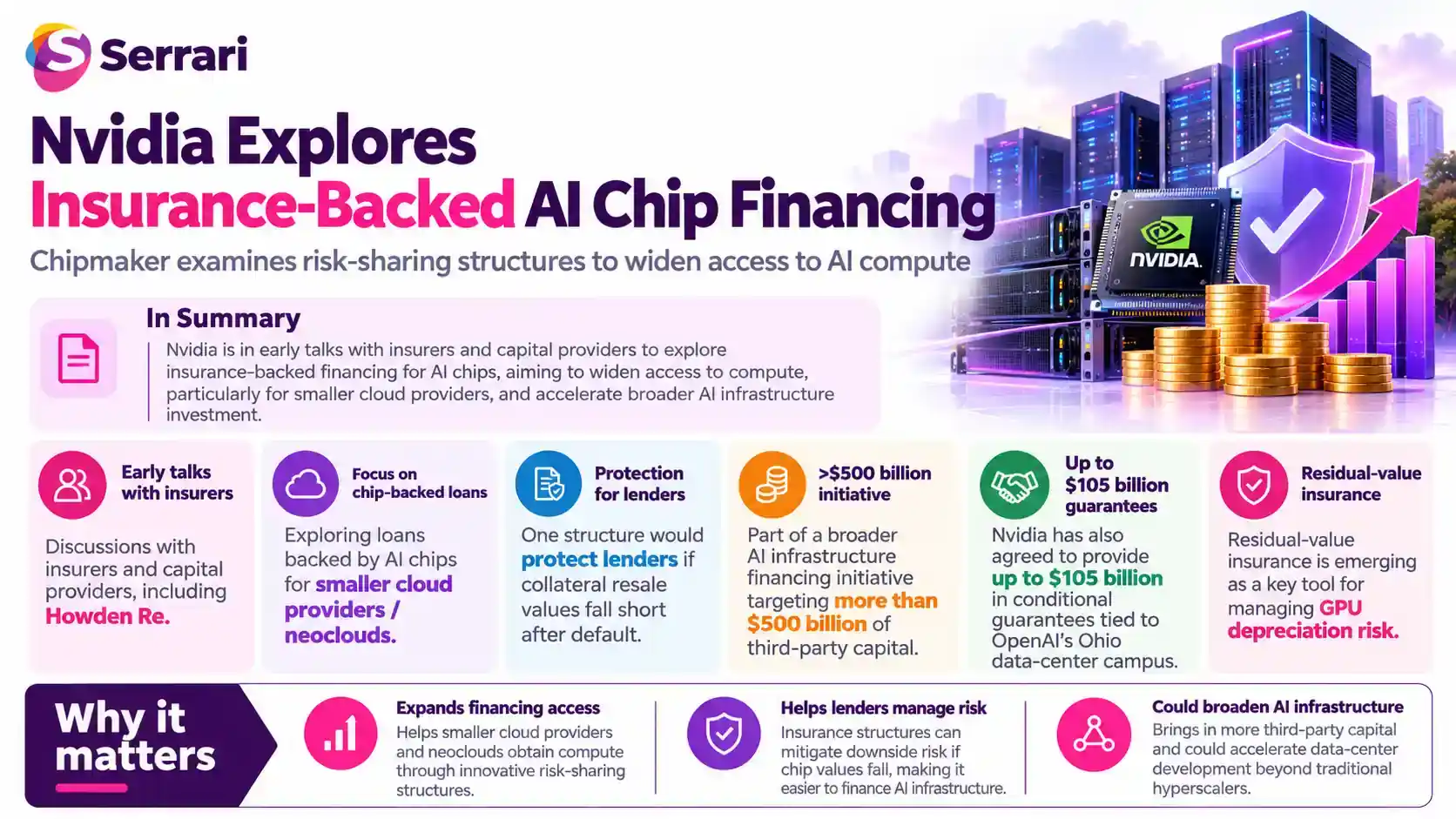
- Nvidia has held early discussions with insurers and other capital providers over ways to reduce risk on loans backed by AI chips.
- The company is reportedly working with insurance broker Howden Re on possible structures for neocloud customers.
- One model would protect lenders if a borrower defaults and the pledged GPUs cannot be resold for enough to cover the outstanding loan.
- Nvidia is separately involved in a financing initiative targeting more than $500 billion of third-party capital for AI infrastructure.
- The chipmaker has also agreed to provide up to $105 billion in conditional guarantees linked to OpenAI’s planned Ohio data-centre campus.
- Residual-value insurance is emerging as a potential tool for managing uncertainty around future GPU resale prices.
Nvidia Looks to Insurers to Support Neocloud Financing
Nvidia has held discussions over insurance-backed structures for lending against its AI chips, particularly for smaller cloud operators often described as neoclouds.
Under one structure being explored, an insurer could cover part of the loss if a borrower defaults and the Nvidia hardware pledged as collateral is sold for less than the amount still owed to lenders. That could make financiers more comfortable extending credit to businesses without the balance sheets of the world’s largest technology companies.
The discussions remain preliminary, meaning they may not result in completed transactions. However, Nvidia has reportedly shared information on chip depreciation and future computing economics with insurers while exploring ways to distribute risk across insurers, hedge funds and other investors.
That matters because GPU-backed lending depends heavily on assumptions about the future value of the hardware. If the resale value falls faster than expected, lenders could recover substantially less than their original exposure after a default.
Context is everything. Stay ahead of shifting trends with today’s market updates, and uncover emerging opportunities using the Serrari Group Market Index and Marketplace. Then, take control of your own financial future by exploring our Money & Life Reset Transformation Blueprint ™ to build stronger habits, create better systems, and design a path toward lasting wealth.
AI Infrastructure Is Becoming a Financeable Asset Class
Chief executive Jensen Huang has increasingly framed AI compute as infrastructure that can attract institutional capital in much the same way as other expensive productive assets.
Nvidia recently joined major financial groups in an initiative designed to mobilise more than $500 billion of third-party financing for AI infrastructure. Nvidia may provide financing support for portions of individual projects, but the $500 billion figure represents targeted third-party capital rather than a direct Nvidia guarantee of the entire amount.
The company has already taken a much larger role in specific projects. In August, Nvidia agreed to provide up to $105 billion in conditional credit support for the initial phase of an Ohio data-centre campus that SB Energy is developing for OpenAI.
That guarantee is tied to defined lease and residual-value obligations rather than an immediate $105 billion cash investment. Nvidia separately committed $1.5 billion to SB Energy.
Residual-Value Insurance Could Reduce GPU Lending Risk
The insurance market is beginning to develop products specifically for the financial risks surrounding AI hardware.
One approach is residual-value insurance, which places an insured minimum value under equipment at specified future dates. If eligible hardware is eventually sold below that agreed floor, the policy can cover the shortfall subject to its terms.
Industry specialists say GPU resale values can move sharply over short periods, making depreciation risk a major issue for lenders, lessors and private-credit investors.
The uncertainty is particularly important because Nvidia’s product cycle is accelerating. New architectures can improve performance and efficiency rapidly, potentially reducing the value of older systems even when the hardware remains technically useful.
At the same time, older GPUs can retain significant economic value where power, cooling or availability constraints make them easier to deploy than newer hardware. Research on the secondary market therefore increasingly focuses on residual-value ranges rather than assuming a simple straight-line depreciation schedule.
Financing Innovation Could Broaden Access to AI Compute
If Nvidia and its insurance partners succeed in creating scalable risk-sharing structures, smaller AI infrastructure providers could gain access to funding on terms that were previously available mainly to hyperscalers and the strongest neocloud operators.
For Nvidia, expanding the pool of creditworthy buyers could support continued demand for its accelerators without requiring the chipmaker to carry every financing risk directly on its own balance sheet.
For lenders and insurers, however, the key question will remain the same: how reliably can future GPU values be estimated in a market where technology cycles, competition, computing demand and supply conditions can change quickly?
The emerging insurance structures are designed to make that uncertainty easier to finance rather than eliminate it altogether.
Sources: Financial Times / Fortune / Data Center Knowledge / American Compute
Your financial future isn’t something you wait for—it’s something you build.
The real question is: when do you begin?
Move beyond simply staying informed.
Navigate the markets with clarity—track trends through the Serrari Group Market Index, uncover opportunities in the Serrari Marketplace, and build practical knowledge with our Curated Wealth Builder Platform.
Stay connected to what truly matters.
Get daily insights on macro trends and financial movements across Kenya, Africa, and global markets—delivered through the Serrari Newsletter.
Growth opens doors.
Advance your career through professional programs including ACCA, HESI A2, ATI TEAS 7 , HESI EXIT , NCLEX – RN and NCLEX – PN, Financial Literacy!🌟—designed to move you forward with confidence.
See where money is flowing—clearly and in real time.
Track Money Market Funds, Treasury Bills, Treasury Bonds, Green Bonds, and Fixed Deposits, alongside global and African indexes, key economic indicators, and the evolving Crypto and stablecoin landscape—all within Serrari’s Market Index.