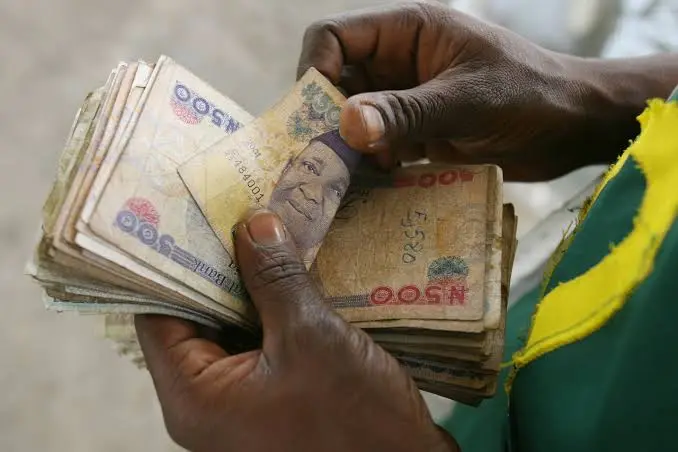
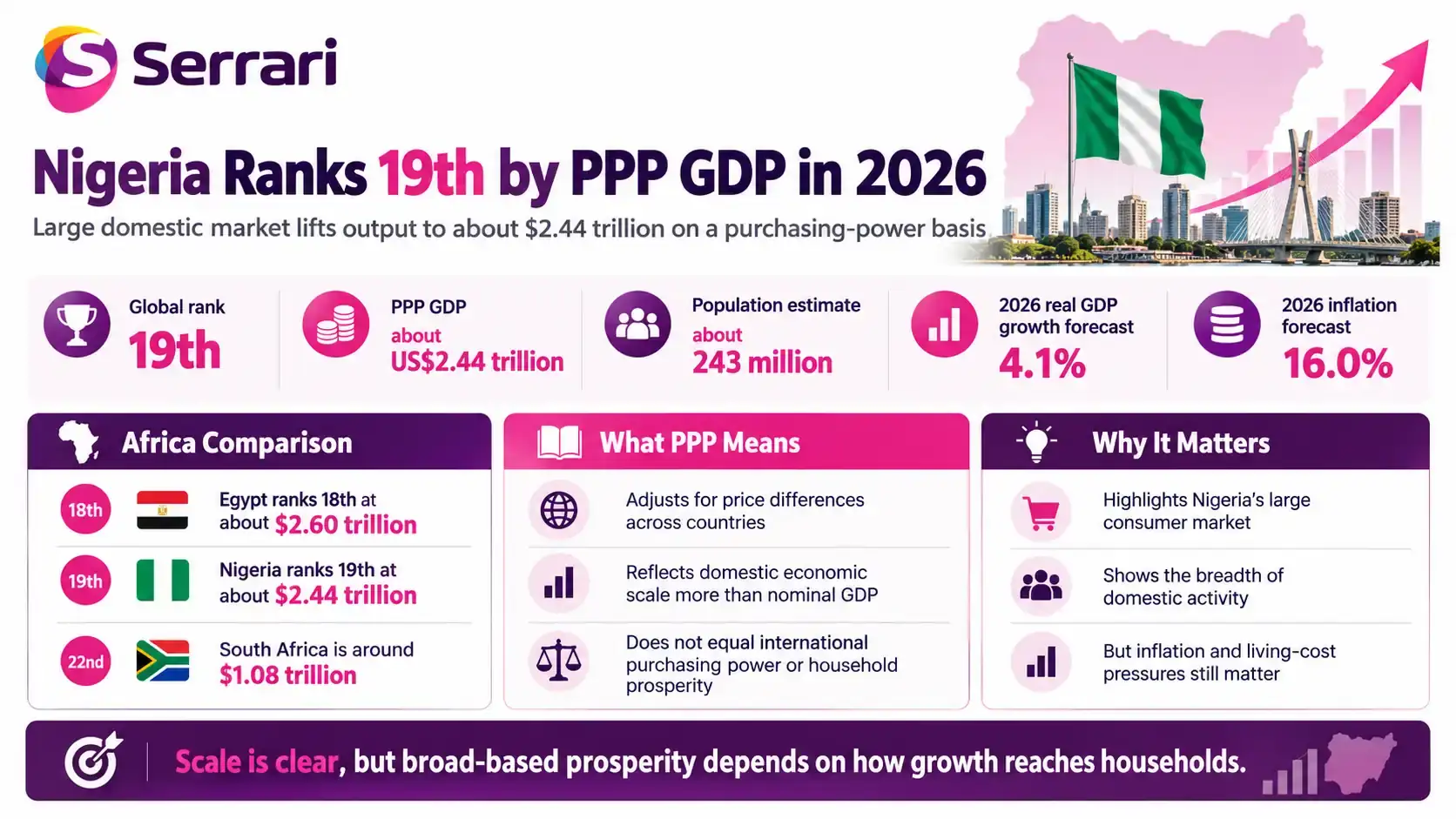
Nigeria is projected to be the world’s 19th-largest economy in 2026 when measured by purchasing power parity (PPP), with output of approximately $2.44 trillion in international dollars. The October 2026 global GDP comparison places Nigeria immediately behind Egypt and ahead of Taiwan, based on International Monetary Fund (IMF) projections.
The ranking reflects the scale of economic activity within Nigeria after accounting for differences in local prices. It does not mean the country produces $2.44 trillion at market exchange rates, nor does it establish that Nigerians enjoy living standards comparable to those in similarly ranked economies.
Key Overview
- Global position: Nigeria ranks 19th by projected 2026 PPP-adjusted GDP, at $2.438 trillion before rounding.
- African comparison: Egypt is 18th globally at $2.600 trillion, while South Africa’s projected PPP output is approximately $1.075 trillion.
- World leaders: China ranks first at $44.555 trillion, followed by the United States at $32.642 trillion and India at $19.193 trillion.
- Nominal GDP: Nigeria does not appear among the 20 largest economies when output is converted using market exchange rates.
- Domestic challenges: Inflation, infrastructure constraints and limited household purchasing power remain important despite the economy’s size.
- Growth outlook: The IMF’s Nigeria country profile lists 2026 real GDP growth at 4.1% and consumer-price inflation at 16.0%; these are projections, not confirmed full-year outcomes.
Why Nigeria Ranks Higher Under Purchasing Power Parity
PPP compares economies after allowing for differences in the prices of similar goods and services across countries. An international dollar represents purchasing power equivalent to one US dollar in the United States, rather than an actual dollar that can necessarily be exchanged or spent abroad.
For example, locally provided transport, meals or services may cost less in Nigeria than in the United States. PPP adjusts for those price differences, so it often gives large emerging-market economies a higher measured output than nominal GDP comparisons do.
The IMF’s October 2026 economic database provides the underlying framework for these comparisons. Nominal GDP, by contrast, uses prevailing currency exchange rates and is more relevant to assessing international purchasing capacity, hard-currency obligations and the dollar value of economic output.
How Nigeria Compares With Africa and the World
Nigeria’s $2.438 trillion PPP-adjusted economy places it just below Egypt’s $2.600 trillion and slightly above Taiwan’s $2.407 trillion. This makes it Africa’s second-largest economy on the measure, rather than the continent’s largest.
The published country ranking also shows why the measure changes global comparisons. China ranks ahead of the United States, while India is third. Indonesia occupies seventh place, ahead of several advanced economies whose output ranks higher when measured in nominal US dollars.
Nigeria’s large population and broad range of activities—agriculture, trade, financial services, telecommunications, manufacturing and construction—help explain the scale of its domestic market. But aggregate GDP is not a direct measure of how much an average household earns or can afford.
Context is everything. Stay ahead of shifting trends with today’s market updates, and uncover emerging opportunities using the Serrari Group Market Index and Marketplace. Then, take control of your own financial future by exploring our Money & Life Reset Transformation Blueprint ™ to build stronger habits, create better systems, and design a path toward lasting wealth.
Why a Large Economy Does Not Guarantee Higher Living Standards
GDP measures overall production, not how evenly income is distributed. A country can have considerable total output while millions of residents face rising food prices, weak public services or limited access to well-paying jobs.
Nigeria continues to face those pressures. The IMF’s 2026 economic assessment highlights persistent poverty and food insecurity despite improvements in some economic indicators. Inflation also reduces the real value of wages when earnings rise more slowly than consumer prices.
PPP-adjusted GDP is useful for comparing domestic production and purchasing power across countries, but it should not be confused with household spending power or disposable income. GDP per capita, real wages, poverty levels and access to services provide a fuller view of living conditions.
What the Ranking Means for Businesses and Investors
Nigeria’s position reinforces the potential scale of its consumer market. Businesses serving locally priced products and services may find a large addressable market, particularly where distribution, digital payments and infrastructure can reach underserved consumers.
International investors must nevertheless examine exchange-rate risk, financing costs, regulatory conditions and customers’ actual disposable incomes. A high PPP ranking does not remove those constraints or indicate that the equivalent amount of internationally tradable wealth is available.
The key test is whether projected economic growth translates into higher productivity, more formal jobs and sustained improvements in household purchasing power. Nigeria’s position among the top 20 PPP economies demonstrates scale; broader prosperity will depend on how that scale benefits its population.
Sources: International Monetary Fund / Visual Capitalist / New Telegraph / Reuters
Your financial future isn’t something you wait for—it’s something you build.
The real question is: when do you begin?
Move beyond simply staying informed.
Navigate the markets with clarity—track trends through the Serrari Group Market Index, uncover opportunities in the Serrari Marketplace, and build practical knowledge with our Curated Wealth Builder Platform.
Stay connected to what truly matters.
Get daily insights on macro trends and financial movements across Kenya, Africa, and global markets—delivered through the Serrari Newsletter.
Growth opens doors.
Advance your career through professional programs including ACCA, HESI A2, ATI TEAS 7 , HESI EXIT , NCLEX – RN and NCLEX – PN, Financial Literacy!🌟—designed to move you forward with confidence.
See where money is flowing—clearly and in real time.
Track Money Market Funds, Treasury Bills, Treasury Bonds, Green Bonds, and Fixed Deposits, alongside global and African indexes, key economic indicators, and the evolving Crypto and stablecoin landscape—all within Serrari’s Market Index.