The newly issued meal-kit company bond from HelloFresh has attracted unusually high levels of short selling, reflecting growing concerns among bond investors over the company’s financial outlook. Weak operating performance, a recent credit downgrade and rising bond yields have placed the issue under pressure in the corporate bonds market.
Key Overview
- HelloFresh bond attracts heavy short interest.
- Over 10% of the issue has been borrowed.
- Bond trades below its issue price.
- S&P downgrade increased investor caution.
- Borrowing costs significantly exceed market averages.
- Rising yields reflect higher perceived credit risk.
- Secondary market performance remains weak.
- Bond investors remain cautious on outlook.
Meal-Kit Company Bond Faces Heavy Short Selling After Weak Market Debut
The newly issued meal-kit company bond from HelloFresh has come under significant pressure just weeks after entering the debt market, attracting unusually high levels of short selling and highlighting growing concerns among bond investors over the company’s financial outlook.
According to securities lending data from EquiLend, more than 10% of the €350 million corporate bond has already been borrowed by investors seeking to profit from further price declines. That level of short interest is more than five times the average observed across European corporate bonds, making HelloFresh’s debut one of the most heavily shorted bond issues in the region this year.
Short Selling Signals Investor Pessimism
The exceptionally high level of borrowing reflects growing bearish sentiment toward HelloFresh’s credit profile.
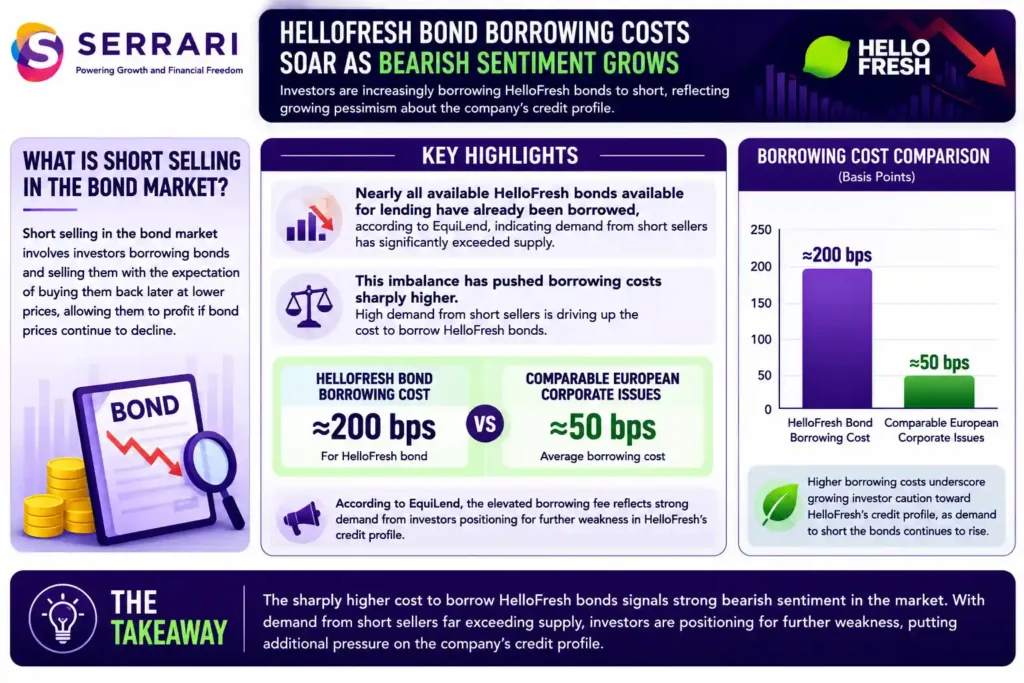
Short selling in the bond market involves investors borrowing bonds and selling them with the expectation of buying them back later at lower prices, allowing them to profit if bond prices continue to decline.
EquiLend reported that nearly all available bonds available for lending have already been borrowed, indicating that demand from short sellers has significantly exceeded available supply.
This imbalance has also pushed borrowing costs sharply higher.
The financing cost for borrowing the HelloFresh bond has risen to approximately 200 basis points, compared with an average borrowing cost of around 50 basis points for comparable European corporate issues.
According to EquiLend, the elevated borrowing fee reflects strong demand from investors positioning for further weakness.
Bond Trades Below Issue Price
Market pricing has reinforced the cautious outlook.
Issued at par value on July 1, the HelloFresh bond has since fallen to approximately 95 cents on the euro in secondary market trading.
When bonds trade below their original issue price, investors purchasing the security receive a higher effective return than the coupon rate, causing bond yields to increase.
The decline therefore reflects increased risk premiums demanded by investors rather than changes to the bond’s contractual coupon.
The weaker pricing illustrates deteriorating market confidence in the company’s financial prospects.
Context is everything. Stay ahead of shifting trends with today’s market updates and uncover emerging opportunities using the Serrari Group Market Index and Marketplace. Then, take control of your own financial future by exploring our Money & Life Reset Transformation Blueprint ™ to build stronger habits, create better systems, and design a path toward lasting wealth.
Credit Downgrade Increased Credit Risk
Investor concerns intensified after S&P Global Ratings downgraded HelloFresh’s credit rating to junk status approximately two months before the bond was issued.
The downgrade cited several factors contributing to higher credit risk, including:
- Declining sales.
- Pressure on household consumer spending.
- Intense industry competition.
- Rapid technological changes affecting the business.
Lower credit ratings generally increase borrowing costs for companies while making newly issued debt less attractive to conservative fixed-income investors.
The subsequent performance of the bond suggests that many investors continue sharing those concerns.
Fixed Income Investors Demand Higher Compensation
The HelloFresh bond’s performance demonstrates how quickly investor sentiment can influence the fixed income market.
Although newly issued bonds often experience modest price fluctuations after issuance, the combination of heavy short selling, higher borrowing costs and declining market prices represents an unusually negative reception.
Investors are demanding greater compensation for holding the company’s debt, resulting in higher market yields and lower bond prices.
Such developments typically indicate expectations of elevated business risks rather than immediate concerns about default.
Corporate Debt Market Remains Selective
The HelloFresh experience also highlights increasing selectivity across the corporate debt market.
While investment-grade issuers continue accessing financing under relatively favourable conditions, companies facing weaker earnings or deteriorating business fundamentals often experience significantly greater scrutiny from credit investors.
Credit rating downgrades can amplify this process by limiting the pool of institutional investors permitted to own lower-rated securities.
As a result, speculative-grade issuers frequently encounter higher financing costs and greater volatility in secondary market trading.
Consumer Spending Pressures Continue
HelloFresh has faced several operational challenges over the past year.
Demand for meal-kit delivery services has moderated as consumers respond to persistent inflationary pressures and tighter household budgets.
At the same time, competition within the convenience food and online grocery sectors has intensified, placing additional pressure on revenue growth and profitability.
These operating challenges contributed directly to the company’s weaker credit outlook and have influenced investor sentiment toward its newly issued bond.
What Heavy Short Interest Means for Investors
High levels of short selling do not necessarily guarantee further declines in bond prices.
However, they generally indicate that a significant number of sophisticated market participants expect the underlying security to underperform.
In the case of the meal-kit company bond, unusually elevated borrowing activity, higher financing costs and declining secondary market prices collectively suggest that investors remain cautious regarding HelloFresh’s financial trajectory.
Future improvements in earnings, cash flow or business performance could help restore confidence, but current market pricing reflects continued uncertainty.
Outlook for the Meal-Kit Company Bond
The performance of the meal-kit company bond illustrates how rapidly investor sentiment can shift within the corporate bonds market following deteriorating business fundamentals and a credit rating downgrade. Heavy short selling, higher bond yields and elevated borrowing costs indicate that bond investors remain concerned about HelloFresh’s operating outlook and long-term credit risk.
Unless the company demonstrates meaningful improvements in revenue growth, profitability and financial performance, its debt is likely to remain under pressure in the fixed income market. The bond’s weak secondary market debut underscores the increasingly selective nature of today’s corporate debt market, where investors are demanding stronger fundamentals before committing capital.
FAQs
Why is the HelloFresh meal-kit company bond being heavily shorted?
Investors are betting that the bond’s price could decline further due to concerns about HelloFresh’s weakening financial performance, declining sales and recent credit rating downgrade. More than 10% of the issue has reportedly been borrowed for short-selling purposes.
What does it mean when a bond trades below par?
A bond trading below its issue price indicates that investors require a higher return to compensate for increased risk. As bond prices fall, bond yields rise, reflecting changing market perceptions of the issuer’s credit quality.
Why did S&P downgrade HelloFresh?
S&P downgraded HelloFresh to speculative, or junk, status after citing declining sales, pressure on consumer spending, strong competition and broader operational challenges affecting the company’s business outlook.
What does high short interest indicate in the corporate bond market?
High short interest generally signals that investors expect a bond to weaken further. It reflects negative sentiment regarding the issuer’s financial prospects, although future business improvements could eventually reverse that outlook.
Sources: Yahoo Finance, Briefs, Guru Focus
Your financial future isn’t something you wait for—it’s something you build.
The real question is: when do you begin?
Move beyond simply staying informed.
Navigate the markets with clarity—track trends through the Serrari Group Market Index, uncover opportunities in the Serrari Marketplace, and build practical knowledge with our Curated Wealth Builder Platform.
Stay connected to what truly matters.
Get daily insights on macro trends and financial movements across Kenya, Africa, and global markets—delivered through the Serrari Newsletter.
Growth opens doors.
Advance your career through professional programs including ACCA, HESI A2, ATI TEAS 7 , HESI EXIT , NCLEX – RN and NCLEX – PN, Financial Literacy!🌟—designed to move you forward with confidence.