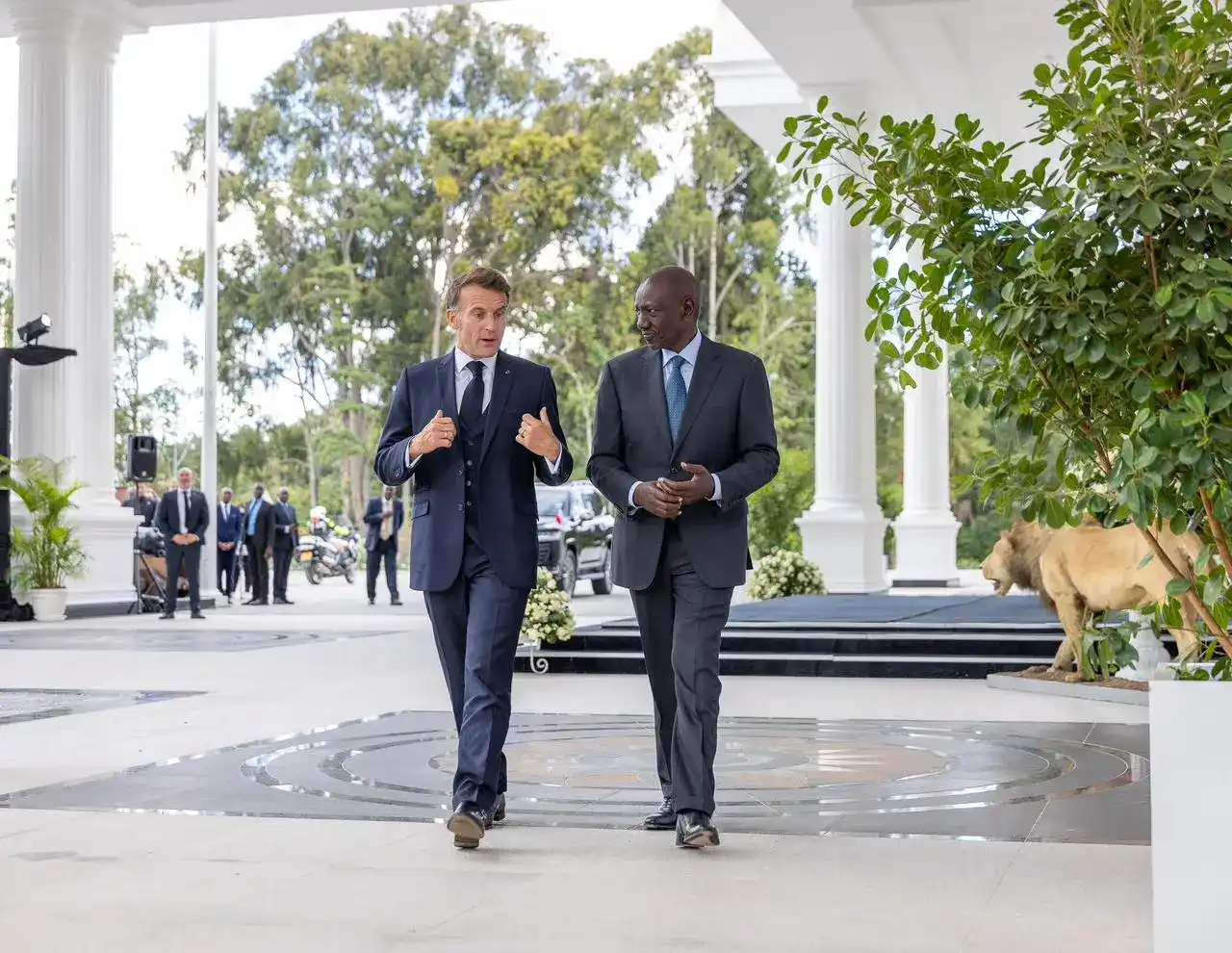
French President Emmanuel Macron has embarked on a three-country East African tour — spanning Egypt, Kenya, and Ethiopia — in his most significant diplomatic effort to redefine France’s relationship with the African continent before his term ends in 2027. The centrepiece of the trip is the “Africa Forward” summit, co-hosted with Kenyan President William Ruto in Nairobi on 11–12 May 2026, marking the first time Macron has held such a gathering in an Anglophone African country since taking office in 2017. The summit, focused on innovation, trade, and cross-border investment, will bring together African heads of state and business executives, with multiple French-Kenyan commercial agreements expected. Macron opened the tour in Alexandria, Egypt, where he inaugurated the new campus of Senghor University alongside President Abdel Fattah al-Sisi, before arriving in Nairobi on Sunday. He will conclude in Addis Ababa with talks at the African Union headquarters alongside AU Commission Chairperson Mahmoud Ali Youssouf and UN Secretary-General Antonio Guterres. The tour comes after France’s most dramatic loss of influence in Africa in decades — forced military withdrawals from Mali, Burkina Faso, Niger, Chad, Senegal, and Ivory Coast between 2022 and 2025 — and the expansion of Russian mercenary presence across the Sahel.
Markets move fast; don’t get left behind. We’ve paired the Serrari Group Market Index with a curated Marketplace and a comprehensive Wealth Builder Platform to ensure you have the data—and the skills—to act on it.
Key Overview
- Tour dates: 9–14 May 2026
- Countries visited: Egypt (Alexandria), Kenya (Nairobi), Ethiopia (Addis Ababa)
- Centrepiece event: “Africa Forward” summit, Nairobi, 11–12 May — co-hosted with Kenyan President William Ruto
- Significance: First France-Africa summit held in an Anglophone country under Macron
- Egypt leg: Inauguration of new Senghor University campus in Alexandria with President al-Sisi; bilateral ties elevated to strategic partnership in 2025
- Ethiopia leg: Talks at African Union headquarters with AU Commission and UN Secretary-General
- French military exits (2022–2025): Expelled from Mali, Burkina Faso, Niger, Chad; troops withdrawn from Senegal, Ivory Coast — from ~10,000 soldiers to ~2,000 on the continent
- Sahel shift: Mali, Burkina Faso, and Niger formed the Alliance of Sahel States (2023), withdrew from ECOWAS (2024), and replaced French forces with Russian mercenaries
- Russia’s expansion: Africa Corps (successor to Wagner Group) now operates in at least six African countries
- Macron’s framing: Seeking “partnerships on equal footing” replacing traditional postcolonial influence
- Legacy context: One year before the end of Macron’s presidential term
Opening in Alexandria
Macron launched the tour on Saturday with a stop in Alexandria, Egypt, where he joined President Abdel Fattah al-Sisi to inaugurate the new campus of Senghor University — a French-language international institution dedicated to training African professionals in governance, health, and sustainable development. The new campus, located in the Borg El Arab district on the outskirts of Alexandria, was built with Egyptian state support and an investment of approximately €60 million. Macron described it as “a remarkable global initiative” and declared that the Francophone community “belongs to everyone who chooses to embrace the French language.”
The two leaders held expanded bilateral talks in which they reaffirmed the Franco-Egyptian strategic partnership, elevated during Macron’s visit to Egypt in April 2025. Macron highlighted growing trade and French investment, while Sisi called for expanded cooperation in industry, transport, and education. Discussions also addressed the war in Gaza, regional escalation around the Strait of Hormuz, and mounting instability across the Middle East.
However, the relationship has drawn sustained criticism from international rights organisations, including Amnesty International and Human Rights Watch, which accuse France of prioritising security interests and major arms sales over concerns about political repression in Egypt.
The Africa Forward Summit in Nairobi
The diplomatic and symbolic heart of Macron’s tour is the Africa Forward summit in Nairobi, co-chaired with President William Ruto on 11–12 May. Subtitled “Africa–France Partnerships for Innovation and Growth,” the summit brings together heads of state, government officials, and business executives, with multiple commercial agreements between French and Kenyan companies expected.
The choice of Kenya — an Anglophone country with no colonial ties to France — is deliberate. By staging the summit outside Francophone Africa, Macron is signalling that France’s engagement with the continent extends beyond its former colonial sphere. One diplomat described the event as a “report card on his Africa policy,” with Macron seeking to cement his legacy one year before his term ends.
The Élysée Palace described the summit as a “major milestone in relations between France and the African continent.” President Ruto’s office framed it in even more transformative terms, saying the event aims to demonstrate Africa’s innovation capacity and “affirm a shared commitment to developing common, mutually beneficial solutions.” The summit’s official framing emphasises that Africa is “no longer content with aspiration alone” and is “shifting from dialogue to delivery.”
The focus on economic cooperation — trade, investment, entrepreneurship, and innovation — represents a conscious pivot from the security-heavy agenda that defined France’s Africa engagement for decades. Macron is also pushing for deeper cultural and educational cooperation focused on climate, youth engagement, and entrepreneurship.
Context is everything. While you follow today’s updates, use the Serrari Group Market Index and Marketplace to spot emerging shifts. Need to sharpen your edge? Our Wealth Builder Platform turns these insights into a professional-grade strategy.
Addis Ababa and the African Union
Macron will conclude the tour in Addis Ababa on Wednesday, where he will hold talks with Ethiopian Prime Minister Abiy Ahmed and meet AU Commission Chairperson Mahmoud Ali Youssouf and UN Secretary-General Antonio Guterres at the African Union headquarters. Discussions are expected to focus on peace and security across Africa, including the ongoing conflicts in Sudan, the Great Lakes, and the Horn.
The Addis Ababa stop carries its own symbolic weight: the city hosts the AU headquarters and is widely regarded as the diplomatic capital of Africa. Macron’s visit signals a desire to engage with continent-wide institutions rather than solely relying on bilateral relationships with individual countries.
The Sahel Collapse
The urgency behind the tour is inseparable from the dramatic collapse of French influence in West Africa over the past four years. France maintained extensive military operations across the Sahel for more than a decade, deploying approximately 5,100 troops under Operation Barkhane across Mali, Niger, Burkina Faso, and Chad to combat jihadist insurgencies. At its peak, France’s military presence in Africa exceeded 10,000 soldiers.
That presence unravelled with startling speed. Between 2022 and 2025, France was expelled or forced to withdraw from virtually every country in which it maintained troops. Mali’s military junta demanded the departure of French forces in 2022. Burkina Faso cancelled military agreements and expelled France’s ambassador in 2023. Niger’s coup leaders ordered French troops out in late 2023. Chad terminated its defence agreement in late 2024, while Senegal and Ivory Coast also requested withdrawals, completed by mid-2025. By early 2025, France’s African military footprint had contracted from more than 10,000 to approximately 2,000 soldiers, limited primarily to bases in Djibouti and Gabon.
The expulsions were driven by a confluence of factors: widespread perception that France’s military interventions had failed to defeat the jihadist threat, deep resentment over what many Africans viewed as neo-colonial economic relationships, and opportunistic exploitation of anti-French sentiment by military juntas seeking to consolidate domestic support.
Russia Fills the Vacuum
In the wake of France’s departure, Russia rapidly expanded its security footprint across the Sahel and beyond. The Wagner Group, a private military company with ties to the Kremlin, first established a significant presence in Mali and the Central African Republic, offering security assistance to governments in exchange for access to mining concessions and other resources.
Following the death of Wagner founder Yevgeny Prigozhin in 2023 and a Kremlin-directed restructuring, Russia’s African operations were reorganised under the Africa Corps, a paramilitary formation directly subordinate to the Russian Ministry of Defence. The Africa Corps has since expanded to at least six countries, including Mali, Burkina Faso, Niger, the Central African Republic, Libya, and Equatorial Guinea.
Mali, Burkina Faso, and Niger formalised their pivot away from the West in September 2023 by forming the Alliance of Sahel States, a mutual defence pact. The three countries subsequently withdrew from ECOWAS in January 2024, severing ties with the primary regional economic bloc that had historically served as a channel for Western influence.
However, security analysts have questioned whether Russia’s presence has improved the situation. The Small Wars Journal noted that Russian forces have proved unable to quell domestic instability in most countries where they operate, while leaving a trail of human rights abuses. Africa is now the global epicentre of jihadist terrorism, accounting for more than half of all terrorist casualties worldwide. The DefenceWeb observed that militant Islamist violence against civilians increased by nearly 280 per cent after Wagner’s deployment in Mali, with the group linked to the operation of secret prisons and mass civilian detentions.
Africa’s Demand for Equal Partnerships
Macron’s tour takes place against a broader continental shift in which African nations are increasingly demanding partnerships built on equality and mutual benefit rather than post-colonial dependency. The rise of China as Africa’s largest bilateral trading partner, Russia’s security expansion, Gulf state investment, and growing intra-African economic integration through the African Continental Free Trade Area have all created a more competitive landscape in which France is just one player among many.
The rhetoric at the Africa Forward summit reflects this reality. Both the Kenyan and French presidencies have framed the event around “co-creation, co-investment, and measurable impact,” with explicit language about moving “beyond legacy narratives.” President Ruto’s office described the summit’s ambition as ensuring Africa participates in the global economy “on its own terms” rather than within frameworks defined externally.
Yet scepticism persists. France’s record of supporting unpopular leaders for strategic gain, maintaining opaque economic relationships through the CFA franc monetary zone, and deploying military force while human rights concerns accumulated has left deep reservoirs of distrust. Anti-French protests have become commonplace across West Africa, and the sentiment has spread to countries well beyond France’s traditional sphere.
Can Macron Deliver a Reset?
Whether the Africa Forward summit produces lasting results or becomes another exercise in declaratory diplomacy will depend on follow-through. The summit’s own framing acknowledges this tension: “The true measure of this Summit will not be the conversations we hold, but the outcomes we deliver for our people.”
Macron faces structural constraints. With only one year remaining in his presidency, his capacity to drive long-term institutional change in France’s Africa policy is limited. His successors may not share his priorities. And the deeper structural dynamics — Africa’s demand for sovereignty, the competitive multipolarity of external engagement, and the lingering legacy of Françafrique — are not problems that summitry alone can resolve.
Still, the symbolic significance of staging a France-Africa summit in Anglophone Kenya, engaging with the African Union in Addis Ababa, and investing in educational institutions in Egypt suggests a president attempting to lay the groundwork for a fundamentally different relationship — even if the architecture remains incomplete and the sceptics numerous.
Sources: Al Jazeera, Arab News, Asharq Al-Awsat, Egyptian Streets, EgyptToday, Daily News Egypt, Middle East Online, EWN, Modern Ghana, Africa Forward Summit, Small Wars Journal, Democracy in Africa, DefenceWeb, CFR Global Conflict Tracker, Defcon Level, Harvard International Review, US Congressional Research Service.
Your financial future isn’t something you wait for—it’s something you build.
The real question is: when do you begin?
Move beyond simply staying informed.
Navigate the markets with clarity—track trends through the Serrari Group Market Index, uncover opportunities in the Serrari Marketplace, and build practical knowledge with our Curated Wealth Builder Platform.
Stay connected to what truly matters.
Get daily insights on macro trends and financial movements across Kenya, Africa, and global markets—delivered through the Serrari Newsletter.
Growth opens doors.
Advance your career through professional programs including ACCA, HESI A2, ATI TEAS 7 , HESI EXIT , NCLEX – RN and NCLEX – PN, Financial Literacy!🌟—designed to move you forward with confidence.
See where money is flowing—clearly and in real time.
Track Money Market Funds, Treasury Bills, Treasury Bonds, Green Bonds, and Fixed Deposits, alongside global and African indexes, key economic indicators, and the evolving Crypto and stablecoin landscape—all within Serrari’s Market Index.