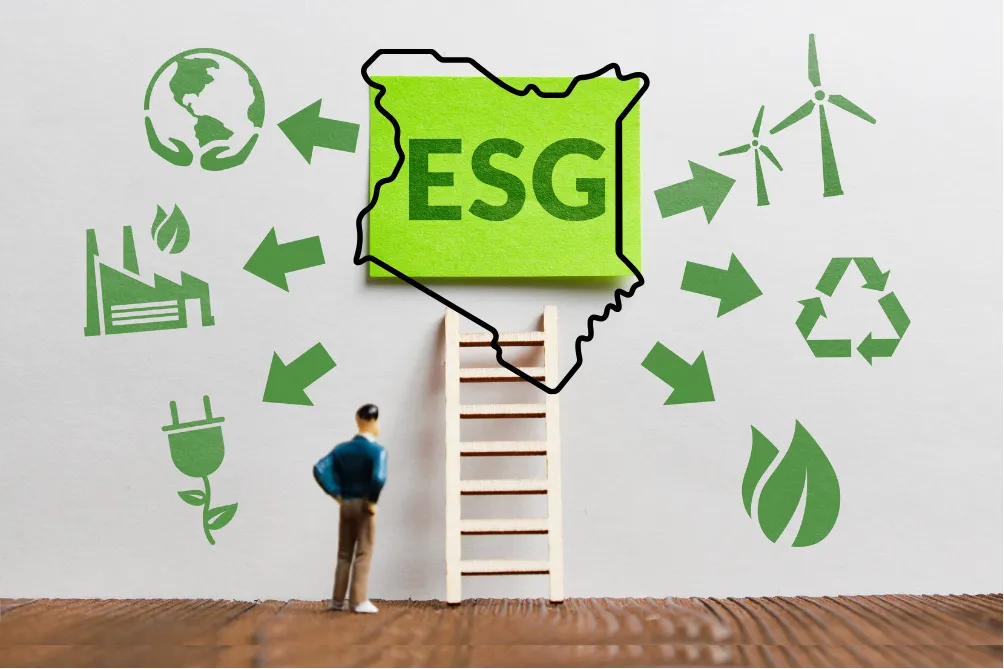
Kenya is preparing to strengthen corporate governance after the Capital Markets Authority (CMA) approved a Draft Environmental, Social and Governance (ESG) Code alongside new Corporate Governance Regulations. The proposals require listed companies to embed ESG into board oversight, strategy, executive remuneration, risk management and sustainability reporting. They also introduce an “Apply and Explain” governance model aimed at improving transparency, accountability and investor confidence while aligning Kenya’s capital markets with global governance standards.
Key Overview
- Capital Markets Authority (CMA) has approved a Draft ESG Code for public participation before gazettement.
- ESG oversight will become a core responsibility of company boards.
- Executive remuneration may be linked to sustainability performance.
- Companies will adopt the new “Apply and Explain” governance model.
- New Corporate Governance Regulations replace the 2011 framework for market intermediaries.
Kenya Modernizes Corporate Governance
Kenya is set to introduce one of Africa’s most significant corporate governance reforms after the Capital Markets Authority (CMA) approved a Draft ESG Code for listed companies. The proposals shift Environmental, Social and Governance (ESG) from voluntary reporting to a key board responsibility, integrating sustainability into long-term business strategy and decision-making.
The regulator also approved new Corporate Governance Regulations for market intermediaries, replacing the 2011 framework. Together, the reforms aim to improve governance, strengthen transparency and align Kenya’s capital markets with evolving global ESG standards.
According to the CMA, the new framework will enhance investor confidence, improve board effectiveness and support long-term market resilience.
ESG Moves into the Boardroom
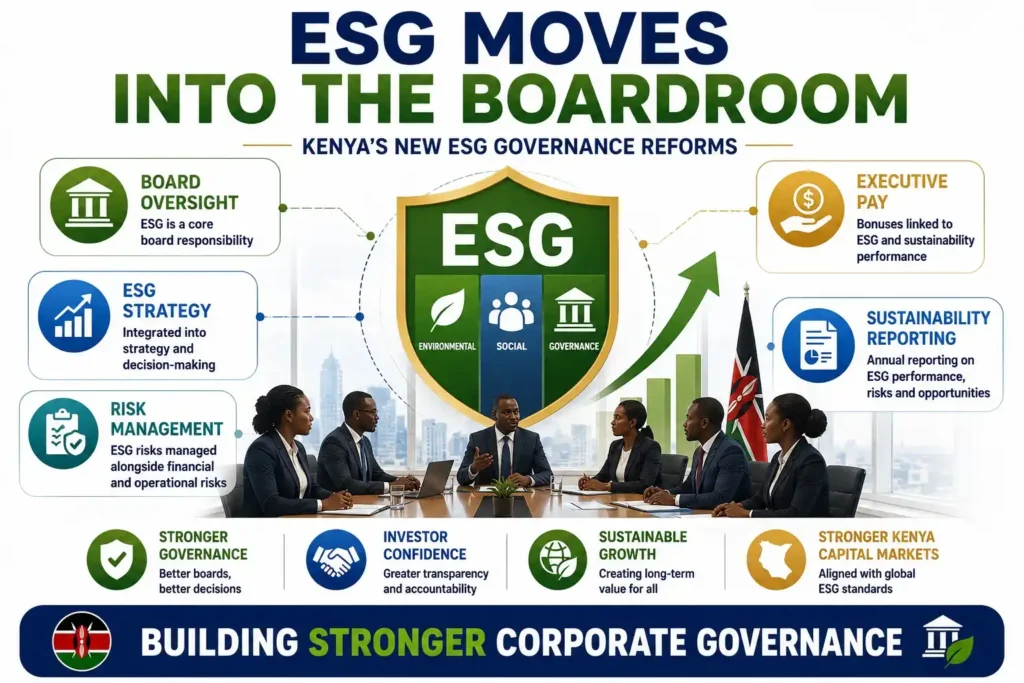
The draft code makes Environmental, Social and Governance (ESG) a core governance responsibility rather than a standalone sustainability function.
Boards will oversee environmental, social and governance risks alongside financial and operational risks. ESG considerations will become part of corporate strategy, enterprise risk management, internal controls, stakeholder engagement and annual reporting.
Directors will also be expected to consider the long-term environmental and social impacts of major business decisions, making sustainability part of their fiduciary responsibilities.
“Apply and Explain” Replaces Compliance-Based Reporting
The proposed code introduces an “Apply and Explain” governance model.
Instead of simply confirming compliance, companies must explain how governance principles are applied, justify any departures and outline plans to achieve full compliance.
The approach promotes meaningful governance rather than box-ticking. Mandatory provisions are expected to take effect within one year after publication.
Stronger Sustainability Reporting
Boards will be required to establish formal ESG governance frameworks and oversee sustainability-related risks and opportunities.
Listed companies must publish annual sustainability reports and regularly review governance policies to ensure they remain effective.
The code also encourages companies to align ESG goals with financing opportunities such as green bonds and sustainability-linked loans, supporting Kenya’s growing sustainable finance market.
Context is everything. Stay ahead of shifting trends with today’s market updates, and uncover emerging opportunities using the Serrari Group Market Index and Marketplace. Then, take control of your own financial future by exploring our Money & Life Reset Transformation Blueprint ™ to build stronger habits, create better systems, and design a path toward lasting wealth.
Higher Standards for Boards and Executives
The reforms introduce higher expectations for directors and senior management.
Executive bonuses may be linked to ESG performance alongside financial results, while clawback provisions are proposed to discourage misconduct and excessive risk-taking.
Independent directors will lose their independent status after six years to strengthen board renewal. Companies must also maintain succession plans for board chairs, CEOs and senior executives.
Boards will be encouraged to improve diversity across gender, skills and experience while ensuring directors receive ongoing training in climate risk, cybersecurity and artificial intelligence.
New Rules for Market Intermediaries
The CMA has also approved updated Corporate Governance Regulations for licensed market intermediaries, including stockbrokers, investment banks, fund managers, custodians and investment advisers.
The regulations replace the 2011 framework and introduce staggered board transitions to improve continuity, preserve institutional knowledge and strengthen board oversight.
According to the regulator, the reforms will help governance structures keep pace with the growing complexity of Kenya’s capital markets.
Aligning with Global Standards
The Draft ESG Code was developed with the International Finance Corporation (IFC) and the Nairobi Securities Exchange (NSE).
It aligns with the G20/OECD Principles of Corporate Governance, Kenya’s Sustainable Development Goals (SDGs), Nationally Determined Contributions (NDCs) and the country’s sustainable finance agenda.
As investors increasingly consider ESG performance when allocating capital, the reforms are expected to improve Kenya’s attractiveness as a destination for responsible investment.
Outlook
Kenya’s proposed ESG Code represents a major step toward modernizing corporate governance and embedding sustainability into business leadership. By integrating ESG into board oversight, executive remuneration, risk management, and corporate reporting, the reforms aim to strengthen transparency, improve investor confidence, and support sustainable economic growth. Once finalized, the framework is expected to position Kenya among Africa’s leading markets for responsible investment, ESG reporting, and sustainable finance. The new governance standards are also likely to encourage companies to strengthen climate risk management, enhance board accountability, and improve long-term value creation while making Kenya’s capital markets more attractive to both domestic and international investors seeking well-governed, sustainability-focused businesses.
FAQs
1. What is Kenya’s Draft ESG Code?
It is a proposed governance framework requiring listed companies to integrate Environmental, Social and Governance (ESG) considerations into board oversight, strategy, risk management and corporate reporting.
2. What does the “Apply and Explain” approach mean?
Companies must explain how they apply governance principles, justify any departures and disclose plans for achieving compliance instead of simply stating that they comply.
3. How will the reforms affect company boards?
Boards will oversee ESG risks, strengthen sustainability reporting, improve diversity, maintain succession plans and link executive performance more closely to long-term sustainability objectives.
4. Why are these reforms important?
The reforms are expected to improve transparency, strengthen investor confidence, align Kenya’s capital markets with international governance standards and support sustainable long-term business growth.
Sources: Africa Sustainability Matters, The Kenyan Wall Street, The Star
Your financial future isn’t something you wait for—it’s something you build.
The real question is: when do you begin?
Move beyond simply staying informed.
Navigate the markets with clarity—track trends through the Serrari Group Market Index, uncover opportunities in the Serrari Marketplace, and build practical knowledge with our Curated Wealth Builder Platform.
Stay connected to what truly matters.
Get daily insights on macro trends and financial movements across Kenya, Africa, and global markets—delivered through the Serrari Newsletter.
Growth opens doors.
Advance your career through professional programs including ACCA, HESI A2, ATI TEAS 7 , HESI EXIT , NCLEX – RN and NCLEX – PN, Financial Literacy!🌟—designed to move you forward with confidence.
See where money is flowing—clearly and in real time.
Track Money Market Funds, Treasury Bills, Treasury Bonds, Green Bonds, and Fixed Deposits, alongside global and African indexes, key economic indicators, and the evolving Crypto and stablecoin landscape—all within Serrari’s Market Index.